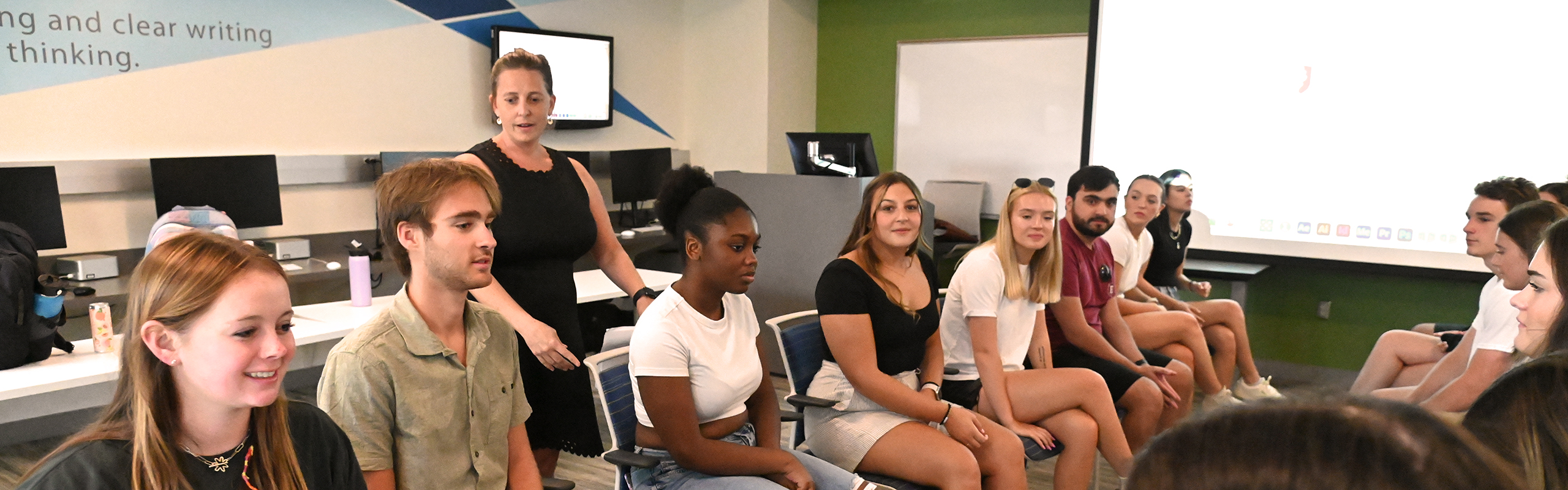
Here is the General Studies course required of all students in the School of Communications:
GST 115. PUBLIC SPEAKING
Students learn principles for speaking in public settings, with significant in-class presentation and out-of-class topical research. The course focuses on the structure and effective delivery of ideas, use of language, supporting evidence, reasoning and emotional appeals, diction, pronunciation and nonverbal communication. 2 credit hours
Here is a listing of all courses in the School of Communications:
COM 100. COMMUNICATIONS IN A GLOBAL AGE
Contemporary media play a vital role in society, both locally and globally. In this course, students study the importance of books, newspapers, magazines, recordings, movies, radio, television and the internet, and the messages carried through news, public relations and advertising. The course emphasizes the relationship of media and democracy, ethical decision-making, the diversity of audiences, and the global impact of communications. 4 credit hours
COM 110. MEDIA WRITING
Clear, logical writing is necessary to communicate effectively to an audience. This course focuses on background research, interviews, accuracy, attribution and styles of writing (print, broadcast, online, news releases). Grammar and language skills are refined, and Associated Press style is introduced. 4 credit hours
COM 220. DIGITAL MEDIA CONVERGENCE
Convergence is the blending of text, sounds and images in the media environment to create new media. This course features units on visual literacy, photo editing, audio processing, video editing and web publishing. Students learn theories of aural and visual aesthetics and produce individual web pages. Prerequisite: C- or better in COM 100. 4 credit hours
COM 230. MEDIA HISTORY, MEDIA TODAY
A free society requires a free and vibrant media. This course examines the development, growth and impact of media in America. It studies the major trends, important personalities, ownership structures, technological advancements, diversity of audiences, the rise of media convergence, and societal impact ranging from colonial newspapers in the 1600s to today’s print, broadcast and online media. Prerequisite: C- or better in COM 100. 4 credit hours
COM 232. PUBLIC RELATIONS AND CIVIC RESPONSIBILITY
Public relations is the bridge between an organization and its many publics. This course emphasizes theories, strategies and techniques in organizational environments (corporate, not-for-profit, associations, agencies, government) and studies historical roots, formation of public opinion, crisis management, marketing and the ethical requirements to be a responsible corporate citizen. Prerequisite: C- or better in COM 100. 4 credit hours
COM 234. BROADCASTING IN THE PUBLIC INTEREST
Broadcasting was conceived and is regulated to serve the public interest. This course provides a philosophical, historical, technological and social overview of the broadcast industry and its progeny. It focuses on broadcast economics, audience analysis, management, programming, media effects, government policy and FCC regulation in the public interest. Prerequisite: C- or better in COM 100. 4 credit hours
COM 236. DEVELOPMENT AND INFLUENCE OF CINEMA
The cinema has a rich history as an art form, entertainment medium and business enterprise. This course explores the social influence of cinema, both American and international. Students also study contemporary trends and business models in the film industry. Prerequisite: C- or better in COM 100. 4 credit hours
COM 260. THE PROCESS OF COMMUNICATION
Theories seek to explain how and why we communicate, and with what effects. This course examines communication as a field of study, focusing both on human and mediated communication (news, persuasion, entertainment). In the scientific method, theories provide a way to understand, explain, predict and implement communication processes and events. Prerequisite: C- or better in COM 100. 4 credit hours
COM 262. INTERPERSONAL COMMUNICATION
Interpersonal relationships can be enhanced through the acquisition and development of communication skills. Topics include self-concept, perception, conversation skills and conflict resolution. 2 credit hours
COM 265. SMALL-GROUP COMMUNICATION
The effectiveness of small-group communication can be enhanced through the acquisition and development of skills related to committee, team and work-group processes. 2 credit hours
COM 266. THE LOS ANGELES EXPERIENCE
This course for Communications Fellows provides students an inside look at the media and entertainment industries in Los Angeles. Through visits with production companies and direct interaction with industry leaders, students study the creative process, funding, production and distribution of entertainment products. Prerequisite: Communications Fellows only; application process required. 4 credit hours
COM 286. COMMUNICATIONS ACTING COMPANY
Performing Arts students may earn credit for working as actors for shorts or scenes in cinema and broadcast courses. Prerequisite: THE 115, 120 or 125, an audition, and permission of course instructor. May be repeated up to four times. 1 credit hour
COM 300. PERSUASION
This course explores the factors and techniques that either reinforce or change one’s knowledge, attitudes and behaviors as applied to media and communication messages. Students study classical and contemporary strategies, identify accepted rules that guide the decision-making process, and review how source, receiver, situation and message characteristics impact the social influence process. Prerequisite: C- or better in COM 110. 4 credit hours
COM 310. REPORTING FOR THE PUBLIC GOOD
Students become reporters and writers who emphasize accuracy, logic, and the sound and sense of words. Students analyze good journalism and discuss concepts such as civic journalism, the watchdog function of the news media, ethical practice, and journalism’s role in serving the public good in a democracy. Prerequisite: C- or better in COM 110. 4 credit hours
COM 311. BROADCAST NEWS WRITING
Students become broadcast reporters and writers for the ear by producing a variety of radio news stories. They analyze good broadcast journalism, audience research, media effects research, ethical standards and industry trends. Prerequisite: C- or better in COM 110. 4 credit hours
COM 312. STRATEGIC WRITING
This course emphasizes the importance of writing in public relations, advertising and media relations. Informative and persuasive methods include news releases, backgrounders, speech writing, employee publications, annual reports, news conferences, multimedia, public service announcements, and oral presentations to a variety of audiences. Prerequisite: C- or better in COM 110. 4 credit hours
COM 314. WRITING FOR BROADCAST AND NEW MEDIA
Writing for radio, television and new media has its own style, form and content approaches. The course focuses on writing news, commercials, public service announcements and other copy for the ear. Students discuss contemporary issues, audience research, media effects research, ethical standards and industry trends. Prerequisite: C- or better in COM 110. 4 credit hours
COM 316. SCREENWRITING
As the heart and soul of cinema, screenwriting requires mastery of story, structure and format. This course helps students harness their imaginations in scripts for cinematic movies, series and shorts. Prerequisite: C- or better in COM 110. 4 credit hours
COM 320. EDITING AND DESIGN
Precision in word usage and style and an aesthetic sense of design are valuable in publications. Students practice crafting content, editing copy, writing headlines, using photos and graphics, writing captions and designing pages. Prerequisite: COM 220. 4 credit hours
COM 322. CORPORATE PUBLISHING
Print and web media (publications, public relations, advertising and the internet) are used to communicate with internal and external publics. This course emphasizes effective visual design and publishing for corporate purposes. Prerequisite: COM 220. 4 credit hours
COM 323. CORPORATE VIDEO
Businesses often use video to communicate with internal and external publics. This course emphasizes achieving an organization’s goals through informing, persuading and entertaining. Students focus on research, writing, and both studio and remote video production. Prerequisite: COM 220. 4 credit hours
COM 324. TELEVISION PRODUCTION
Students explore the principles and techniques in television broadcasting and other video media. Studio and field assignments emphasize the aesthetics of television production and the centrality of effective audio. Students research, write and produce news, public service announcements, commercials and entertainment programming. Prerequisite: COM 220. 4 credit hours
COM 326. CINEMA PRODUCTION
This course focuses on digital cinema picture and sound production, highlighting the relationship between technology and artistic form in documentary and narrative production. Students explore cinematic principles and techniques, learn production positions and procedures, and produce a short cinematic work. Prerequisite: COM 220. 4 credit hours
COM 328. PHOTOJOURNALISM
Photojournalism is the visual reporting of news. Students produce digital photojournalism by translating ideas and newsworthy information into visual form. The course emphasizes composition, lighting, storytelling and editing, along with the history of photojournalism and its legal and ethical frameworks. Prerequisite: COM 220. 4 credit hours
COM 330. INTERNATIONAL COMMUNICATIONS
Media systems differ substantially in the Americas, Europe, Asia, Africa and the rest of the world. In this course, students examine the media systems of many countries, stressing the chief problems of communications across cultural, economic, sociological and political barriers. 4 credit hours
COM 331. ENVIRONMENTAL COMMUNICATIONS
The environment is central to our future. Students develop an understanding of environmental issues and communication practices to promote public awareness, change behavior and influence public policy. The class analyzes media coverage of sustainability topics and methods for informing, educating and influencing important target audiences. 4 credit hours
COM 332. ORGANIZATIONAL COMMUNICATIONS
Every organization has its own internal communication patterns and leadership practices. This course addresses the theories and workplace issues related to leadership, teams, interpersonal relations, and organizational culture and strategy. Students analyze leadership and ethical dimensions of communication in organizations. 4 credit hours
COM 333. RELIGION AND MEDIA
Religion and media are two powerful influences in society. This course analyzes how they intersect through media coverage of religious issues and themes, religion’s use of television and the internet, and media portrayals of religious people and traditions. 4 credit hours
COM 334. POLITICS AND MEDIA
The media have a tremendous effect on the American political system in terms of news coverage, candidate visibility, political messages and the creation of public opinion. This course traces the evolution of media impact to the present day. 4 credit hours
COM 335. SPORTS AND MEDIA
A symbiotic relationship exists between athletic competition and the media. This course traces the century-old expansion of media coverage of athletics as well as social science research, weighing the capability of the media to participate in shaping and packaging sports content and programming as forms of popular culture. 4 credit hours
COM 336. INTERNATIONAL CINEMA
Around the world, cinema is a reflection of societies, cultures and the times. This course surveys the development and evolution of selected international cinemas and movements and examines the social, cultural, economic and historic forces that influence, or are influenced by, that evolution. 4 credit hours
COM 338. ADVERTISING IN SOCIETY
Advertising is a creative communications process between messenger and consumer. This course studies the research foundation and methods used in creating advertising for print, broadcast and online media. Topics include history, ethics, social dynamics, economic implications for society, and the global spread of advertising. 4 credit hours
COM 340. FEATURE WRITING
Students study writing styles and write feature articles for potential publication. The course applies techniques such as narrative, characterization, dialogue and scenes to nonfiction writing. Prerequisite: COM 110. 4 credit hours
COM 342. SPORTS INFORMATION
This course focuses on the writing and organizational skills essential for journalistic and public relations functions related to collegiate, professional and Olympic sports coverage. The functions of sports information tend to be closely related to media coverage and also can include effective operations of sporting events. Prerequisite: COM 110. 4 credit hours
COM 345. SPORTS BROADCASTING
Students learn the structure, strategies and techniques of sports broadcasting, which serves the dual role as journalism (an accurate reporting of an event) and as entertainment. The course considers different content and styles of radio and television sportscasting. Assignments include broadcast coverage of athletic events and subsequent critique. Prerequisite: COM 324. 4 credit hours
COM 348. BROADCAST PRESENTATION
This course emphasizes effective presentation of ideas and information on radio, television and online. Students focus on vocal and visual presentation, voice and diction, pronunciation, appearance, gestures and movement. Prerequisite: COM 220. 4 credit hours
COM 350. WEB PUBLISHING
Students analyze the effective use of the internet as a publication tool, the importance of web design, and the internet’s impact on society. Students experiment with diverse ways of using media such as text, graphics, sound and video to effectively transmit information and data and to interact with users. Prerequisite: COM 220. 4 credit hours
COM 351. TELEVISION NEWS REPORTING
Students research, write, edit and produce television news packages and newscasts as well as analyze current examples of news and public affairs programming. They work as producers, reporters, anchors, editors, videographers and studio production crew for news, sports and information segments in a newscast. Prerequisite: COM 311 and 324. 4 credit hours
COM 354. AUDIO FOR VISUAL MEDIA
Sound is an important element in television, cinema and other visual media. This course analyzes digital audio production concepts and techniques such as on-location recording, post-production, editing sound with pictures, synchronization, automated dialogue replacement, signal processing, and the use of sound effects and music. Prerequisite: COM 220. 4 credit hours
COM 355. THE DOCUMENTARY
Students trace the origins of the documentary and analyze its status today, ranging from news documentaries to nature and travel productions to major artistic documentaries. Students produce projects outside of class. Prerequisite: COM 220. 4 credit hours
COM 356. CINEMA AESTHETICS
Aesthetics refers to the creative use of camera angles, motion, lighting, color, sounds, music, special effects and editing for cinematic impact. This course examines theories of shooting and editing. Students apply these concepts to the production of individual short narrative films. Prerequisite: COM 324 or 326. 4 credit hours
COM 360. INTERACTIVE MEDIA
Students analyze the history and structure of interactive and newer media forms and explore their potential uses. This course experiments with interactive presentations and emerging media, using a media theory framework and models drawn from the fields of cognition and graphic design. Prerequisite: COM 220. 4 credit hours
COM 361. MEDIA MANAGEMENT AND SALES
For media to thrive, they need good management and a steady revenue stream. This course explores the principles of management and sales for print, broadcast and online media. Topics include ownership and regulation, organizational structure, personnel, business models and clients, and how to sell time and space. 4 credit hours
COM 362. COMMUNICATION RESEARCH
Students learn both theoretical and methodological concepts for conducting applied research in communications. This course explores public opinion polling, marketing research and qualitative methods, and highlights surveys, content analysis, focus groups and audience analysis. 4 credit hours
COM 364. AUDIO FOR SOUND MEDIA
Students learn digital audio production concepts and techniques applicable to radio and music recording. Emphasis is given to studio recording techniques such as the nature of sound and acoustics, signal flow, file formats, miking, multi-channel recording and mixing, non-linear editing, signal processing and mastering. Prerequisite: COM 220. 4 credit hours
COM 365. EDITING THE MOVING IMAGE
Students learn the concepts and techniques of digital video editing for broadcast and cinema. The course examines the historical and theoretical evolution of editing, and students complete projects that require mastery of video editing techniques. Prerequisite: COM 220. 4 credit hours
COM 366. NARRATIVE DIRECTING
The director’s vision shapes almost every aspect of a story’s transformation from page to stage and from stage to screen. Students work with scripts, actors, camera and editing as they practice the art and craft of directing. Prerequisite: COM 316 and 326. 4 credit hours
COM 368. MAGAZINE PUBLISHING
This course examines the magazine publishing industry from its origins to today. Students explore industry trends toward specialization and magazine publishing processes including concept, planning, writing, editing, advertising, production, promotion and distribution of a finished product. 4 credit hours
COM 370-379. SPECIAL TOPICS IN COMMUNICATIONS
The School of Communications periodically offers special topics courses. Prerequisite: determined by instructor. 1 to 4 credit hours
COM 380. MEDIA WORKSHOP
An on-campus practicum with student media, featuring weekly instruction from a faculty advisor. Prerequisite: approval of department chair. Maximum of four credit hours applied toward major. 1 credit hour
COM 381. COMMUNICATIONS INTERNSHIP
An off-campus, professionally supervised internship in journalism, strategic communications, media arts and entertainment, or communication science. Students secure an internship with guidance from the school’s internship office and enroll for one or two credit hours, based on at least 80 work-hours per credit hour. An internship involves creation of a student portfolio, reflection assignments and supervisor evaluations. Prerequisite: approval of school’s internship director. Maximum of four credit hours applied toward major. 1 or 2 credit hours
COM 382. COMMUNICATIONS STUDY ABROAD
Students who study abroad may earn credit for specialized study on a communications topic. 1 to 4 credit hours
COM 400. MEDIA LAW AND ETHICS
The First Amendment is the philosophical foundation for freedom of speech and press in America. This course distinguishes between forms of communication that have constitutional protection and those with limitations (libel, privacy, copyright, censorship, commercial speech, broadcast licensing, access to information). Students explore the foundations of moral reasoning and apply ethical responsibilities to communications cases. 4 credit hours
COM 406. FILM THEORY, GENRES AND AUTEURS
This course surveys classical and contemporary film theory and critical approaches to the study of film including formalism, realism and expressionism. Students explore film genres (drama, suspense, comedy), auteur directors (those whose vision dominates great movies), and the social, cultural, economic and historic forces at play. 4 credit hours
COM 420. DESIGN AND INFORMATION GRAPHICS
Students focus on effective design, information graphics and photo editing for news and feature outlets. Students apply that knowledge to design projects. The course analyzes use of type, images and color. Prerequisite: COM 320 or 322. 4 credit hours
COM 428. VISUAL STORYTELLING
Multimedia tools are used to produce online visual stories through photojournalism. This course emphasizes advanced photojournalistic technique and methods of evoking emotion. Each student develops a working portfolio. Prerequisite: COM 328. 4 credit hours
COM 438. ADVERTISING TECHNIQUES
Advertising has a creative side as well as a business side. This course focuses on writing advertising copy and merging it with graphic design elements to communicate messages both creatively and effectively. Emphasis is placed on concepts, strategies and presentation style. Prerequisite: COM 338. 4 credit hours
COM 440. PUBLIC AFFAIRS REPORTING
Journalism provides eyes and ears for the public at large. In this advanced reporting course, students concentrate on how best to cover politics, government, business and other social institutions. Students explore story topics, sources and pitfalls. Prerequisite: COM 310. 4 credit hours
COM 450. MULTIMEDIA JOURNALISM
Students gather and present news and information in a converged media environment that combines text, graphics, photojournalism, audio and video. Students work as individuals and in teams to write, report and produce online multimedia products. This culminating course in the Journalism major also explores career opportunities. Prerequisite: COM 350 or 351. 4 credit hours
COM 452. STRATEGIC CAMPAIGNS
Students apply strategies and techniques to create a communications campaign for real clients. In the process, students engage in audience analysis, budget preparation, and development of a strategic plan for corporate, nonprofit, association and/or government clients. This culminating course in the Strategic Communications major also explores career opportunities. Prerequisite: COM 312 and 362. 4 credit hours
COM 454. PRODUCING FOR BROADCAST AND NEW MEDIA
To attract target audiences, those in broadcast and new media must place importance on program development, message design, production aesthetics and distribution channels. Students produce substantive team or individual projects based on programming strategies and client needs. This culminating course for Broadcast and New Media students also explores career opportunities. Prerequisite: COM 314 and 324. 4 credit hours
COM 455. PRODUCING THE DOCUMENTARY
This course emphasizes the power of the documentary and its potential to address issues of social significance. Students examine the world of the documentary from initial concept to financing to distribution and produce a documentary suitable for submission to a film festival. This culminating course for Documentary students also explores career opportunities. Prerequisite: COM 355 or 356. 4 credit hours
COM 456. PRODUCING NARRATIVE CINEMA
This course examines production management and the business of cinema, focusing on the role of the producer. Students work as screenwriters, directors, cinematographers, editors and in other production roles to create a substantive work suitable for submission to a film festival. This culminating course for Narrative Cinema students also explores career opportunities. Prerequisite: COM 355 or 356. 4 credit hours
COM 460. COMMUNICATION INQUIRY
Using a social science perspective, students analyze the role of media and professional communication in society. They pursue important questions, apply theories and observation, cite credible sources, and write a significant paper that reflects the scientific method. This culminating course in the Communication Science major also explores career opportunities. Prerequisite: COM 362. 4 credit hours
COM 491. INDEPENDENT STUDY
Students engage in an academic project outside the domain of existing courses, closely guided by a faculty mentor in the School of Communications. Many students enroll for one or two credit hours; enrollment for three or four credit hours must represent the equivalent of a full and rigorous course. A project proposal form completed by the student and faculty mentor is required for registration. Prerequisite: approval of department chair. Maximum of four credit hours applied toward major. 1 to 4 credit hours
COM 495. GREAT IDEAS: CAPSTONE IN COMMUNICATIONS
Students examine the importance of free expression in a democracy and other great ideas that have shaped the disciplines of communications. These include trends such as media convergence, the global reach of communications, and the impact of new technologies. Students do an original research project with a paper, or a substantial analytical paper that examines an important idea in communications. The course is the school’s primary instrument for senior assessment. Prerequisite: senior status. Students must pass this course with a grade of C- or better. 2 credit hours
COM 499. RESEARCH AND CREATIVE ACTIVITY
Students engage in original research or creative activity, closely guided by a faculty mentor in the School of Communications. Many students enroll for one or two credit hours; enrollment for three or four credit hours must represent the equivalent of a full and rigorous course. A research proposal form completed by the student and faculty mentor is required for registration. Prerequisite: approval of department chair. Maximum of four credit hours applied toward major. 1 to 4 credit hours