About the Site                     

What You Will Find on This Site

description T he Elon University/Pew Internet Project site Imagining the Internet: A History and Forecast is a multi-section resource containing thousands of pages. It exposes future possibilities while simultaneously providing a peek back at the past. In it, you will find the words of thousands of people from every corner of the world, from today and from yesterday, making thousands of predictive pronouncements about the future of humankind.

  • This resource includes special explanatory sections on the future and past development of communications networks (Forward 150/Back 150).
  • It includes videos and audio recordings that reveal the ideas of cutting-edge thinkers such as Douglas Engelbart and Vernor Vinge as they discuss the future (Visionaries Multimedia).
  • It has informative areas targeted to benefit children under 12 (KidZone), and to help teachers of elementary, middle school, high school and college students use the site to educate (Teachers' Tips) .
  • It allows you to enjoy thousands of world citizens' discussions of our future – from top experts (Predictions Surveys) to your neighbor down the block or a computer programmer in Nigeria (Voices of the People).
  • It allows you to add your vision to the collection by opening up a "Share Your Prediction" form and telling us what you think. Just look for the phrase Share Your Prediction - found in the top-right corner of every page, near the website's logo.
  • The site shares a look back at what people were saying in the 1990s during the "awe" stage of the development of the internet (Early '90s Predictions Database).
  • And it records a legacy of predictive statements as they are made, continuously building a historic record of lasting value that documents the way we see ourselves as we move into an explosion of changes wrought by the combination of genetics, nanotechnology and robotics as they leverage our future networks.

Why is it Vital to Study the Future?

Better policy choices and social planning can be accomplished if the coming impact of new technologies can be accurately pre-assessed. To read a brief explanation of the importance of forward-thinking and pre-planning, go to:
http://www.elon.edu/e-web/predictions/whystudyfuture.xhtml

How the Site Was Started

description The research was inspired by a suggestion from Lee Rainie, director of the Pew Internet & American Life Project, during a visit to Elon University in 2000. He spoke then with faculty members Janna Quitney Anderson and Connie Ledoux Book about his idea to assemble a database of predictions. His idea was inspired by Ithiel de Sola Pool's research work "Forecasting the Telephone." The "Imagining the Internet" site was built at Elon University in steps over many years, and it continues to evolve today. Following is a year-by-year breakdown of the site's development.

2001-2002: Book undertook a small preliminary study funded by the Pew Internet Project, seeking predictions made between 1993 and 1995 in the Lexis-Nexis database. Book's ensuing 2002 research report, an analysis of several hundred predictive statements, established the following major themes: The internet will transform society; it will transform economies; content will drive the internet's success; the internet presents security and privacy concerns; the internet's growth is dependent on an efficient and reliable infrastructure; the internet will spawn a new generation of hardware and software; it will create a smaller world; it will transform America's schools; it will impact professions. The interesting results found in this work made it evident that the predictions research should be expanded upon.

2003: Anderson used Book's small study as the base from which to launch a research initiative aimed at assembling a large, thorough, public database of thousands of the predictions made between 1990 and 1995. This comprehensive study targeted statements made by internet stakeholders and skeptics. These were mined through searches of the major books of the time, Internet sites, magazines, speeches, research presentations and newspaper articles. (None of the predictions logged in Book's initial study were slotted into this online database; it was built with a more detailed method of searching, identifying, mining and sorting the data.) The Early '90s Predictions Database is not exhaustive; there are many predictive statements that went unlogged; the collection is a representative sample.

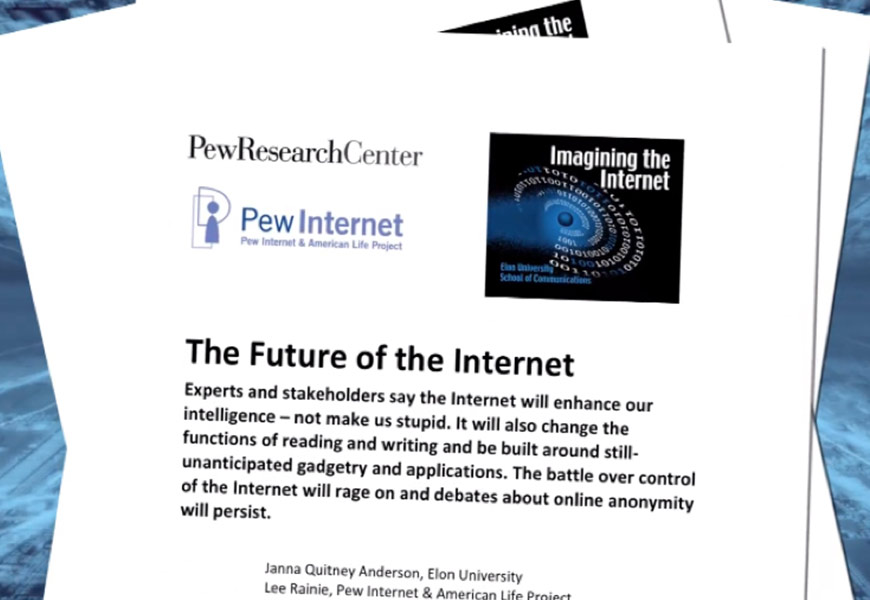
2004-continuing: Upon the completion of the Early 1990s Predictions Database, Rainie's continuing, enthusiastic support led to the further development of the Imagining the Internet site under Anderson's direction. In 2004 and years to follow, experts quoted in the early 1990s database and many other technology leaders have been sent an e-mail invitation to participate in a web-based survey that records their thoughts about changes to come in the years ahead. The responses are published along with an accompanying research report in the Predictions Survey section on this site. In addition, the Voices of the People section of the site, started in the fall of 2004, is a constantly evolving, open invitation to everyone in the public to share their thoughts about the future of networked communications. It includes nearly a thousand predictions from every corner of the earth, and it is one of the most fascinating facets of Imagining the Internet.

2005-06: The book tied to the site, "Imagining the Internet: Personalities, Predictions, Perspectives," was published. In addition, the site was redesigned to add extra layers of useful information. Videos and audio recordings sharing the ideas of visionaries (Visionaries Multimedia) were added with the cooperation of John Smart of the Acceleration Studies Foundation (http://www.accelerating.org); he allowed us to tape participants at the Accelerating Change Conference in 2005 and the Metaverse Roadmap Summit in 2006. Interviews were also taped at the first-ever Internet Governance Forum in Athens in the fall of 2006; we are thankful for the assistance of UN administrators at that venue. Additional informational sections were added to the site in 2006 to: educate children under age 12 (KidZone); help teachers of elementary, middle school and high school students use the site (Teachers' Tips); provide perspective in narrative form about the past and the future (Forward 150 and Back 150).

2006-07: Highlights included publishing the results of the second "Future of the Internet" survey; the production of the documentary film "Bridging the Digital Divide," student Erin Barnett's compilation of interviews from IGF Athens; and the day-by-day video and written coverage of the second Internet Governance Forum in Rio de Janeiro. 

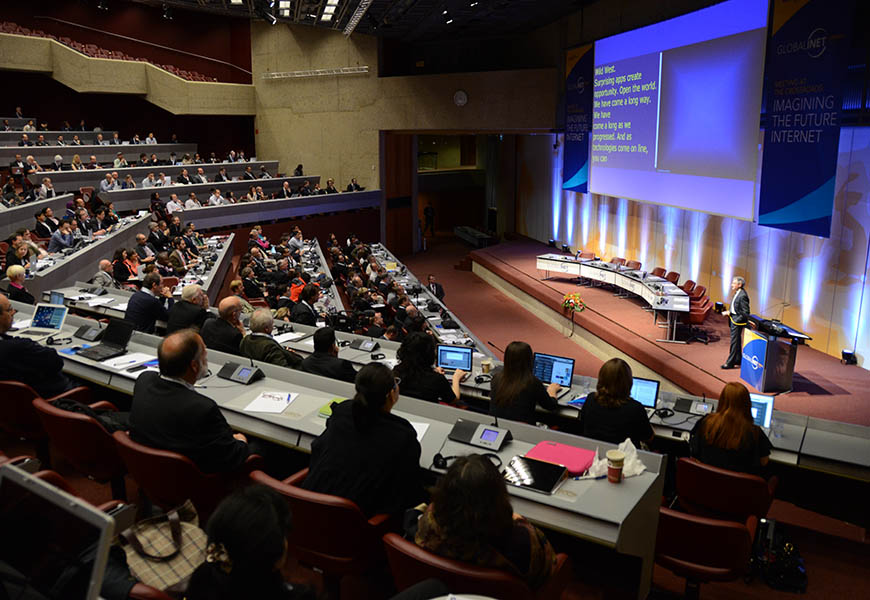
2007-08: An Imagining the Internet team recorded 4 hours of interviews with 32 stakeholders at the 2008 Future of the Internet Economy conference of the OECD. In addition, the results of the 2007 IGF Rio Internet Policy survey and the results of the third "Future of the Internet" survey will also be published in 2008. All of this content is in the process of being analyzed, edited and packaged for placement on the site.

About the Site's Builders

description Janna Quitney Anderson is an associate professor and director of internet projects at Elon University's School of Communications. She has directed several major studies for the Pew Internet Project, including the work leading to generation of all of the content on the Imagining the Internet site and an ethnographic study of the use of the internet by small-town families (www.elon.edu/pew/oneweek). She is the author of the books "Imagining the Internet: Personalities, Predictions, Perspectives" (Rowman & Littlefield, August 2005) and a co-author of the "Future of the Internet" book series, published by Cambria Press. 

This site was conceived and developed and is edited and maintained by Anderson with database and Web page-design assistance from Dan Anderson, John David Parsons, David Morton and Christopher Eyl of the University Relations department at Elon.

In the years since 2005, students Erin Barnett, Scott Myrick, Janus Rogerson, Michele Hammerbacher, Anne Nicholson, Dannika Lewis, Eryn Gradwell, Tyler West, Ashley Barnas, Craig Campbell, Alexa Milan; faculty members Connie Book and Glenn Scott; and Elon staff members Dan Anderson, Bryan Baker, Colin Donohue and J McMerty have helped produce elements for the site and the “Future” reports

Administrative support for the project is provided by Elon University President Leo Lambert, Provost Gerry Francis, School of Communications Dean Paul Parsons, School of Communications Associate Dean Connie Book, leaders of the Elon University Undergraduate Research Program and support-staff members Phyllis Phillips and Pam Baker. Elon alumni Jennifer Guarino and Jennifer Connolly have served as research assistants.

Other Student Contributors

Elon University students who contributed creative input, new content, design work and/or some assistance with public relations strategies for the 2005-2006 update to this site include:

Kara Anderson
Mary-Hayden Britton
Bridget Holmstrom
Bettina Johnson
Alex Kreitman
Ben Malone
Heather Mills
Sarah Moser

Scott Myrick
Candra Nazzaro
Amy Parker
Christina Pompeo
Sarah Putnam
Laura Somerville
Laura Weisiger

Elon University student researchers participating in logging the 1990-1995 predictive data on this site as part of a Media History course in 2003 include:

Crystal Allen
Patrick Allen
Justen Baskerville
Angela Beckett
Natalie Bizzell
John Bolger
Jason Boone
Lindsay Bradshaw
Erin Bricker
Marian Bruno
Jay Burnham
Lawrence Butler
Lauren Canizaro
Cara Catalfumo
Jason Chick
Kaci Collier
Theresa Cooley
William Culp
Jay Dorne
Kristen Dube
Elizabeth Edwards
Peter Falcone

Peter Fedders
Adam Garber
Barbara Goodrich
Jennifer Guarino
Mathea Gulbranson
Nichelle Harrison
Abbey Heiskell
Shavanna Jagrup
Kathleen Johnson
David Kafoure
Tiffany Kildale
Kelly Kohlhagen
Anne Komorowski
Kevin Krout
Ellie Lightburn
Brandi Little
Travis Lusk
Casey Marge
Rory McAlister
Jennifer Meyer
Erin Moseley
Diana Nolan

Shawna Pagano
Bradley Pinkerton
Kristin Ries
Melanie Sampson
Nicholas Schmidt
Carrie Scott
Tim Severs
Ian Smith
Barry Smoot
Shawn Stevens
Ben Stewart
Larry Stotler
Amanda Strickland
Matt Sturmfelz
Kellen Taylor
Elizabeth Tencer
Evelyn Uhlfelder
Amanda Vellucci
Abigail Wahl
Meghan Walsh
Laura Wright

description

About the Sponsors

Elon University is ranked among the top five Southern universities by U.S. News & World Report and is named among the nation's best colleges and universities by Princeton Review and Newsweek-Kaplan. With an enrollment of about 5,000 students, Elon offers 48 majors in Elon College, its College of Arts and Sciences, and in the schools of communications, business, and education.

description Elon is recognized by the National Survey of Student Engagement as one of the most effective universities in the nation in actively engaging students in learning. Forbes and Intel Corp. have named Elon University among the top colleges and universities in the nation for wireless computing access. Elon's undergraduate students have been active participants in all Elon/Pew research projects.

As a national model of engaged learning, Elon seamlessly blends academic and co-curricular activities, especially in flagship programs known as the Elon Experiences (including volunteer service projects, internships, leadership positions, formal undergraduate research, and study abroad).

The Pew Internet & American Life Project creates and funds original, academic-quality research that explores the impact of the Internet on children, families, communities, the workplace, schools, health care and civic/political life. The Project aims to be an authoritative source for timely information on the Internet's growth and societal impact, through research that is scrupulously impartial.

The basic work-product of the center includes phone and online surveys; data-gathering efforts that often involve classic shoe-leather reporting from government agencies, academics, and other experts; fly-on-the-wall observations of what people do when they are online; and other efforts that try to examine individual and group behavior.

The Pew Internet & American Life Project is a non-profit initiative of the Pew Research Center for People and the Press. Support for the project is provided by The Pew Charitable Trusts. For more information, see the Web site: http://www.pewinternet.org.