n. The handing down of statements, beliefs, legends, customs, information, etc., from generation to generation, especially by word of mouth or practice
Leo M. Lambert became Elon's eighth president in January 1999. Immediately, he focused on completing the Elon Vision strategic plan which included the construction of Rhodes Stadium and the opening of Carol Grotnes Belk Library. Today, Lambert's work focuses on an ambitious new strategic plan which aims to place Elon among the nation's best small, selective, private universities.
Elon's academic climate has been strengthened by endowed programs such as the Kenan Honors Fellowships, Baird Pulitzer Prize Lecture Series and Isabella Cannon Distinguished Visiting Professorship in Leadership. Lambert has led efforts to more than double expenditures on library acquisitions, increase faculty sabbatical opportunities and improve Elon's competitiveness in NCAA Division I athletics by joining the Southern Conference. He has been deeply committed to further strengthening Elon's international programs, primarily through the Isabella Cannon International Centre and the Isabella Cannon International Studies Pavilion and his leadership in national efforts such as Campus Compact and Project Pericles.
During his tenure, the Martha and Spencer Love School of Business has attained accreditation by the Association to Advance Collegiate Schools of Business - International and the School of Communications earned accreditation from the Accrediting Council on Education in Journalism and Mass Communications. He also oversaw the completion of the Ernest A. Koury Sr. Business Center and the establishment of Elon University School of Law in Greensboro, N.C., both in fall 2006.
J. Fred Young has spent a lifetime striving for educational excellence in Alamance County. A native of Burnsville, N.C., Young attended Mars Hill College, Wake Forest University, the University of North Carolina at Chapel Hill and Columbia University. In 1973, Young became the seventh president of Elon College and served until 1998, making him one of the longest-serving presidents in Elon's history.
During his tenure, the college more than doubled its enrollment and became one of the premier undergraduate institutions on the East Coast. New academic offerings included master's programs in business administration, education and physical therapy; a new general studies program; and new majors including communications, computer systems, sports medicine and leisure and sport management.
The Elon campus expanded from about 145 acres to more than 500 acres during Young's presidency. New construction and renovations included the Center for the Arts; the Koury Center for athletics and physical education; Moseley Center for campus activities; Story Center, Jordan Center and East Campus residence hall complexes; and the McMichael Science Center. Young presided over the groundbreaking for Carol Grotnes Belk Library just before he stepped down as president, and he also led initial fundraising for Rhodes Stadium.
A native of Alamance County, J. Earl Danieley has dedicated more than half a century to the growth and improvement of Elon and its surrounding community. A 1946 Elon graduate, he received graduate degrees in organic chemistry from the University of North Carolina at Chapel Hill and Johns Hopkins University.
Beginning his career as a chemistry instructor at Elon, Danieley served from 1953 to 1956 as dean of the college before being named president of Elon in 1957. He stepped down in 1973 to dedicate the next years of his life to teaching and has served as the Thomas E. Powell Jr. Professor of Chemistry since 1982. He was elected to the University of North Carolina Board of Governors in 1983 and served in that capacity for 12 years. In 1987, Danieley agreed to reduce his teaching hours and picked up the additional role of director of planned giving for Elon, a position he held until 1992. In that year, he received the title of 'president emeritus."
A 1910 Elon College graduate, L.E. Smith was the longest-serving and among the most influential presidents in the institution's history. His dedication to Elon and his business-minded leadership saved the college from financial collapse. Smith carried Elon College through the Great Depression, three small campus fires, World War II and the Korean Conflict.
He was the 1950 recipient of the Outstanding Alumnus Award and oversaw the construction of an on-campus gymnasium that year. Throughout the 1950s, he continued to improve Elon's programs, opening a night school, building new residence halls and growing enrollment. Before his retirement in 1957, Smith became the first president in Elon history to be honored with the title "president emeritus."
William Allen Harper was tasked with rebuilding Elon College after the devastating 1923 fire. His vision led to the construction of many of the key buildings still used at Elon today.
Harper was born in Berkeley, Va., in 1880. He graduated from Elon College in 1899, earned a master's degree from Yale University in 1905 and subsequently began teaching Latin and religion at Elon. In 1908, he was elected dean of the college and served in that position until he became Elon's fourth president in 1911. Harper saw Elon through World War I, a campus-wide Spanish influenza outbreak in 1918 and the fire of 1923.
After the fire, Harper and the board of trustees embarked on an expansive, long-term building plan for the college. The Mooney Christian Education Building, Alamance Building, Artelia Roney Duke Science Building, Carlton Building and Whitley Auditorium were all constructed within five years of the fire.
A native of Asheboro, N.C., Emmett L. Moffitt, Elon's third president, oversaw the expansion and modernization of Elon's campus. Prior to his tenure as president, Moffitt served on the Elon faculty as a professor of English from 1890 to 1894. He then served as editor of the Christian Sun until 1900 and worked as secretary-treasurer of the Asheboro Wheelbarrow Company until he was selected as Elon's president.
During Moffitt's era, Elon's campus was transformed with the addition of electric lights, running water and steam radiators. Moffitt also oversaw the construction of West Dormitory, the only building still standing that survived the 1923 fire. In addition, students enjoyed participation in intercollegiate athletics for the first time in 1906.
A native of Alamance County, Rev. William Wesley Staley was born in 1849 and studied under his predecessor, former Elon President William S. Long, at Graham High School. He graduated from Trinity College (the predecessor of Duke University) in 1874. Following graduation, he became a member of the Graham High School faculty and was ordained as a minister in the Christian Church before pursuing graduate studies at the University of Virginia from 1877 to 1878. Staley served as superintendent of public instruction for Alamance County while living in Graham with his wife, Martha L. Pearce, before the couple moved to Suffolk, Va., where Staley served as pastor of a Christian Church parish.
In 1894, Staley agreed to serve as a non-resident president of Elon, without salary or an expense account, and began making frequent trips between the college and his home in Suffolk. As the second president of the new college, Staley oversaw plans that brought Elon out of debt for the first time and paved the way for much-needed improvements to the campus. A dormitory built in 1968 was named Staley Hall in his honor.
Born Oct. 22, 1839, on a farm near Graham, N.C., William S. Long spent his life working in Alamance County to provide quality education for young men and women. He operated a junior college in Graham, opened Graham Female Seminary in 1865 and served as the superintendent of public instruction for Alamance County.
His dream of establishing a four-year coeducational college in Alamance County was realized in 1889, when he and other dedicated educators received the official charter for an institute they planned to build in the Mill Point village west of Burlington. Ground was broken, foundations laid and the infant school was named Elon College. The village was later renamed for the college. Long served as a professor and as president of Elon from its founding until his resignation in 1894.
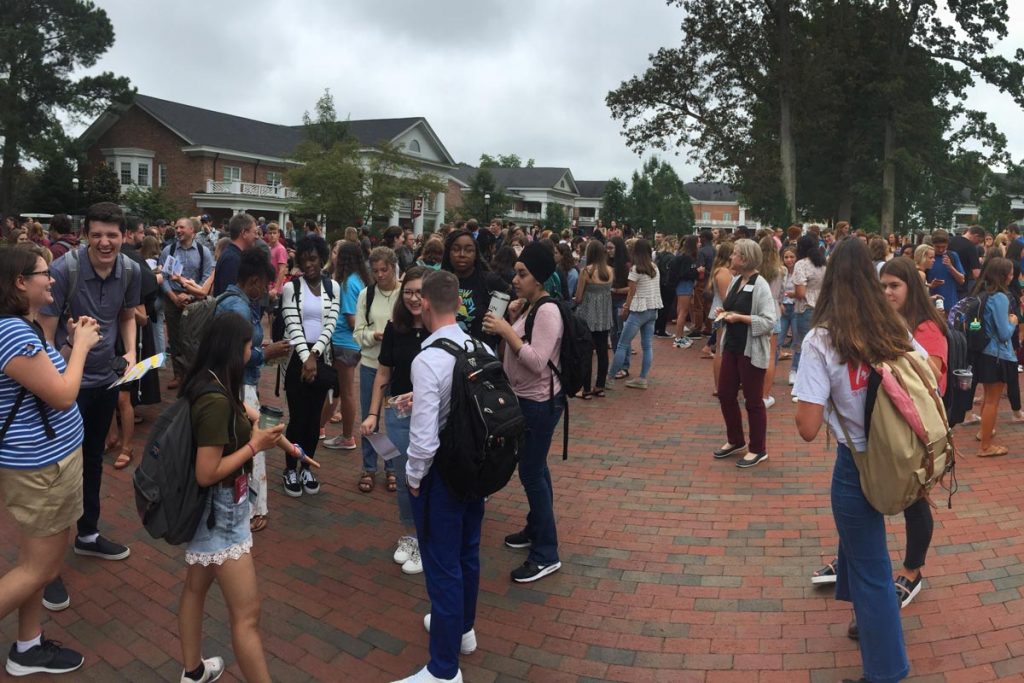
This event takes place every fall for incoming first-year students to give their commitment to the Elon Honor Code. Honesty, integrity, responsibility and respect are the core values Elon students seek to uphold and serve as the backbone of the Elon Honor Code. Each of the four class presidents lights a candle onstage to represent these four core values. First-year students are joined by numerous alumni and older students as they receive the symbolic honor coin and recite the Call to Honor.
The Fall Convocation speaker typically, but not always, is the author of the university's Common Reading selection. For example, in 2009, Khaled Hosseini headlined Fall Convocation while his novel, A Thousand Splendid Suns, was Elon's 2009-10 Common Reading selection.
Other Fall Convocation speakers have included two Pulitzer Prize winners, historian David McCullough and columnist Anna Quindlen, and the former president of Pakistan, Pervez Musharraf (pictured), among others.
This is a formal ceremony marking the start of a student's college career. The opening convocation emphasizes that the journey about to be taken is not to be traveled alone but with the support and help of others. New students are surrounded by Elon faculty and staff, parents, relatives and friends, marking the transition from the nurturing world of the family to the caring mentorship of Elon's academic community.
Each new student is given an acorn as a symbol of the promise of an Elon education, as "Elon" is the Hebrew word for "oak."
Since the first Commencement exercises, held June 2-3, 1891, all Elon graduates have had their names read in full at Commencement and received their diploma, a tradition rare for institutions Elon's size today.
On their way to their Commencement ceremony, graduates take one last walk along the brick paths as Elon students from Koury Athletic Center to the area Under the Oaks. They pass through rows of robed faculty and staff, and many share heartfelt congratulations, hugs and goodbyes with their students.
For many years, there were separate spring and summer Commencement exercises, but now only a spring undergraduate Commencement is held in late May.
Also held in May are Commencements for the Elon MBA program and the Elon University School of Law. Elon master of education students graduate each August and doctor of physical therapy students graduate in December.
The first Founders Day celebration was on Sept. 14, 1939. There were many years when it was not celebrated, but it has been held annually since 2000. Its purpose is to honor the lives of administrators, faculty and staff, trustees and alumni who have impacted the growth of Elon. It also serves as a means of educating the campus community about Elon history.
Although Elon's archives include references to events called 'Honors Convocation" before 1995, the current Convocation for Honors was established on April 28, 1995, during the visit of former British Prime Minister Margaret Thatcher. The ceremony typically features an address from an accomplished guest speaker. It also honors graduating seniors, master's and doctoral candidates, as well as underclassmen who received honors over the preceding academic year. In addition, selected faculty, staff and university benefactors are recognized.
On Jan. 18, 1923, the Main Administration Building, in which all classes and main components of Elon's academic setting were housed, caught fire. The early-morning blaze woke the entire town and many citizens ran to assist in putting out the flames. The nearby East Dormitory and North Dormitory buildings were saved after being doused with water and chemicals, but "Old Main" could not be saved. The cause of the fire was never determined but an electrical spark was suspected.
Months later, the administration raised money to begin building five buildings in the shape of an 'H" with the Alamance Building in the center. Years later, the university recognized the significance of the 1923 fire to Elon's history by renaming the school mascot the Phoenix, a mythical bird that rises from its own ashes.
In its early years, Elon College's sports teams went by several different monikers. But during a 1930s contest between Elon, founded by the Christian Church, and nearby Guilford College, founded by the Quakers, a sportswriter called the Elon team the 'fightin' Christians," and the name stuck until 2000.
When Elon moved from NCAA Division II athletics to Division I in the late 1990s, members of the university community felt Elon needed a new athletics identity. Drawing upon its history, Elon selected the Phoenix for its mascot, because like the mythical bird, the university rose from its ashes after the 1923 fire.
Elon was founded as a college and remained so until 2001. On Oct. 11, 2000, the board of trustees voted to adopt the name Elon University to better reflect the institution's academic organization effective June 1, 2001. On that date, the institution officially became Elon University.
West opened in 1905 for females only. The building originally included an annex, which contained a dining hall for both male and female students of the college.
West featured state-of-the-art architectural features for its time, including fire walls and fire doors. Such features helped save West in 1942 when a fire destroyed the annex but left the main building intact. Because it is the only building to have survived the 1923 fire, West's architectural style of red brick and white columns and trim has guided Elon's design aesthetic for nearly a century.
Elon broke ground for Alamance in May 1923 to replace the Main Administration Building, which was destroyed in the January fire. Alamance was named after the county in which Elon resides and its residents, many of whom donated funds to build the new building. The building was intended to be part of an "H"-shaped area of academic buildings. Crushed bricks from the remnants of "Old Main" were reused in Alamance's foundation. The cupola atop Alamance, which houses a bell, has become one of the university's most identifiable symbols.
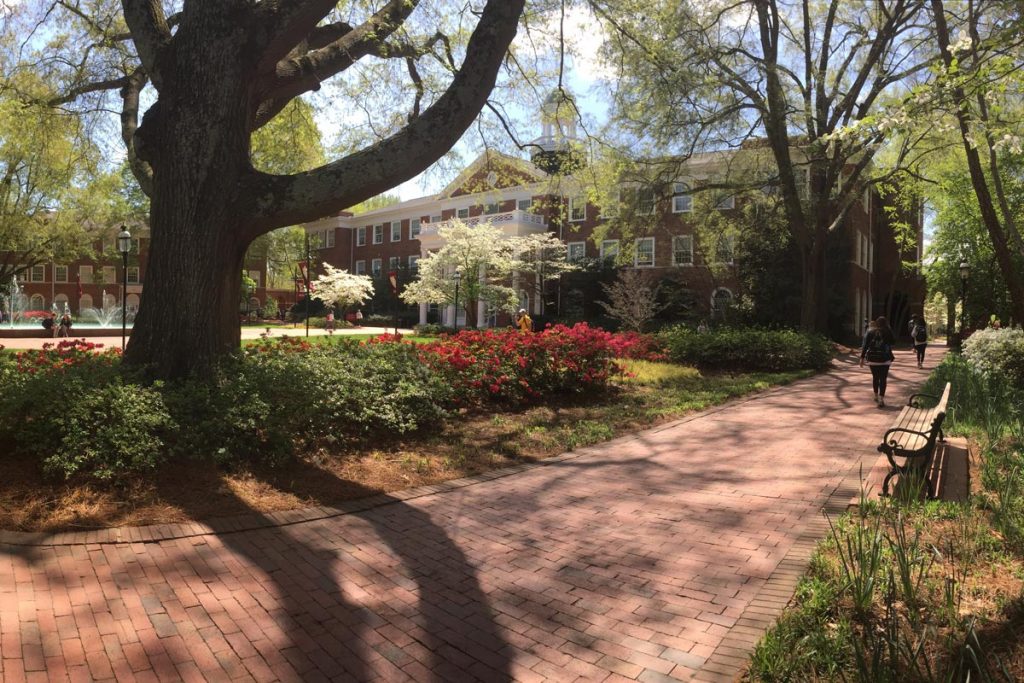
The oldest part of campus, which lies within the original campus walls, includes the 'H"-shaped academic quad (Alamance, Powell, Duke, Carlton, Whitley and Mooney), Long and McEwen Communications buildings, McEwen Dining Hall, and Sloan, Virginia, West, Smith, Carolina, Hook, Brannock and Barney residence halls. Many of these buildings are named in honor of past presidents, faculty and Elon community members, a tradition that largely has continued for buildings constructed in the modern era.
Several significant structures have been built and razed since Elon's founding.
North Dormitory was built in 1912 and was intended to house male students on the upper floors and a gymnasium on the ground floor. The building was frequently called the Alumni Building and was razed in 1959.
The Main Administration Building was the first building built on campus and housed much of Elon College's operations in its early years. The building was destroyed by the January 1923 fire and its remnants were razed.
East Dormitory was the first dormitory built on campus, with construction beginning shortly after the college started building the Main Administration Building. It was intended to house female students and was named for its location to the east of "Old Main." While it survived the 1923 fire, it was gutted by another fire in July 1966.
For many years, Elon had a power plant that furnished electricity for the entire campus. The power plant stood in the footprint of the current Carol Grotnes Belk Library. In addition, part of the campus served as a working farm at one point.
The Senior Oak was an Elon icon from its earliest days until its demise and removal in 1980. As men worked to clear a grove on the land upon which Elon would be built in 1889, a tree that stood near where West Residence Hall is located today "grew from the ground in a curve the height of a man before its trunk straightened out," wrote Elon alumnus and historian Durward Turrentine Stokes '64. William S. Long, Jr., son of Elon's first president, encouraged his father to save the old white oak for its aesthetic value, so it was spared.
For decades, the tree, dubbed the Senior Oak, became the go-to spot for photographs, friendly gatherings and marriage proposals. But in 1980, the tree was struck by lightning, died and was cut down the following year. The Senior Oak lives on as a collectors' item. The felled tree was cut into more than 800 pieces that were given to Elon donors, and also was incorporated into various artifacts, some of which can be seen in the Elon archives.
The location of the Senior Oak has been a matter of debate for more than three decades, but photographs indicate it stood in the Under the Oaks area, near the south entrance of Whitley Auditorium and just north of the parking lot shared by McEwen, West and Whitley. The Class of 1990 relied upon such approximations when it planted a replacement oak on the spot, but that tree perished as well.
Jordan Center, built in 1980, was originally intended to serve as temporary student housing, yet the six-building dormitory complex on Elon's west campus stood until 2006, when it was razed and replaced by The Oaks.
"J.C.," as the area was commonly known to students, became a campus attraction during the holiday season, when the residents of each building banded together to adorn their units with lights and holiday decor in an annual competition and exhibition. Amazingly, in 25 years, not a single dorm or student was damaged or destroyed in the proceedings.
Memorial Stadium at Burlington's Walter Williams High School played host to a generation of Elon football, from 1949 through 2001 when Elon's on-campus venue, Rhodes Stadium, opened. Memorial Stadium notably was the site of Elon's back-to-back national championship victories in 1980 and 1981. Prior to using Memorial Stadium, Elon's earliest football teams practiced and played on various fields on or near campus.
The "Old Main" bell served as a beacon for Elon's earliest students, calling them to class and chapel from its perch atop the tower of 'Old Main," the first building constructed on Elon's campus. But on the morning of Jan. 18, 1923, wrote Stokes, 'the old college bell, making its last clank, plummeted down from the tower" as "Old Main" was engulfed in flames. The bell survived its fall mostly intact. After it was plucked from the rubble, the bell was housed in various rooms and closets on campus.
Raymond Beck '75 discovered references to the bell's existence while researching another aspect of Elon history and remembered seeing the relic in a closet in the former Carlton Library. Along with Professor Emeritus George Troxler and a metallurgist from North Carolina State University, Beck tracked down the bell and confirmed it as the one that hung in "Old Main." In summer 2010, the bell became part of an exhibit in Alamance Building. It sits on a podium surrounded by plaques explaining its history.
When the founders of Elon selected a name for the institution, they settled upon "Elon," the Hebrew word for "oak," in reference to the large grove of oak trees that stood on the land where the college was built. As men worked to clear that land, several large oaks were spared - and stand in front of where West Dormitory stands today. This area, known as Under the Oaks, is the site of the annual New Student Convocation in the fall and Commencement exercises in the spring.
This space was dedicated on Oct. 10, 2000, to honor President Emeritus J. Fred Young and his wife, Phyllis J. Young. "Young Commons, which connects the historic and new campuses and unites the intellectual, physical and social dimensions of Elon life, stands as testimony to the Youngs' leadership and vision," declared the Young Commons dedication program. During Young's 25-year tenure, Elon grew from a small, regional college to a university that ranked in the top-10 of Southern master's-level universities.
Alumni Gym is home to Elon's men's and women's basketball and volleyball teams. It also hosts major Elon events throughout the year, including Fall Convocation and the spring Convocation for Honors, and ElonTHON, among others.
Alumni Memorial Gymnasium was built as part of a campus expansion plan in the post-World War II years. It was dedicated Dec. 2, 1950, during halftime of a men's basketball game between Elon and the University of North Carolina at Chapel Hill. The Class of 1950 unveiled its gift to Elon, a bronze plaque listing the names of the 37 Elon alumni who died in World Wars I and II, to whom the building is dedicated. The plaque still hangs in the north entrance to Alumni Gym.
In 1992-94, Alumni Gym underwent renovations as part of the Koury Center construction. In 2010, work began on a second renovation to the gym that provided new seating, many technological upgrades and a new playing surface named Robertson Court to honor trustee Jeanne Robertson and Jerry Robertson, Elon parents whose major gift supported the renovation.
In August 2001, Elon commissioned John Hair to design the 11-by-9-foot sculpture that stands near the entry road to the North Athletics Complex. The sculpture was dedicated in fall 2003, and the Fire of the Carolinas marching band performed at the ceremony.
Hair intended for his creation to intimidate opposing teams, but he said the final product went far behind his initial vision. He studied Greek mythology to get a feel for the history of the phoenix and began incorporating unique aspects into the sculpture's design through geometric form. Reading the story of the phoenix, a mythical bird that rises from its own ashes, Hair focused on the continuous cycle of renewal that symbolizes the phoenix's immortality.
"There is a feeling of the Elon spirit of revival, how one can triumph over adversity through personal strength," Hair said of his work.
On-campus football returned to Elon in 2001 with the opening of Rhodes Stadium in the North Athletics Complex. The stadium, named for trustee Dusty Rhodes, his wife, Peggy, P'86, and their family, opened its doors for the first time on Sept. 22, 2001, to host a matchup between the Phoenix and the Aggies of North Carolina A&T State University. The largest crowd recorded to date at Rhodes Stadium assembled Nov. 14, 2009, when 14,167 fans watched Elon battle Southern Conference foe Appalachian State.
The playing surface in the stadium is named McKinnon Field in honor of trustee Bob McKinnon '62 and his wife, Ray. The Theos Arch, under which Elon fans enter the stadium, is named for the late Nick Theos '56, a former Elon football player. Furman Moseley '56 made a gift to name the arch for his friend and former teammate. In front of the stadium stands the Alan J. White Bell Tower, dedicated in September 2006 following the retirement of Elon's longtime athletics director. Trustee Jeanne Robertson P'89 and Jerry Robertson P'89 made a gift to build the bell tower in honor of White, their longtime friend.
The tradition began in 1991 with the Commencement address by Furman Moseley '56. Moseley spoke of his career in the timber business and gave each graduate a redwood sapling. President J. Fred Young decided to make the gift of saplings a permanent Commencement tradition in 1992. Instead of a redwood sapling, Young opted to give each student an oak sapling in recognition of the Hebrew origin of the school's name.
When Leo M. Lambert became president, he built upon Young's tradition by giving each new student an acorn, symbolizing the beginning of their Elon journey, at the end of New Student Convocation.
Thad Eure became North Carolina's secretary of state in 1936 and served under 13 state governors. He was a champion for common citizens and children and insisted the door to his office never be closed to the public. He also had extensive family ties to Elon.
Remaining faithful to Elon, Eure joined the board of trustees in 1942. He offered a booming voice and gave powerful speeches on campus, ending each with the pronouncement, "Long Live Elon!" This tradition continues today at Commencement, when graduates join the university president in hailing their alma mater.
Listen to the Hon. Thad Eure deliver a speech during Elon's 100th Commencement
The Elon school colors are maroon and gold. In 1907, faculty wanted Elon's colors to match the colors of the three literary society groups - the Philologian, Psiphelian and Clio societies - which were garnet, white and blue. However, the athletes wanted to match the two-tone color scheme of rival schools. A committee of faculty was appointed in 1909 and they chose maroon and gold, which have been Elon's official colors ever since.
The official seal was created in 1908 by Professor Walton C. Wicker and adopted by the board of trustees. Many of the seal's symbols draw from Masonic culture, about which Wicker was quite knowledgable.
The words "Elon College, North Carolina" and "Numen Lumen" are written around the outer rim; the word "college" was replaced by "university" in 2001. Two pillars that represent power and strength sit in the middle of the seal, along with the Holy Bible and several other books. The Bible refers to the religious foundations of Elon, and the books represent culture and knowledge. The candlestick and flame represent the light that members of the Elon community spread throughout the world, and the "All-Seeing Eye" is a representation of those keeping watch over the institution. The founding year of 1889 is also on the seal.
The university's motto, "Numen Lumen," incorporates the Latin words for "spiritual light" and “intellectual light." This motto inspired the name of Elon's premier award that recognizes scholarship, the Lumen Prize. Established by President Leo M. Lambert and the board of trustees, the inaugural Lumen Prize recipients (pictured) were selected in 2008. The prize is awarded to rising juniors through a competitive application process, and each scholar receives a $15,000 scholarship to support and celebrate their academic and artistic achievements and potential.
The mace is an ancient symbol of authority. The Elon University mace, given in memory of Elon professor Alonzo L. Hook, is carried in academic procession by a senior member of the faculty. The Elon mace was first carried by President Emeritus J. Earl Danieley '46 at the Centennial Convocation on April 25, 1989.
Approximately 40 inches in length, the Elon University mace was handcrafted in Portugal of sterling silver and gilding and incorporates many symbols. The shaft of the mace is ornamented with bands of oak leaves and has four sections that represent the four years of study. An acorn, symbolizing the seed of learning, is carved at the top of the shaft. The head of the mace is a six-sided replica of Elon's colonnades, complete with open arches and brickwork, which signify strength and stability. The mace is crowned with the Elon seal.
Elon's rural setting has allowed squirrels and other wildlife to live harmoniously wih students since its establishment in 1889. In 2000, Mark Albertson, registrar and assistant to the provost, noticed that summer school enrollment had been flat for nearly 20 years. Albertson channeled Elon's unique relationship with squirrels to create "Sammy the Squirrel," a promotional tool to increase summer school enrollment. These days, Sammy can be seen all over campus, from posters, to advertisements in The Pendulum, to a giant squirrel costume.
The original train depot near Elon was built to handle freight for mills and businesses near the village of Mill Point. The train stop became an important way Elon College students traveled to and from campus. According to a Sept. 9, 1927, article in the student newspaper, the Maroon and Gold, titled "Trains and buses bringing in students from all sections," students came from 16 states and two foreign countries via train.
Though the depot was demolished in 1961, the tracks still run by the south side of campus, with several trains passing Elon daily. In 2010, Elon and the North Carolina Railroad Company opened a people tunnel under the tracks as a safe way for pedestrians to walk from main campus to South Campus.
The Elon fight song is played at all Elon sporting events. At football games, the song is played by the Fire of the Carolinas, Elon's marching band. At basketball games, the song is played by the university Pep Band. The fight song is played to the tune of F.E. Bigelow's march, "Our Director." The lyrics were written by Elon student and band director Mark Z. Rhodes '23 in 1921.
This is a seven-day celebration of student achievement in research and the arts held each April. The centerpiece of CELEBRATE! Week is the Spring Undergraduate Research Forum, or SURF, when students and faculty showcase their projects in poster sessions and presentations campus-wide. SURF became an annual campus tradition in the 1990s. When the university established CELEBRATE! Week in 2006, art exhibitions, panel discussions, and dance, music and theatrical performances were included in the week surrounding SURF to illustrate the university's excellence in the arts and sciences.
Once a mandatory part of student life, College Chapel is among the oldest of Elon's traditions. Today, College Chapel is voluntary and focuses on all faith traditions. Students, faculty and staff meet each Thursday from 9:50 to 10:20 a.m. for reflection and informal worship. College Chapel is the perfect time to rejuvenate your spirit during the hustle and bustle of life on campus and serves as a weekly reminder that the purpose of an Elon education is to develop the whole student - mind, body and spirit.
One of Elon's most cherished traditions, College Coffee is held every Tuesday, 9:40 to 10:20 a.m., during the fall and spring semesters at Phi Beta Kappa Commons in the Academic Village. The entire Elon community unites for conversation over coffee and pastries. College Coffee as it's known today was established in 1984 by President Emeritus J. Fred Young, who had heard of a similar tradition at Davidson College. It has been held in various locations on campus, including Scott Plaza and Young Commons, before relocating to Phi Beta Kappa Commons in fall 2009.
Young's College Coffee initiative was preceded by similar student-organized events in the early 1980s. In the 1980-81 academic year, the Student Government Association hosted "weekly coffees" on Thursday mornings in the Long Student Center's second floor. In February 1983, then-SGA President Ted Reinheimer '83 hosted an SGA Faculty/Student Coffee to "talk about problems and present new ideas."
The Elon community gathers each December to share hot chocolate and cider, sing holiday songs of all faiths, light a Menorah and stroll through more than 2,000 luminarias set up around Young Commons and Scott Plaza. Campus buildings and trees are lit with more than 50,000 lights, and the decorations stay up through early January. Students, faculty and staff join with family and friends for the joyous celebration.
Right before winter break, all Elon students are invited to Maynard House, the residence of Elon's president, to celebrate the holiday season with hors d'oeuvres and desserts. Students have the opportunity to take a holiday photo with President Leo M. Lambert and his wife, Laurie, that is sent to the student's home over the break.
Family and friends return to campus, generally in late September or early October, to visit their Elon students and participate in numerous events. This tradition began Nov. 5, 1966, and was called Parents' Weekend. The name of the event changed to Family Weekend in 1993 to include grandparents and other extended family members.
ElonTHON is Elon's version of Dance Marathon, a fundraiser benefiting Duke Children's Hospital in Durham, N.C. Students of all years are encouraged to get involved in the event, which requires them to literally dance the night away, staying on their feet for 24 straight hours. This is Elon's largest student-run fundraiser, bringing in tens of thousands of dollars each year to help families at Duke Children's Hospital with medical expenses. ElonTHON began in spring 2003.
The Rev. Richard McBride, Elon's chaplain from 1984 to 2009, established this celebration in spring 1998 as a way to honor the important milestone of turning 21 years old. The event is held each semester, and all students who turn 21 years old during that semester are invited to the dinner and may bring one faculty or staff mentor to be their guest.
The idea came to McBride after attending an event friends held for their daughter recognizing her entrance into adulthood. "I wanted to help people recognize the transition that occurs in life. It's a marker," he said. "Our culture doesn't do well with marking transitions."
The Turkey Trot began in 1991 with fewer than 10 students participating, but has grown into a popular annual event at Elon. Each November, hundreds of students, faculty and staff gather to run the five kilometer trail around campus while contributing canned goods to a local agency benefiting the community.
In 1895, 11 of Elon's first graduates united to establish the Elon Alumni Association, which strove to keep "the memory of college days among the alumni, and to keep their support united for the good of the college." To meet those goals, the association sponsored reunions to bring graduates back to campus. One such reunion, an annual October/November event called "Homecoming Days," is mentioned in Elon communications dating to the early 20th century. Though the specifics of the celebration have changed considerably in the past 100 years, the spirit remains the same, bringing to the forefront the indelible link between Elon's past and present.
Elon's first Greek Week was held in April 1975. All the activities started on a Tuesday afternoon with a parade, and included field day events and a skit competition at night in Jordan Gym. As Greek Week evolved over the years, the competition eventually included homemade boat races across Lake Mary Nell, tennis, golf, archery, bike races, eating contests and swimming. Other activities over the years have included sack races, centipede races, egg and Frisbee tossing, football and softball throwing, and tug-of-war. Today, the centerpiece event of Greek Week is the annual Dance Competition, during which fraternities and sororities from Elon's three Greek councils present choreographed performances for the student body.
Elon 101 is a one-credit fall semester course for first-year students that helps them acclimate to Elon's academic and campus climate. There is conflicting evidence about the origin of the Elon 101 course. A 1989 article in The Pendulum stated that it began in 1983. But it did not appear as an official course in the academic catalog until the 1988-89 edition and was not included in the official course schedule until fall 1989.
Founded in 1974, The Pendulum is produced by 20 editors and 50 to 100 staffers, reporters, photographers, and business and advertising workers. The paper's online and print versions cover major sports events, internationally recognized speakers, entertainment and the campus community. The Pendulum drops on Wednesdays during spring and fall semesters and on occasion during winter and summer terms.
ESTV was created in 1992 by Christopher Waters '94. Hundreds of students work in some capacity each year producing ESTV entertainment, news and sports programming, including "Phoenix14News," Elon's live weekly newscast, and the "Win Stuff" game show. The organization constantly encourages students to pitch their ideas for new shows.
In spring 1975, students established an FM radio station whose call letters stood for "Wonderful Sounds of Elon." WSOE began regular broadcasts on Oct. 6, 1977, from its original studio in Moffitt Hall. Today, WSOE's signal reaches as far west as Greensboro, N.C. and eastward to Durham, N.C., and broadcasts 24 hours a day.
Founded in 1913, Elon's yearbook is named for the original three literary societies at Elon - Philologian, Psiphelian and Clio. The group employs several student editors and traditionally carries sections covering student life, people, sports, organizations, arts, study abroad and academics. Yearbooks are distributed free to students.
In 1937, Elon published the first issue of Colonnades, an annual literary periodical containing 35 contributions from student writers spanning 27 pages. Recent editions of Colonnades have grown to encompass more than 100 pages and feature not only nonfiction, fiction and poetry but also original art and photography. The magazine is published each spring and provided free to students, faculty and staff.