On the Edge Symposium 2026
Center for the Study of Religion, Culture, and Society
Elon University (NC)
Feb. 18-20, 2026
Elon University’s “On the Edge” symposium, hosted by the Center for the Study of Religion, Culture and Society (CSRCS), explores new directions in the interdisciplinary study of religion. This bi-annual symposium brings together scholars working at the theoretical and methodological boundaries of those fields that have a stake in the critical analysis of religion—law, history, psychology, anthropology, literature/textual studies, philosophy, art history, political science, classics, sociology, geography, folklore, and gender studies, to name a few. “On the Edge” aims to exercise a self-conscious attention to methodological advances that can be made through interdisciplinarity. Its proceedings contribute to a richly contextualized and multi-layered understanding of the role of religion in societies past, present, and future.
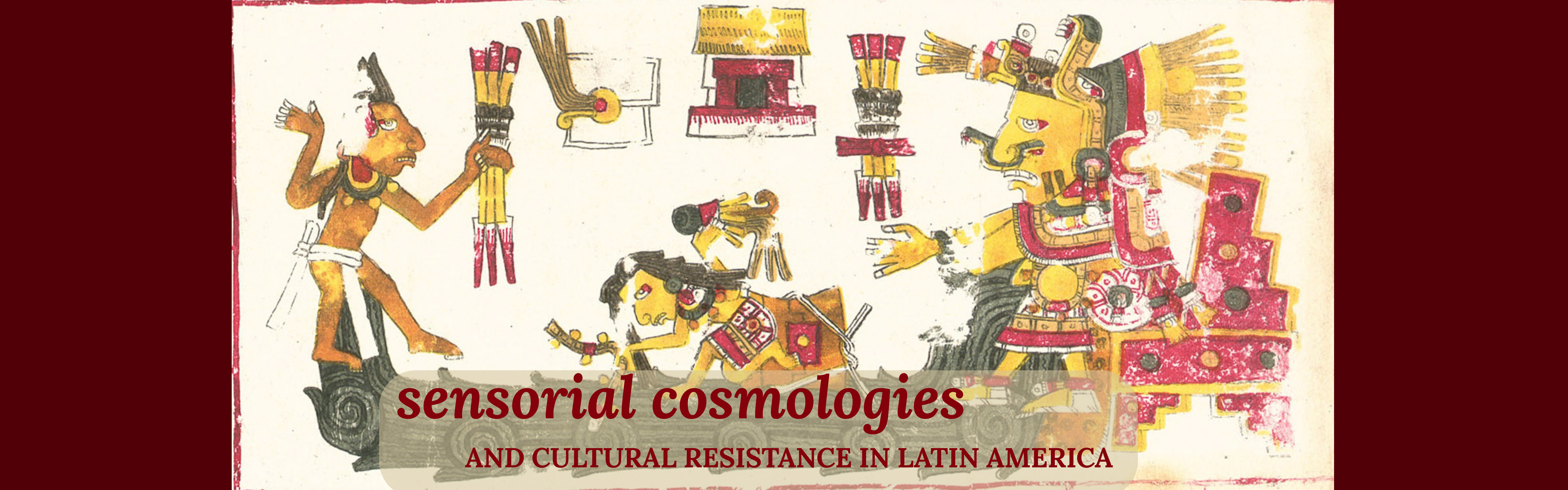
2026 Symposium: Sensorial Cosmologies and Cultural Resistance in Latin America
The 2026 “On the Edge” symposium hosted by CSRCS at Elon University invites scholars to participate in collective conversations about political strategies, activism, and theoretical interventions against cultural homogenization in Latin America and the Caribbean. The ongoing epistemicide of Indigenous and Afro-Caribbean worldviews, alongside processes of land and labor exploitation, reinforces structural inequalities related to class, gender, race, and the environment. We call for active reflection and civic engagement on these intersectional issues to create a meaningful dialogue for social change.
The symposium will foster interdisciplinary discussions on alternatives to enduring forms of exclusion, contextualizing multiple sensorial cosmologies as forms of resilience. Sensorial Cosmologies, broadly understood as experiences that incorporate the senses for an immersive worldview, considers how Indigenous communities, mestizos, Latinx, and other underrepresented minorities have mobilized and provoked transcultural exchanges that reconfigured the continent known as Abya Yala.1
We invite presentations that feature the heterogeneous archive of counternarratives and cultural resistance from Indigenous cosmogonies, religious and theological movements of liberation, artistic interventions for intersectional eco-feminism and grassroots activism. We encourage submissions related to, but not limited to, the following broad themes:
Religion, cosmologies, and critical theory
Scholarly works addressing Indigenous cosmologies, diverse religions, and critical theory in Latin America and the Caribbean. These works may explore how Indigenous worldviews, philosophy, and theological thought have impacted cultural production and sensorial regimes in the colonial and post-colonial era. We welcome research inclusive of visual arts, music, oral traditions, and literature from the region.
Gender Justice and Eco-Feminism
We consider the urgency of pursuing gender justice and invite presentations that analyze the role of feminist politics in contesting authoritarianism and its impact on the environment. In what ways have religious practices, historical events, and cultural plurality influenced (eco)feminist social movements? Environmental activists, Indigenous and Afro-Caribbean leaders, artists, and reproductive justice advocates are transversed by public policies addressing gender inequality, the feminization of poverty, and violence against women. We welcome perspectives on feminist artistic practices in Latin America that illuminate dynamics of gender and environmental justice.
Migrations from the Global South and racial inequality in the USA
We encourage submissions of scholarly works and community-based projects around migration and racial justice in the Americas/Abya Yala. The symposium will hold conversations on diaspora from the Global South to the United States, Canada, and Europe, as well as migrations within Latin America. We encourage presentations on strategic collective responses to historical and contemporary migratory phenomena, considering border cultures, forced displacement, deportations, refugees’ human rights, and the social challenges faced by Latinx communities.
We invite scholars from different academic fields and at different stages of their careers to submit their abstracts by October 15, 2025.
Presenters will be invited to submit an extended version of their research papers following the author guidelines of the journal A Contracorriente for inclusion in a special dossier of the symposium. The peer-reviewed journal will make the final decisions regarding publications.
We accept submissions in English, Spanish, and Portuguese. We also welcome work engaged with Indigenous languages.
1Also Abiayala. The word comes from the Guna Language, which is spoken by the Guna people in present-day Panama and Colombia. It is translated as “land in full maturity”, “saved territory”, and “land of fertile blood”. Indigenous people, decolonial thinkers, and social movements commonly use this term to refer to the Americas.
To submit a proposal, please use the submission form here.
Elon faculty conveners
Federico Pous, Associate Professor of Spanish
Leyla Savloff, Assistant Professor of Anthropology
Juan Leal Ugalde, Associate Professor of Spanish
For further information, please contact Brian K. Pennington, Director of the Elon Center for the Study of Religion, Culture, and Society and Professor of Religious Studies