Tenure and continuing track
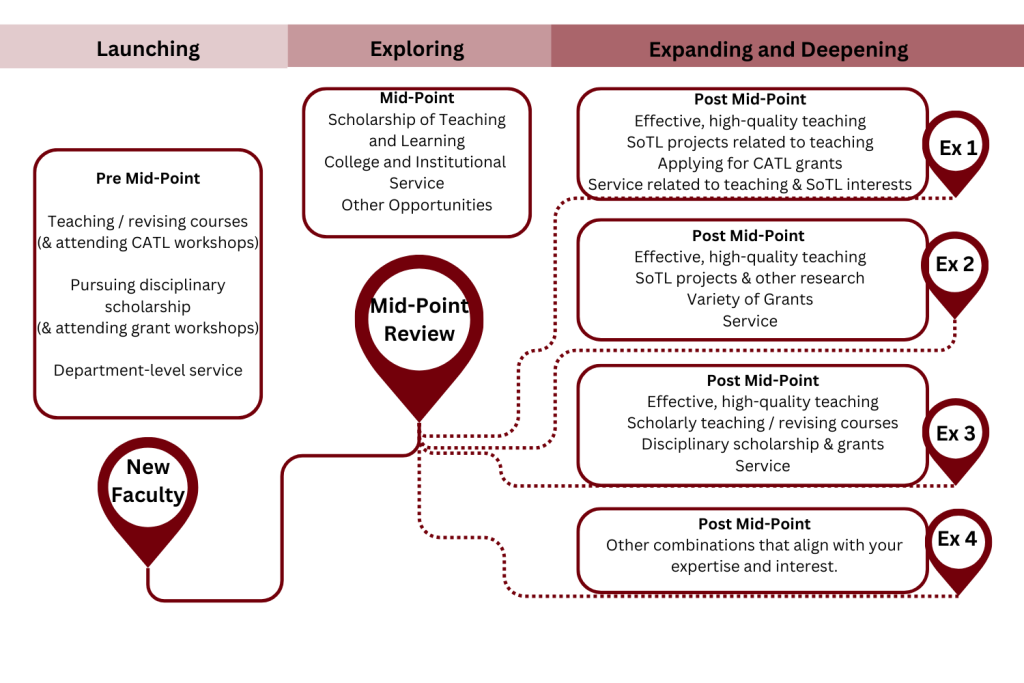
As the image below illustrates, faculty pathways to tenure, continuance, and promotion often include multiple phases, of launching a career at Elon, exploring opportunities, and expanding and deepening professional identities. These specific examples are not intended to be prescriptive nor exhaustive, but rather to spark thinking about the variety of intentional and strategic paths a faculty member might take.
- Launching: Prior to the mid-point review for tenure or continuance, faculty often focus on teaching or revising courses (and attending faculty development workshops related to their teaching), pursuing disciplinary scholarship (and attending grant workshops), and contributing department-level service.
- Exploring: At the mid-point of the pathway towards tenure or continuance, faculty might explore intersections of teaching and professional activity by embarking on a scholarship of teaching and learning (SoTL) project, and they likely will begin participating in college and institutional service. They might explore other opportunities related to emerging interests or to areas of growth identified during the mid-point review.
- Expanding and Deepening: Post mid-point, faculty pursue more customized pathways that remain attentive to first-level criterion for evaluation (teaching) and second-level criteria (professional activity and contributions to the life of the university). Examples include:
- Continuing effective, high-quality teaching, while pursuing SoTL projects related to teaching, applying for CATL grants, and contributing service related to teaching and SoTL interests.
- Continuing effective, high-quality teaching, while pursuing a mix of SoTL projects and other research, applying for a variety of grants, and contributing service aligned with the individual’s expertise and interests.
- Continuing effective, high-quality teaching, supported by scholarly teaching activities and course revision, while pursuing disciplinary scholarship and grants and contributing service aligned with the individual’s expertise and interests.
- Continuing effective, high-quality teaching, while pursuing other combinations of professional activity and service aligned with the individual’s expertise and interests.
The probationary period for tenure-track faculty is four, five, or six years, depending on the faculty member’s prior full-time college teaching experience. The mid-point review for tenure-track faculty typically occurs within the third year.
The length of the probationary period for a faculty member on continuing track is four years. The mid-point review, therefore, occurs within year two.