


Findings were presented at a Sept. 17 conference, “The Human Edge: Our Future with Artificial Intelligences", co-hosted by Elon University and RTI International in Durham, N.C.
A new survey by Elon University’s Imagining the Digital Future Center finds that more than half of American adults believe the expanded use of AI will have significant impacts on key human capacities and behaviors in the next decade.
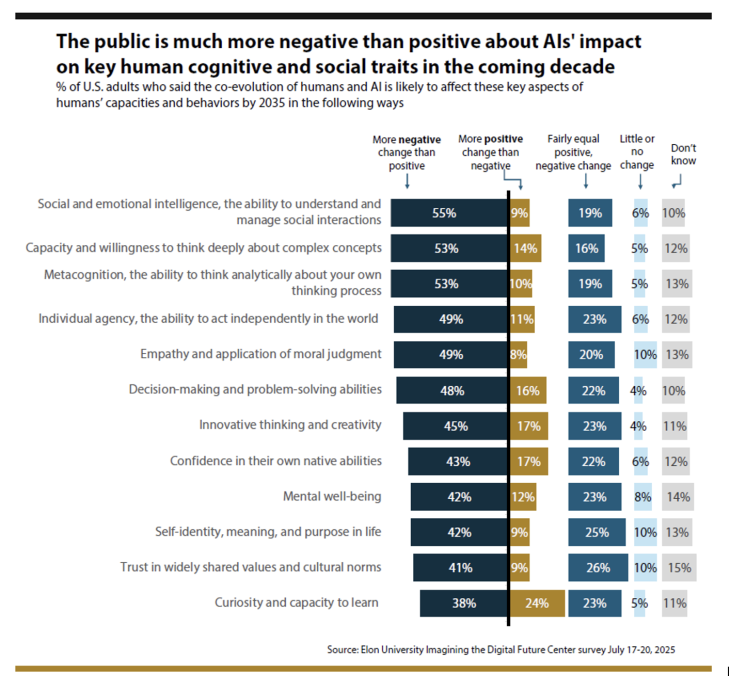
The survey asked U.S. adults about their views on the effect of AI systems on 12 core human capacities and found that on each of those attributes, people expect that the impact of AI systems will be more negative than positive in the next 10 years, particularly on these traits:
- Social and emotional intelligence: By a six-to-one margin (55%-9%), people said the impact of AI will be more negative than positive.
- Empathy and moral judgment: By a similar margin (49%-8%), they said the impact of AI will be more negative.
- Capacity and willingness to think deeply about complex subjects: By a 53%-14% margin, they said the impact of AI will be more negative.
- Sense of individual agency: By a 49%-11% margin, they said the impact of AI will be more negative.
- Confidence in their own native abilities: By a 43%-17% margin, they said the impact of AI will be more negative.
- Self-identity, meaning and purpose in life: By a 42%-9% margin, they said the impact of AI will be more negative than positive.
American adults said they expect that by 2035 AI will have had a mixed impact overall on “the essence of being human”: 41% said the changes will be for the better and for the worse in fairly equal measure, while 25% said the changes will mostly be for the worse and 9% said the changes will mostly be for the better.
“These findings raise stark questions about the impact of AI on the essence of being human,” said Lee Rainie, director of Elon University’s ITDF initiative. “Americans expect the effect of AI will be more negative than not across each of the key human attributes we offered them. This is striking because it challenges the conventional notion that key human skills and social intelligences – sometimes called ‘soft skills’ – will be our saving grace as AI becomes more capable of matching or surpassing other kinds of basic intelligence. It’s now the case that the population fears that in the next decade AI could diminish many of the very qualities that make us uniquely human.”
These findings were presented at a Sept. 17 conference co-hosted by Elon University and RTI International in Durham, N.C.: “The Human Edge: Our Future with Artificial Intelligences.”
The survey followed an earlier set of findings from the ITDF Center which canvassed several hundred experts on these same questions. Comparing those results, the general public is considerably more negative about the impact of AI than experts are about the impact of AI on human curiosity and capacity to learn, people’s capacity for innovative thinking and creativity, decision-making and problem solving and human metacognition (the ability to think analytically about thinking).
The public also is more likely than experts to declare that they don’t know how to answer these questions about the future impact of AI.
The survey of 1,005 U.S. adults was conducted by SSRS on its Opinion Panel from July 17-20, 2025, and has a margin of error of +/- 3.5 percentage points. The methodology of the survey and topline findings can be found at the ITDF Center’s website. And the 285-page report covering expert views on these issues can be found at: “Being Human in 2035: How Are We Changing in the Age of AI?”