


The Residential College Society recognized Elon’s commitment to building community, belonging and student success through its collaborative residential learning model.
Elon University earned two honors at the inaugural Residential College Society Awards Ceremony: the 2025 Institutional Excellence in Residential Education Award and the Outstanding Faculty Member Award, presented to Sandy Marshall, faculty director of the Global Neighborhood. Together, these recognitions underscore Elon’s national leadership in integrating academic and residential life to foster community, high-impact learning and a sense of belonging.
The Residential College Society, a national organization that seeks to create a network where faculty and student affairs educators can learn, build and advance scholarship on the residential college experience, launched its awards program this year to recognize excellence in residential education.
A national model for living and learning
At Elon, living and learning are intentionally intertwined. Faculty and staff work across divisions to connect students’ academic journeys with their residential communities through shared courses, embedded faculty roles, themed living-learning communities and opportunities for informal mentorship.
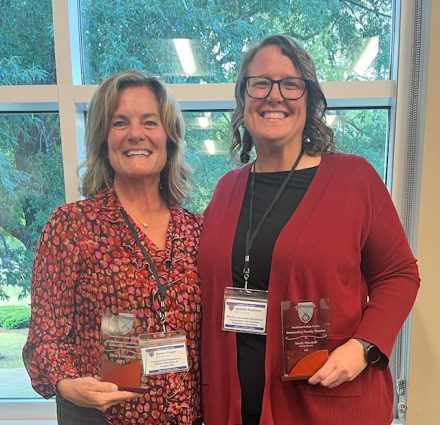
The university was selected as the inaugural recipient of the Institutional Excellence in Residential Education Award for its collaborative, relationship-rich approach, which RCS described as a deeply human model of education that centers belonging, well-being and intellectual engagement.
“At Elon, Living and Learning isn’t just a program; it is the Elon experience,” Nick Tippenhauer, RCS Executive Leadership Team member and assistant Dean for studies at Rockefeller College at Princeton University, said during the awards ceremony, referencing the nomination. “It is a defining commitment to engaged learning that weaves together every aspect of campus life.”
Accepting the award on behalf of the university were Eleanor Finger, assistant vice president for Student Life and dean of campus life, and Jennifer Stephens, director of Academic-Residential Partnerships, who also emphasized the uniqueness of Elon’s integrated model.
“What makes Elon’s model distinctive is that we are fully integrated,” Stephens said. “Rarely do you see an actual partnership between Academic Affairs and Student Life across the entire living and learning experience the way you do at Elon.”
Community building at the heart of residential life
Much of Elon’s national reputation in living and learning is rooted in the day-to-day work happening in its neighborhoods. Faculty-in-residence and community directors collaborate to foster spaces that help students grow personally, academically and socially.
One example of this approach is illustrated in the Global Neighborhood, led in part by Outstanding Faculty Member Award recipient Sandy Marshall, where traditions such as “Sundaes on Sundays” and “Mondays with the Marshalls,” as well as monthly film nights and neighborhood dialogue dinners, have become beloved opportunities for students and faculty to connect beyond the classroom.
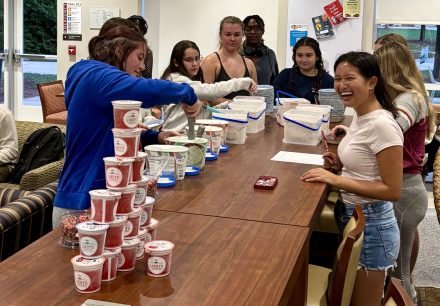
“Our Global Neighborhood team works with our amazing campus partners to create and sustain meaningful opportunities for students to connect with one another as well as faculty, staff, and community mentors,” Marshall said. “I love connecting with the students and seeing them make their own connections at these events.”
During the awards ceremony, Tippenhauer emphasized that Marshall’s programs are more than social events. “They are acts of community-building that make a large campus feel personal and connected,” he said.
Mariann King, community director for the Global Neighborhood, noted that the impact of these programs becomes clear as students grow over the academic year.
“When you think about where students are that first weekend and then see where they are by the time we host our Global Gala in the spring, you really get to see your students shine,” she said. “Those moments show just how much they learn from living on campus.”
Deepening connection, belonging and student success
The awards from the RCS reaffirm Elon’s long-standing commitment to exploring ways to deepen students’ connections and well-being.
“When faculty and staff invest in students as people, students feel like they have a place,” Finger said. “That sense of being cared for is what builds belonging.”
Stephens echoed this sentiment, stating, “The two biggest indicators of student success are student-to-faculty interaction and peer-to-peer interaction,” she said. “When those happen naturally in residential spaces, it strengthens both connection and well-being.”
Looking ahead, Elon will continue to evolve its integrated model. Finger emphasized that ongoing refinement and growth will drive the next phase of this work.
“We are excited to engage more faculty in this transformative work, and to think dynamically about new living and learning communities that spark curiosity and interest in our students,” she said.
Even as the model evolves, its core purpose will remain the same: bringing faculty, staff and students together outside the classroom to build community.