


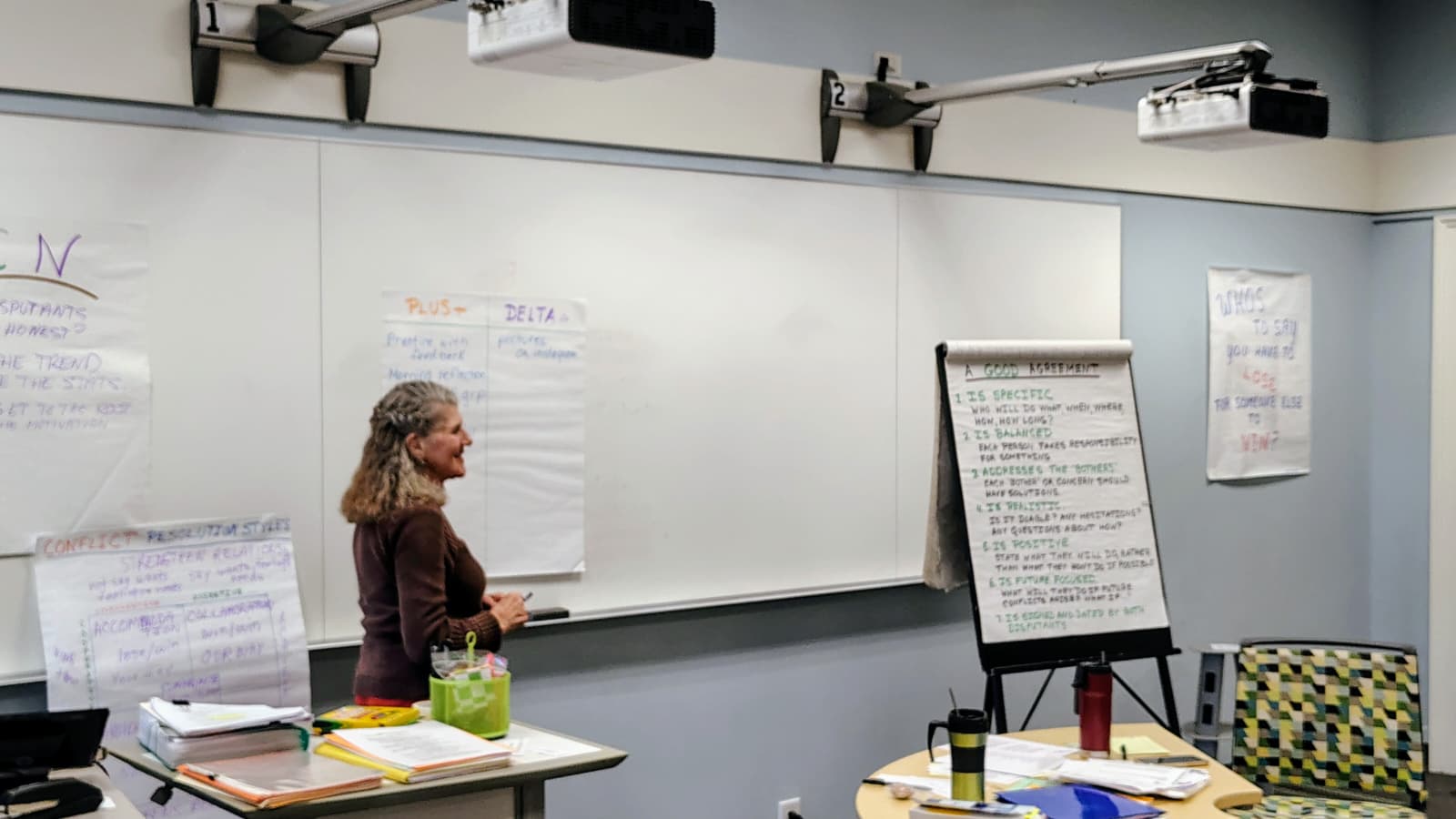
Funded by an Elon Innovates Grant and promoted by the Peace and Conflict Studies Program, the training teaches mediation as a peaceful conflict resolution method.
On Oct. 25, Elon students, faculty, staff and community members particpated in a two-day mediation training conducted by Linda Dunn, a certified mediator who has been part of Elon for almost 30 years.
Mediation is a peacemaking process that empowers disputants to solve their interpersonal conflicts. It is used largely in the US court system and in different organizations to de-escalate and resolve minor issues among employers/employees, students, neighbors, friends, and family members. For me, going through the training was an intensive learning experience that fundamentally relied on one fundamental human task: listening to the other.
Funded by an Elon Innovates Grant and promoted by the Peace and Conflict Studies Program, the training teaches mediation as a peaceful conflict resolution method. Dunn, three students, four professors, one staff and two community members constituted a very diverse, cohesive and energetic group that met for two full days and were introduced into the world of mediation and restorative justice. During the training, people were able to learn the mediation method by practicing it several times from different perspectives. After finishing, they can participate in real mediation cases (supervised by certified mediators) and eventually obtain the certification. At Elon, students can choose to go to mediation to resolve their own conflicts though this method.
“Meditation should be included in professional trainings when we enter a new working place because it fosters the consideration of other views, behaviors, actions, and reactions that affect not only the working environment, but also our own lives,” said Associate Professor of Spanish Mayte De Lama, who participated in the training.
The different racial and ethnic backgrounds, as well as the origins and trajectories of the people in the room enriched the group dynamic in which each of the participants played a role, whether as a disputant or as a mediator, incarnating the six stages of mediation.
Mediation is a process that includes: the introduction of mediators and disputants as well as the reading of ground rules for the conversation; the description of the conflict made by each of the discussant, carefully written by the mediators; the identification of the main concerns that still bother the people involved; a brainstorming process of potential solutions; the election of common solutions; and the writing of an agreement that states the steps to follow to recompose the situation. Although it looks simple at first, walking with other mediators in training through this process requires refined mediation skills to help others navigate their conflicts.
Clarifying the role of the mediator, Linda established from the beginning that they “do not judge, do not take sides, and do not give advice. Mediators help people to take responsibility for their actions and lead them through a collaborative brainstorming process that usually results in win/win solutions to both parties.”
According to Dunn, it is crucial to trust the people involved in the conflict to find their own way of resolving it, and when is possible and needed, repairing the damage produced.
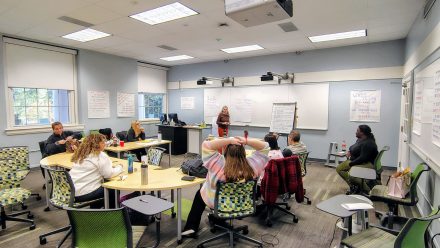
During the training, participants practiced different mediation cases followed by intense conversations and reflections, which also sprang moments of laughter and community building.
“I left having found a new community of amazing individuals, a new kind of understanding and connection to myself and others on a much deeper level than I ever anticipated, while learning to meditate. It was worth every second and I’m so grateful to have been a part of it,” said Gracie Bleiberg ’28.
The training was part of the Campus Mediation Program (CMP), which has run this training once a year over the last three years. CMP also offers mediation conflict resolution opportunities among students at Elon, where already trained students (supervised by Dunn) mediate among other students who have had an interpersonal conflict. Over 15 cases have been resolved successfully with this method.
Usually, students are trained in the course, “PCS1210 Intro to Conflict Mediation,” which prepares them to mediate cases at Elon. For instance, Michael Romano ’26, who took the class, helped facilitate the training.
“Working with Linda and learning about conflict mediation has allowed me to dramatically improve my conflict resolution skills while providing me the opportunity to help those in our community while doing so,” said Romano.
As other students have done in the past, Romano will be going to mediate cases in the Alamance County Court (overseen by Dunn) to achieve certification.
CMP has partnered with other organizations on campus to promote restorative justice practices at Elon. The fundamental goal of this program is to contribute to the creation of an ongoing culture of dialogue about conflict resolution on campus, not only to bring light to mediation as a possible path towards conflict resolution, but also as an ongoing effort to address difficult conversations at Elon.
“It gives me hope to spend time with other people who are also trying to find ways to help humans communicate better,” said Elizabeth Hambouger, a specialist in restorative justice from Durham who participated in the training.