


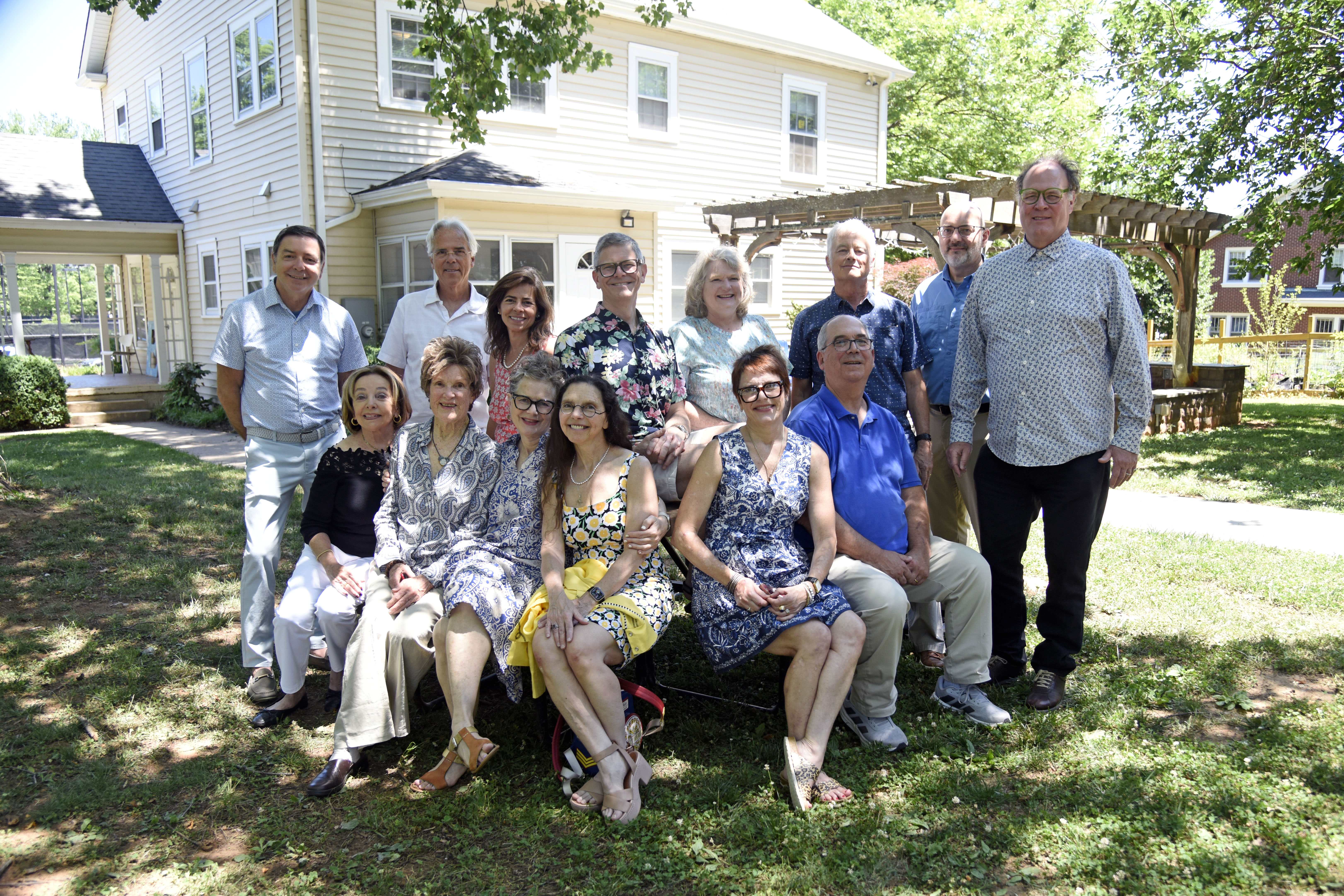
Members of a family with historic connections to the university made a visit to campus in June to celebrate what would have been the 100th birthday of a woman whose childhood home now serves as the Sklut Hillel Center.
For Edward Martin Hamlin, stepping through the front door of the Sklut Hillel Center felt a bit like stepping back in time.
The building now serves as a gathering place for Jewish students at Elon University. Decades earlier, it was the home where his recently departed mother, Mary Martin Hamlin, grew up and where countless family memories were made.
On June 4, 2026, members of the Martin family returned to campus to celebrate what would have been Mary Martin Hamlin’s 100th birthday. The gathering included all seven of her nieces and nephews and several of their spouses, along with Karen Martin Yost, 91, the last surviving Martin sister.
The family’s connection to Elon stretches back more than a century. Leo DeWitt and Annie Raper Martin, both members of Elon’s Class of 1919, returned to the campus community when Leo joined the faculty as a history professor.
Leo Martin, familiarly known as Dick Martin throughout the community, would later partner with fellow Elon professor Thomas E. Powell, Jr. to help launch Carolina Biological Supply Company, whose squid logo and early catalog illustrations were drawn by Annie.
During the Great Depression, Leo Martin designed and built a two-story home on the corner of North Antioch and East College Avenues where he and Annie raised daughters Mary, Joanne and Karen. That home remains standing today, though in a different form.
After being acquired by Elon University, the house served as the home of the Vera Richardson Truitt Center for Religious and Spiritual Life before becoming the Sklut Hillel Center in 2013.
As Hamlin toured the building, memories came flooding back from his visits in the 1960s and 70s. He recalled the smell of canned food once stored in a pantry that no longer exists, the coal kept in the basement to heat the house and the Chinese elms that once shaded the property.
“A lot of this is familiar to me, from the living room and den to the sunroom where my grandfather’s desk was,” he said. “As I walk around now, it’s just wonderful to feel the youthful energy of the students.”
Karen Martin Yost said she enjoyed seeing the architectural details that remain in the house, as well as in her memory and frequently in her dreams—features like the fireplace and mantle, the built-in bookcases, the seventeen steps to the upstairs, and the black and white tiles in her childhood bathroom.
The family’s visit was made possible through arrangements between Betsy Polk Joseph, Elon’s senior director of Jewish Life, and Hamlin, Mary Martin Hamlin’s only child.
Hamlin said he was struck not only by what remained of the home, but also by how it is being used today. To know that the building serves as a center for Jewish students and that Elon continues to create spaces that welcome people from a variety of backgrounds reflects values long embraced by his family, he said.
The June gathering included a celebratory lunch, a tour of the house, readings from memoirs written by Mary Martin Hamlin and Karen Martin Yost, and visits to places around campus that shaped Mary’s childhood.
The day concluded at Magnolia Cemetery, where family members gathered at the family plot to share memories of Mary Martin Hamlin, a proud native of Elon.