


Former North Carolina Democratic Gov. Roy Cooper has an 11% lead over Republican Michael Whatley among likely voters in the race for the open U.S. Senate seat being vacated by Republican Thom Tillis.
As North Carolina gears up for the 2026 midterm elections in November, a new Elon University Poll finds former Democratic Gov. Roy Cooper has an 11% lead over Republican Michael Whatley in the state’s U.S. Senate race. Among likely voters (those who said it is “absolutely certain” they will vote), Cooper was favored by 53%, with Whatley favored by 42%. Five percent were undecided or planned to vote for someone else.
Among all those who said they were registered to vote, Cooper is favored by 51% and Whatley is favored by 35%, with 11 percent saying they were undecided or planned to vote for someone else and 3% saying they do not plan to vote.
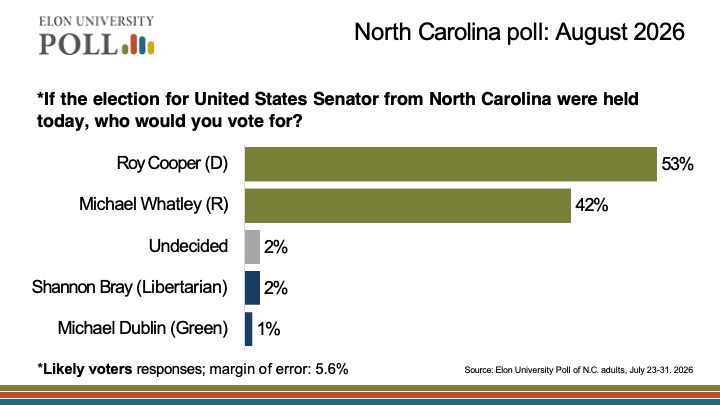 The survey of 800 North Carolina adults was conducted from July 23-31, 2026, and has a margin of error for likely voters of 5.6%. Ninety-eight percent of poll respondents said they are registered to vote in the state. This is the first Elon University Poll to ask voters who they plan to vote for in this year’s U.S. Senate race. A previous Elon poll in March 2026 found that Cooper had much stronger familiarity and favorability ratings, compared with Whatley, who has never run for office in the state.
In this new poll, 84% of registered voters said they had heard “a great deal” (55%) or “some” (29%) about Cooper, who was North Carolina governor from 2017 to 2025 and previously served 16 years as the state’s attorney general. In comparison, 53% said they had heard “a great deal” (17%) or “some” (36%) about Whatley, the former chair of the Republican National Committee and the North Carolina Republican Party. Twenty percent said they had heard nothing at all about Whatley compared with only 5% who had heard nothing at all about Cooper.
“The North Carolina U.S. Senate race has been shaped from the beginning as a contest between a very well-known Democrat and a relatively unknown Republican,” said Jason Husser, director of the Elon University Poll. “While Roy Cooper continues to be much more familiar to voters than Michael Whatley, Whatley’s familiarity among voters has increased meaningfully between March and July. Moreover, among the roughly half of voters who have heard a great deal or some about Whatley, the race becomes very close. This leads me to expect some tightening in polls over the next two months.
Fifty-three percent of registered voters expressed favorable views of Cooper, compared with 36% who had favorable opinions of Whatley.
Cooper is favored by 93% of Democrats. Whatley is preferred by 84% of Republicans. Independents split 49% for Cooper and 22% for Whatley. Third party candidates Shannon Bray (Libertarian) and Michael Dublin (Green) had 1% and 2% support overall, respectively.
Strong interest in the election
Sixty-three percent of registered voters said it is “absolutely certain” they will vote in November and another 20% said it is “very likely” they will cast a ballot.
Despite questions being raised about election integrity and potential foreign interference in U.S. elections, 63% of registered voters said they were “very confident” (27%) or “somewhat confident” (36%) that the election process overall will be fair. Twenty-nine percent said they had little or no confidence in there being a fair election process.
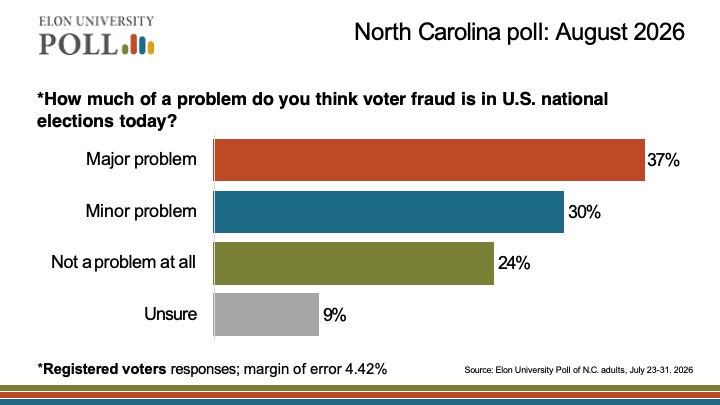
Asked how big of a problem voter fraud is in the United States, 37% of registered voters said it is a major problem, with 30% saying voter fraud is a minor problem. Twenty-four percent said it is not a problem at all and 9% said they are unsure.
Registered voters are split on the threat of foreign interference in U.S. elections, with 39% saying it is a major problem, 35% saying it is minor problem and 10% saying it is not a problem at all, with 17% unsure.
Asked specifically about the outcome of the 2020 presidential election, 55% said Joe Biden was the winner, while 33% maintained Donald Trump won that election and 12% were unsure.
“While a majority of North Carolina voters overall in our sample believe that Joe Biden won the 2020 presidential election, views of the election are highly polarized,” Husser said. “Nearly three-fourths of North Carolina voters who approved of President Trump expressed that Trump actually won the 2020 election.”
Approval ratings and the data center policy issue
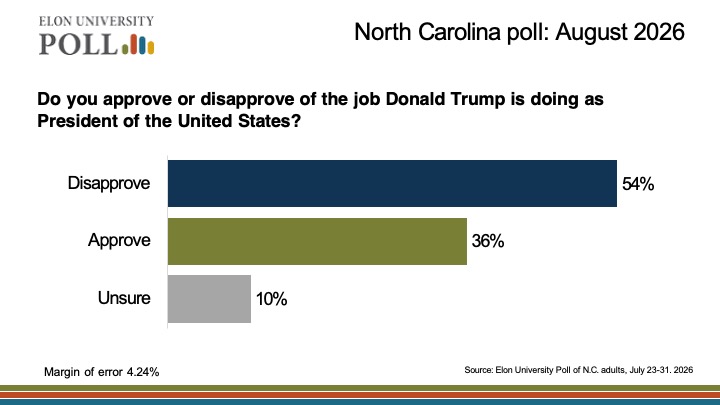 President Trump continues to have low approval ratings among North Carolinians, with 54% of poll respondents disapproving of the job he is doing as president and 36% approving – an 18% gap. Ten percent were unsure about the president’s job performance. In comparison, in the March 2026 Elon University Poll, Trump had a 55% disapproval rating and a 35% approval rating – a 20% gap.
North Carolina Governor Josh Stein has a 46% job approval rating in this poll, compared with a 43% approval rating last March.
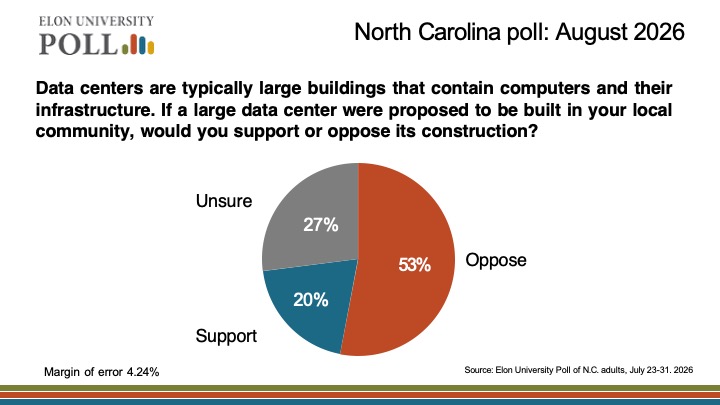
Opposition has grown against technology data centers in the state. Fifty-three percent said they oppose locating data centers in their communities and 20% support data centers, with 27% unsure. In the poll last March, 44% opposed data centers in their communities and 24% supported data centers, with 32% unsure.
“As local governments in North Carolina have grappled with land use regulations and economic development questions regarding data centers over the last five months, we found that data centers have become more unpopular across major political and demographic divides,” Husser said.
Poll Methodology
Access the poll topline and methodology at: www.elon.edu/elonpoll. The survey was developed by the Elon University Poll and fielded by the international marketing and polling firm YouGov as an online, web-based survey, self-administered through online panels. Between July 23 and July 31, 2026, YouGov interviewed 861 North Carolina adults aged 18 and older. These respondents were then matched down to a sample of 800 to produce the final dataset.
The matched cases were weighted to the sampling frame using propensity scores based on age, gender, race/ethnicity, years of education, and home ownership. The margin of error for registered voters in this survey (adjusted for weights) is +/-4.42%.
About the Elon University Poll
Established in 2000, the Elon University Poll conducts national and North Carolina surveys on issues of importance to voters and residents. Information from these polls is shared with media, citizens and public officials to facilitate informed public policymaking through the better understanding of residents’ opinions and attitudes. The poll is fully funded by Elon University and operates as the neutral, non-biased information resource.
The Elon University Poll is a charter member of the Transparency Initiative, a program created by the American Association for Public Opinion Research (AAPOR) in 2014 to educate polling firms on ways to better share how they collect and interpret their information. The Elon Poll’s voluntary participation in this initiative signifies a willingness to clearly state in its reports how questions were asked, in what order, who funded the poll and who conducted it, and a definition of the population under study, among other details.