


A new report by the Elon University Poll finds that political identities receiving the greatest public attention represent a smaller share of the electorate than the broader identities that unite many North Carolinians.
The loudest voices in American politics often come from the ideological left and right. But a new report from the Elon University Poll suggests those voices do not reflect how most North Carolinians describe themselves.
The 2026 North Carolina Political Landscape Report finds that the identities most widely embraced across the state are rooted in work, community, place and shared civic values—not political movements or ideological labels. By examining how North Carolinians identify themselves across 30 political, economic, cultural and lifestyle identities, the report paints a more nuanced portrait of the state’s electorate than traditional measures of party affiliation alone.
“Winning coalitions of voters are often built by group attachments beyond party labels alone,” said Jason Husser, director of the Elon University Poll and professor of political science and public policy. “Outcomes in North Carolina elections are driven not only by whether the state has more Democrats or more Republicans, but also whether politicians can move those who identify with groups like working class, progressives or Second Amendment advocates. We measured the scope of some of the largest politically relevant group identities in North Carolina to offer insight into why some ideas stick in the state and others struggle.”
The broad middle is larger than the ideological edges.
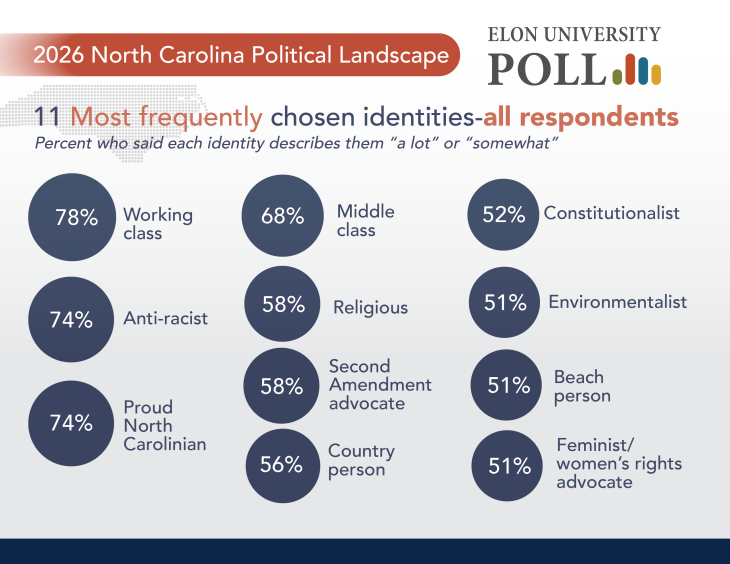
Across the state, the identities most commonly selected are remarkably broad. More than three-quarters of respondents identify as working class (77%), while nearly as many identify as anti-racist (74%) and proud North Carolinian (74%). Majorities also identify as middle class (68%), religious (58%), Second Amendment advocates (58%), country people (56%), Constitutionalists (52%), environmentalists (51%) and beach people (51%).
By comparison, identities associated with ideological movements or political brands are embraced by substantially fewer North Carolinians. Only about one-third identify with MAGA (34%) or democratic socialism (29%), while even fewer identify as libertarian (20%), politically homeless (26%), anti-establishment (32%) or prepper (19%).
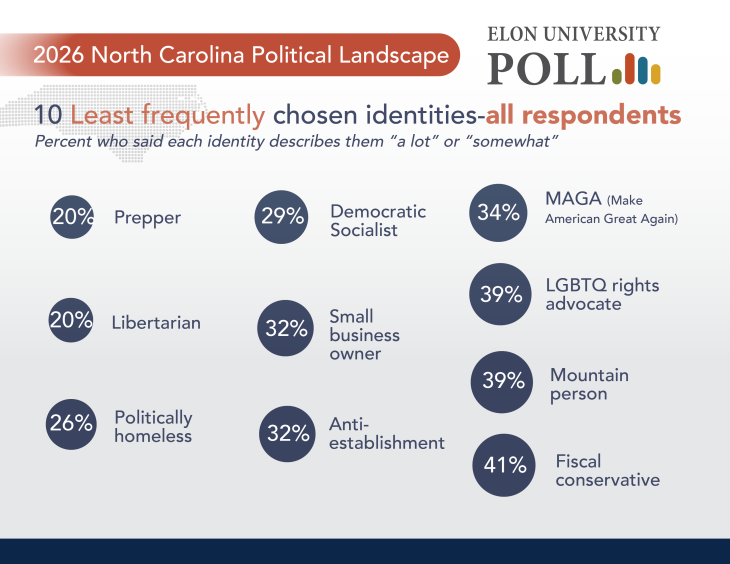
Taken together, the findings suggest that the political identities receiving the greatest public attention represent a smaller share of the electorate than the broader identities that unite many North Carolinians.
Republicans, Democrats and Independents have much in common
The report identifies substantial overlap among the state’s partisan groups.
Three of the top identities for Republicans, Democrats and Independents alike are working class, proud North Carolinian, and anti-racist. Middle-class identity also ranks among the most common across all three groups. These shared identities appear despite well-publicized partisan disagreements and suggest a broader common foundation than political discourse often reflects.
An anti-racist identity ranks among the ten most common choices for Republicans (66%), Independents (75%) and Democrats (80%). Likewise, large majorities across party lines identify as working class and as proud North Carolinians.
“It’s easy to fall into stereotypical thinking about Democrats and Republicans as monolithic and totally distinct from one another. However, we find enough overlap of group identities within North Carolina that suggest people with different political preferences often share many of the same ways of understanding themselves,” Husser said.
Similarly, the way voters in different parties describe themselves also offers potential for common ground. For example, while Democrats are much more likely to consider themselves “environmentalists” than Republicans (64% to 39%), the related label “conservationist” was chosen by 48% of Democrats and 54% of Republicans.
It’s easy to fall into stereotypical thinking about Democrats and Republicans as monolithic and totally distinct from one another.
– Professor Jason Husser, director of the Elon University Poll
The differences remain meaningful
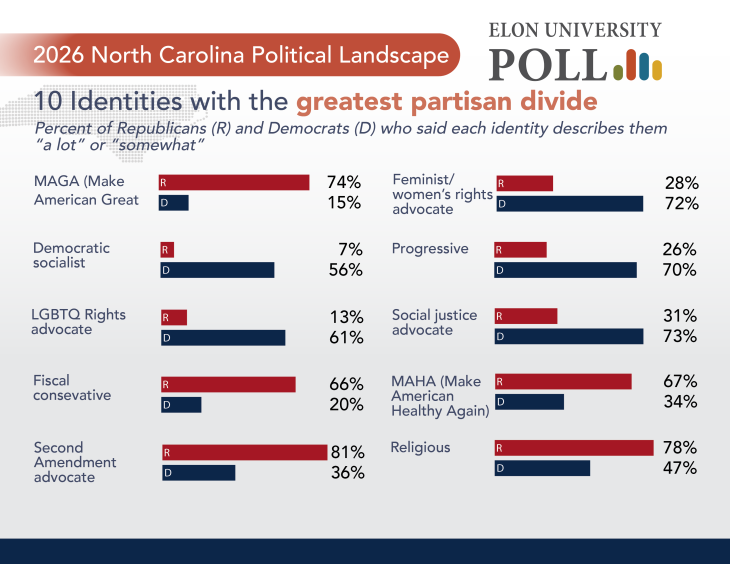
Where Republicans and Democrats diverge is in the identities associated with organized political movements and cultural priorities.
Republicans are substantially more likely to identify as Second Amendment advocates, religious, MAGA, Constitutionalists, country people, and MAHA supporters. Democrats are more likely to identify as progressives, social justice advocates, feminists, environmentalists, LGBTQ rights advocates, and democratic socialists.
Independents present a different profile. Their most common identities emphasize community and lifestyle rather than partisan ideology, including working class, anti-racist, proud North Carolinian, middle class, Second Amendment advocate, religious, environmentalist and conservationist. Unlike Republicans and Democrats, no overt political movement appears among Independents’ ten most common identities.
Views of government are similarly nuanced
The report finds that North Carolinians resist simple ideological categorization. While six in ten favor a larger government providing more services and 57% support providing more assistance to people in need even if it means higher taxes, only 17% say they trust the federal government to do what is right most or all of the time. At the same time, two-thirds believe the American economic system favors a select few rather than being generally fair.
The report is based on an online survey of 800 North Carolina adults created by the Elon University Poll and fielded by YouGov between July 23 and July 31, 2026. The survey has a margin of error of ±4.24%. The full report, topline results and methodology are available at elon.edu/elonpoll.
Poll Methodology
Access the poll topline and methodology at: www.elon.edu/elonpoll. The survey was developed by the Elon University Poll and fielded by the international marketing and polling firm YouGov as an online, web-based survey, self-administered through online panels. Between July 23 and July 31, 2026, YouGov interviewed 861 North Carolina adults aged 18 and older. These respondents were then matched down to a sample of 800 to produce the final dataset.
The matched cases were weighted to the sampling frame using propensity scores based on age, gender, race/ethnicity, years of education, and home ownership. The margin of error for registered voters in this survey (adjusted for weights) is +/-4.42%.
About the Elon University Poll
Established in 2000, the Elon University Poll conducts national and North Carolina surveys on issues of importance to voters and residents. Information from these polls is shared with media, citizens and public officials to facilitate informed public policymaking through the better understanding of citizens’ opinions and attitudes. The poll is fully funded by Elon University and operates as the neutral, non-biased information resource.
The Elon University Poll is a charter member of the Transparency Initiative, a program created by the American Association for Public Opinion Research (AAPOR) in 2014 to educate polling firms on ways to better share how they collect and interpret their information. The Elon Poll’s voluntary participation in this initiative signifies a willingness to clearly state in its reports how questions were asked, in what order, who funded the poll and who conducted it, and a definition of the population under study, among other details.