

How do we best harness data and technology to serve humanity?
We prepare students to lead in a digital age by grounding innovation in ethics, critical thinking and a commitment to the common good.
Technology is only as good as the people who shape it. Across our schools and programs, faculty are teaching students not just how to use emerging technologies, but how to question them, guide them and employ them in service of society.

Mustafa Akben, director of AI integration and assistant professor of management
Through the Data Nexus initiative, Elon’s Quality Enhancement Plan, academic programs are building intentional pathways for students to access, analyze, interpret and communicate complex data. Data Nexus acts as a coordinating hub, ensuring data literacy is embedded across the curriculum. Students gain experience with quantitative and qualitative data through over 60 data intensive designated courses, microcredentials, workshops and co-curricular experiences. Additionally, Data Nexus helps students think intentionally about their data-centric experiences while strengthening their ability to navigate a data-centric world.
As artificial intelligence transforms every sector of society, Assistant Professor of Management Mustafa Akben is leading Elon’s university-wide effort to ensure these technologies are approached with clarity, care and purpose. As the inaugural director of AI integration, he works with faculty and staff across all schools to redesign assignments, update learning outcomes and adopt AI tools responsibly, aligning with Elon’s core mission of preparing engaged, informed citizens ready to thrive in a rapidly changing digital landscape.
Our charge is to teach students, support faculty and empower staff to engage with these AI tools wisely, so they amplify human potential.
FACULTY PERSPECTIVE
Modeling Data for Human Impact
An applied mathematician, Hwayeon Ryu helps students understand how data and mathematical modeling can reveal the undiscovered dynamics of complex biological systems. Her research in cellular dynamics, systems biology and immune response modeling — using nonlinear differential equations and other quantitative methods — demonstrates how mathematical modeling can guide real-world decision-making in health and science. Whether delivering a keynote on mathematical biology, publishing research with undergraduate collaborators or mentoring student presenters at Elon’s Integrating Research in Science Conference, Ryu emphasizes clarity, ethics and curiosity in working with data to deepen our understanding of human impact and global challenges.
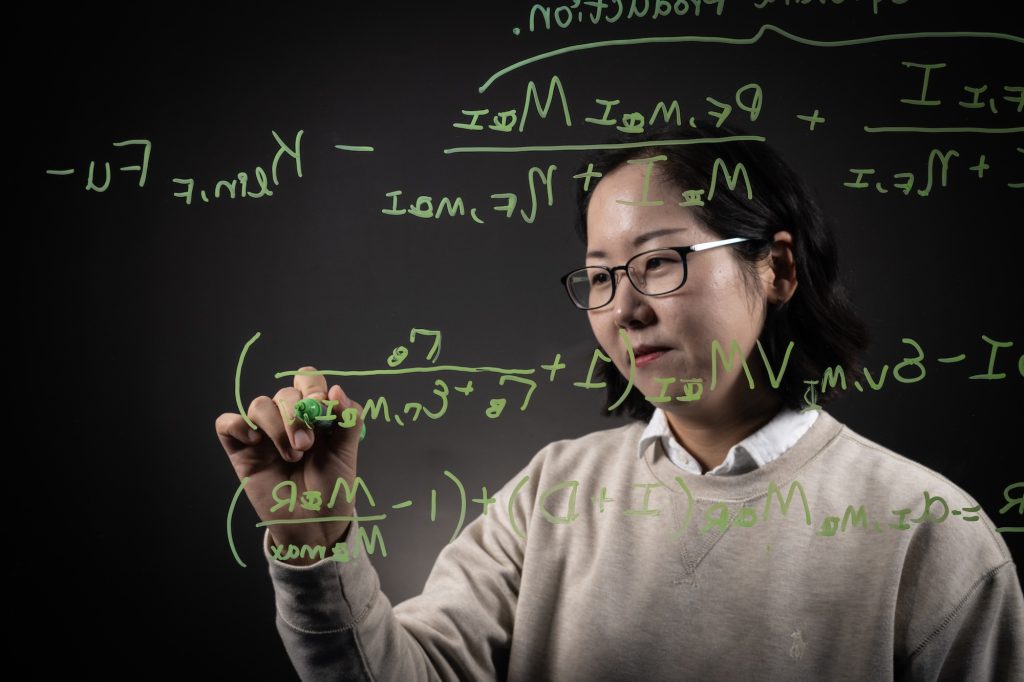
Hwayeon Ryu, associate professor of mathematics
Mathematical models don’t replace human judgment. They help us see the world more clearly.
ALUMNI IN ACTION
AI for the Common Good
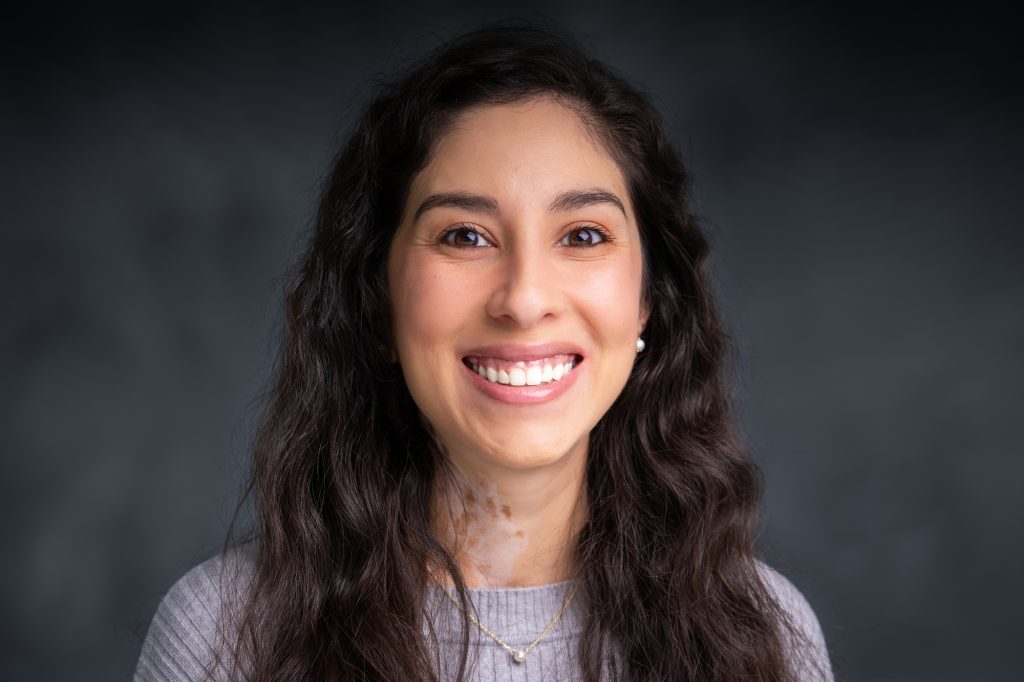
Ana Saravia ’14
As a research statistician at RTI International, Ana Saravia ’14 applies advanced statistical methods to projects that inform national policy and strengthen public well-being. She serves as assistant director of analysis and table production for the National Survey of Drug Use and Health, a leading source of behavioral health data, and contributes to the Occupational Information Network, which tracks workforce trends and job skills. “By integrating AI with statistical methods, we can identify patterns more efficiently and make stronger, more timely recommendations,” she says.
STUDENT SPOTLIGHT
Engineered for Good
Rony Dahdal ’26 uses mathematical models and machine learning to improve how doctors detect injury. His project for the Lumen Prize, Elon’s highest research honor, applies LiDAR technology to develop noninvasive scans that identify vital signs through clothing, offering a faster, safer alternative to traditional imaging. A Goldwater Scholar and triple major in computer science, mathematics and philosophy, Dahdal aims to create tools that serve others. “I see my research being applied to good humanitarian causes,” he says.
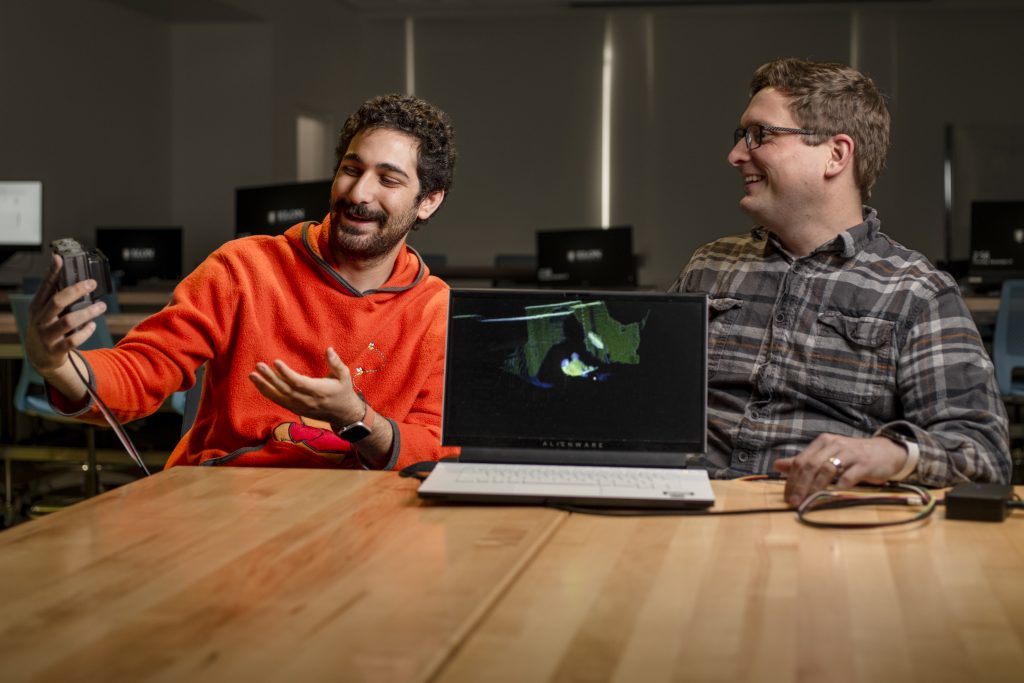
Rony Dahdal ’26 with his mentor Ryan Mattfeld, associate professor of computer science