Knight Commission on Intercollegiate Athletics public opinion survey


Changing the Game: A national public opinion survey
As NCAA Division I college athletics undergoes a historic transformation, a national survey of 1,500 U.S. adults reveals a divided and often uncertain public about the path forward, with significant splits on issues like compensation for college athletes, athletes’ potential status as employees, and who should govern the multi-billion-dollar enterprise. Yet despite these differences, Americans overwhelmingly support maintaining academic standards for college athletes, and they agree that colleges should provide equitable opportunities to female athletes and opportunities for athletes in sports other than those tied to generating revenue (like football and basketball).
These survey results suggest that, in a number of core areas, the American public continues to support a model of college athletics strongly linked to the education and development missions of colleges and universities. In other areas, there were a high number of “unsure” responses, unsurprising in a time of great change and uncertainty in college sports.
The survey by Elon University Poll and the Knight Commission on Intercollegiate Athletics was conducted July 7-11, 2025, a month after a landmark legal settlement that permits Division I athletics programs, for the first time, to share revenue with athletes and compensate them for the value of their names, images and likenesses (NIL). The $2.8 billion antitrust settlement, approved June 6 by U.S. District Court Judge Claudia Wilken, ended several class action lawsuits filed against the NCAA and the five prominent athletic conferences that generate the most revenues.
Survey details:
- Conducted July 7-11, 2025
- Results released in an August 6, 2025, news conference. Watch the video recording
- Survey design: Knight Commission on Intercollegiate Athletics and the Elon University Poll
- Fieldwork: YouGov; Mode: online, web-based survey
- Population: 1,500 U.S. adults ages 18 and older
- Margin of error: +/- 2.87%
Background
This new, post-settlement environment for Division I athletics programs raises legal and operational issues, including whether college athletes should be classified as employees and whether Division I athletics should be regulated by uniform, national standards or by the current patchwork of often conflicting state laws.
At the federal level, Division I athletics is drawing unprecedented attention in Congress and in the Trump administration. The proposed SCORE Act, which aims to codify that college athletes are not employees and to create federal standards on college athletes’ NIL deals, recently passed in two committees of the U.S. House of Representatives before its 2025 summer recess. Then on July 24, a day after the House recessed, President Donald Trump issued the “Saving College Sports” executive order, directing the development of new federal policies related to college sports. This survey was conducted prior to the issuance of that executive order and to the committee votes on the SCORE Act.
Survey findings
Report and charts | Executive summary | Topline with full survey data | News release
- Interest in sports
- College sports governance and coach credentials
- Athlete eligibility and the importance of academics
- Athlete relationships with their schools and compensation
- Women’s and collegiate Olympic sports
- Gambling on college sports
- Importance of college sports
Key findings
 |
Who should regulate the business of college sports? 35% NCAA |
 |
Impact of name, image, likeness (NIL) payments for athletes
31% Positive |
 |
Classifying athletes as university employees
Revenue sports: 36% No, 30% Yes |
 |
Negotiating with athletes on pay, rights and responsibilities
42% Support |
 |
Athletes’ ability to transfer between schools without penalty
38% Oppose |
 |
Importance of academics
81% Very or extremely important for athletes to be enrolled full-time and taking classes |
 |
Preferred funding sources for university payments to athletes for NIL & revenue sharing
71% Fundraising/private support |
 |
Collegiate Olympic sports
68% It is important for universities to offer sports other than those tied to generating revenues |
 |
Providing equitable opportunities for female athletes
39% Colleges and universities have not gone far enough |
Thoughts on the survey results
 “The results of this public opinion poll are a timely and invaluable resource to lawmakers and leaders in Division I athletics as they shape policies and legislation over the next several months. It is important to know that the public overwhelmingly supports keeping college sports connected to its academic mission, even with the historic shifts on other issues like college athlete compensation.” – Len Elmore, co-chair of the Knight Commission on Intercollegiate Athletics, former NBA player and television commentator
 “Americans show lots of uncertainty about the seismic shifts in Division I sports — but they are certain about two things — educational mission matters and athletic participation opportunities should not be limited to only revenue-producing sports. Prioritizing those goals has long been a cornerstone of the Knight Commission’s work, and it is encouraging to see a clear public sentiment on these issues.” – Amy Privette Perko, CEO, Knight Commission on Intercollegiate Athletics
 “It’s clear that many people are still trying to understand new rules on athletes’ compensation, transfers, conference realignments and other issues. Many people who don’t follow college sports closely are still learning about the new environment and forming their opinions based on what they read and hear about these issues. That’s why we see much more definite views among college sports fans and more uncertainty among casual observers.” – Jason Husser, director of the Elon University Poll and professor of political science and public policy
 “It is encouraging to see such broad public support for the importance of collegiate Olympic sports and the key role they play in achieving Team USA Olympic success. But acknowledging the importance of these sports is only half the battle – now is the time for both DI leaders and lawmakers to recognize the urgent need to continue investing in these sports at the collegiate level and to create new mechanisms to make sure that investment is robust.” – Beth Brooke, member of the Knight Commission
Overall reactions to the changes in Division I athletics
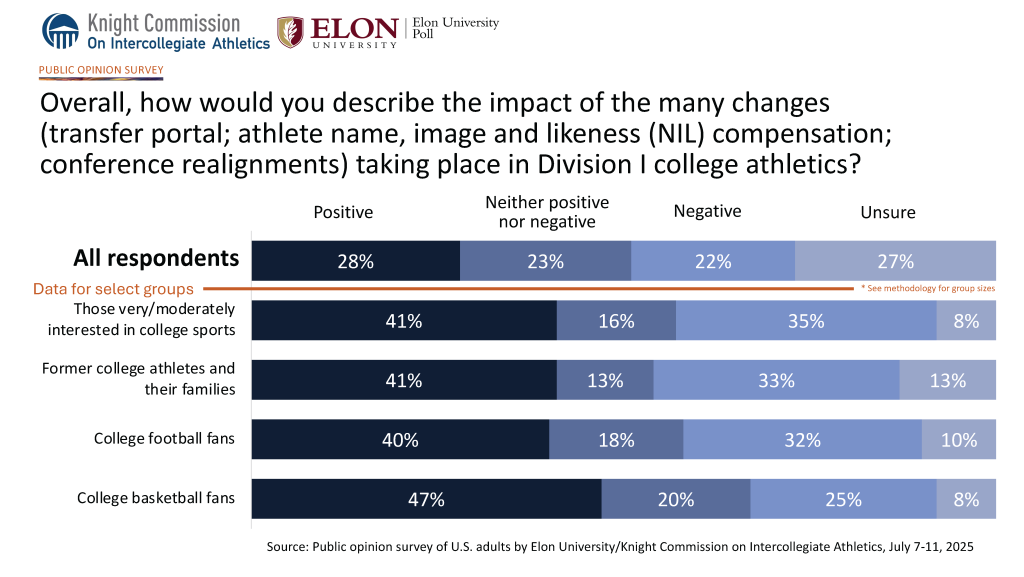
When asked about the collective impact of recent changes in Division I, including the transfer portal, name, image and likeness (NIL) compensation, and conference realignments; Americans were split in their assessment. Overall, 28% viewed these changes positively, while 23% saw them as negative, and 50% considered the impact neither positive nor negative or were unsure about the impact. Those who said they are very or moderately interested in college sports had much stronger opinions about the major changes taking place, with 41% saying the impacts are positive and 35% saying the impacts are negative.
(Text-only screen reader version of all charts in this report)