


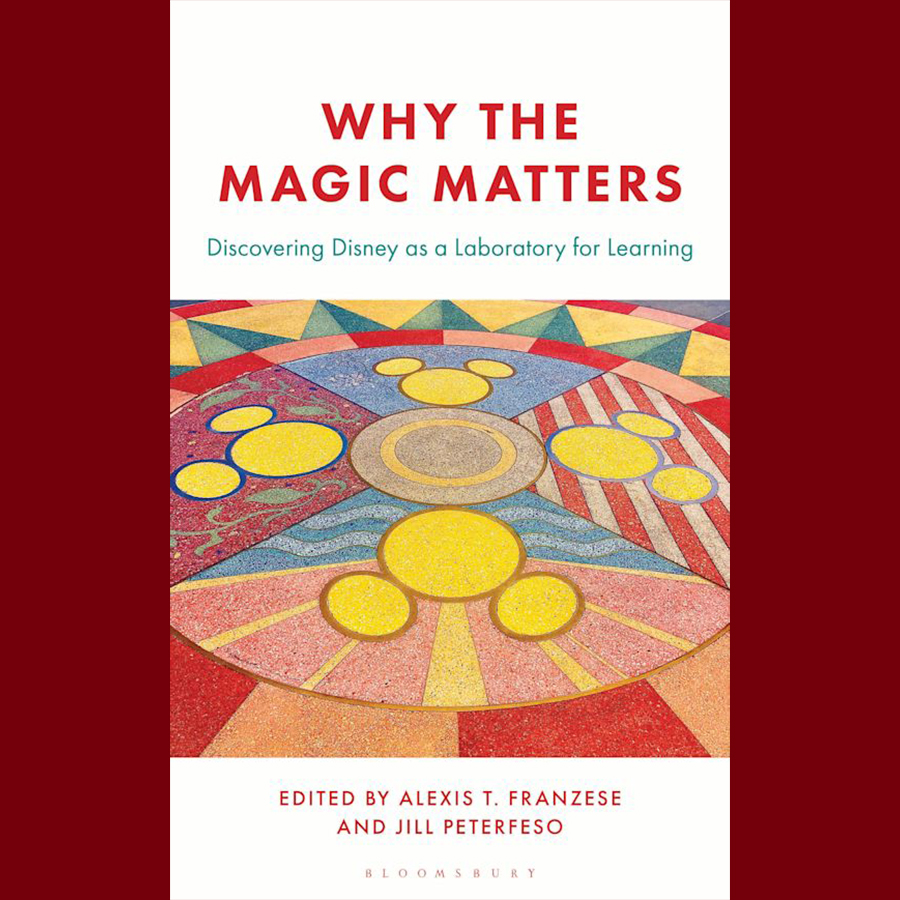
Alexis Franzese, chair of the Department of Sociology and Anthropology and professor of sociology, new book explores how the magic of Disney brings happiness and belonging to millions of people.
An Elon University professor recently co-edited a book that explores Disney’s role in shaping and reflecting culture.
“Why the Magic Matters: Discovering Disney as a Laboratory for Learning” was co-edited by Elon Professor Alexis Franzese and Guilford College’s Jill Peterfeso and published by Bloomsbury Publishing.
Across films, parks, streaming platforms and fandoms, the book asks how Disney expresses ideas about identity, belonging, morality, imagination, creativity and community, and how those ideas are reshaped through its stories, practices and power.
“The book is a love-and-critique project,” Franzese explained. “We honor the joy and meaning people find in Disney, while also examining questions of representation, labor, storytelling authority and corporate influence.”
Franzese explained their goal was to offer accessible, scholarship-backed insights for curious readers and classroom use.
In working on this volume, Franzese, a sociologist and psychologist who studies authenticity, identity and happiness, kept noticing how Disney functions as a shared language.
She explained, “Families bond in line for a ride, friends swap movie quotes, and adults return to stories that helped them make sense of the world.
“My students brought that into class discussions when debating representation in films, the ethics of appealing to sentimentality, the costs to have these experiences, and the ‘why’ behind park pilgrimages. My co-editor and I wanted a book that could meet people where they are — enchanted, skeptical or both — and use Disney as a laboratory for learning about ourselves and our culture.”
Franzese and Peterfeso designed the book with students in mind and she is using the text in both her Winter Term 2026 course Happiest Place: The Science of Happiness at Disney and the pre-departure course this fall, both courses co-instructed with her departmental colleague Rena Zito, associate professor of sociology in the 2025-26 academic year.
The book includes short, conversation-ready essays, written to work in undergraduate classrooms but also for general readers. It is designed to spark discussions across disciplines, from sociology and cultural studies to art, film, television history and business ethics.
In shaping the book, Franzese drew from her background in psychology, and specifically clinical psychology. Inspired by dialectics she first encountered in clinical training, Franzese identified four dialectical pairings that serve as “lenses” for understanding Disney: Magic and Strategy; Authenticity and Simulation; Nostalgia and Innovation; and Leisure and Labor. The book is framed around those pairings.
Franzese noted that the book is truly something she always wanted for her class, and she and Peterfeso were fortunate to have so many phenomenal contributors who made it possible. Franzese and Peterfeso both wanted a book that could meet people where they are — enchanted, skeptical, or both — and use Disney as a laboratory for learning about ourselves and our culture.
Franzese explained, one takeaway for me is how much Disney underscores the power of magic in learning. We don’t just learn through facts, we learn through feelings and feelings move us to think, act and care. Disney figured that out a long time ago.
“For educators, the challenge and opportunity is to bring some of that sense of wonder into our teaching —not to sugarcoat, but to help students engage deeply, even with the hard topics, in ways that inspire both understanding and action.”
A copy of “Why the Magic Matters: Discovering Disney as a Laboratory for Learning” is available in the Carol Grotnes Belk Library.
Franzese joined Elon in 2011 and serves as chair of the Department of Sociology and Anthropology. Her scholarly areas of expertise include medical sociology and social psychology, with a focus on authenticity and wellness.