


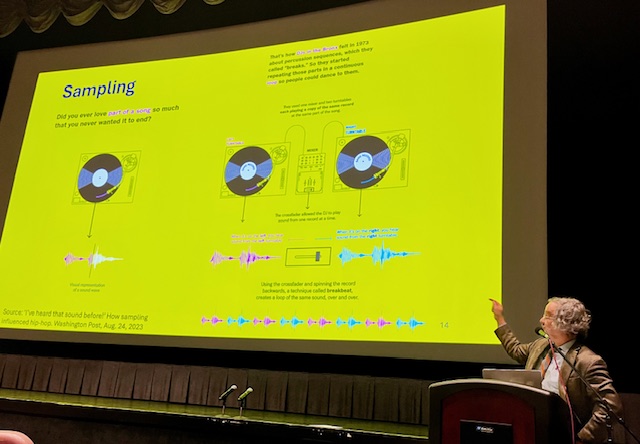
Professor of Law Enrique Armijo presented a lecture last fall on copyright law and musical sampling for the University of North Carolina School of the Arts' "Symposium" series.
Equipped with a library of music clips, Professor of Law Enrique Armijo brought the complexity of copyright law in the digital age to life during a presentation last fall for the University of North Carolina School of the Arts.
The talk focused on De La Soul’s landmark 1989 album, “Three Feet High and Rising,” a creative achievement built on dozens of samples that later became trapped in decades of legal limbo. Because the album’s sample clearances were negotiated for physical formats (and sometimes not at all), the transition to digital streaming brought new licensing hurdles, effectively keeping one of hip-hop’s most influential works unavailable to new audiences for years.
Armijo delivered the presentation for the UNCSA School of Filmmaking’s “Symposium” series, which brings guest artists and scholars to campus to explore creativity and its broader cultural impact. Graduate research assistant Kaytlyn Mullins L’25 played a key role in the presentation, curating the music clips, visuals and examples that illustrated Armijo’s lecture.
Using De La Soul’s experience as a throughline, Armijo examined how sampling fits uneasily within a copyright system designed around ownership by artists, record labels and publishers, and lengthy terms of protection. He illustrated those tensions with clips and references to artists including Lou Reed, A Tribe Called Quest, The Turtles, George Harrison, Madonna, N.W.A., Funkadelic, Taylor Swift, Biz Markie and Gilbert O’Sullivan.
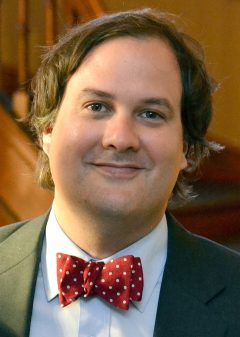
At Elon Law, Armijo’s scholarship and teaching cover broad areas of the law, including the First Amendment, constitutional law, torts, administrative law, media and internet law, online disinformation, and international freedom of expression. He is also a Fellow at the Yale Law School Information Society Project and the UNC-Chapel Hill Center for Information, Technology and Public Life, and a Faculty Fellow with the George Washington University Institute for Data, Democracy, and Politics.