


Mathematicians and astronomers have been working on this problem for centuries
Is the solar system stable? The planets follow generally predictable orbits around the sun, but small gravitational effects from other planets, moons and objects in the solar system subtly affect their motion. Alejandro Cárdenas-Avendaño, assistant professor of physics at Wake Forest University, studies these affects to determine whether the solar system will remain stable over long periods of time.
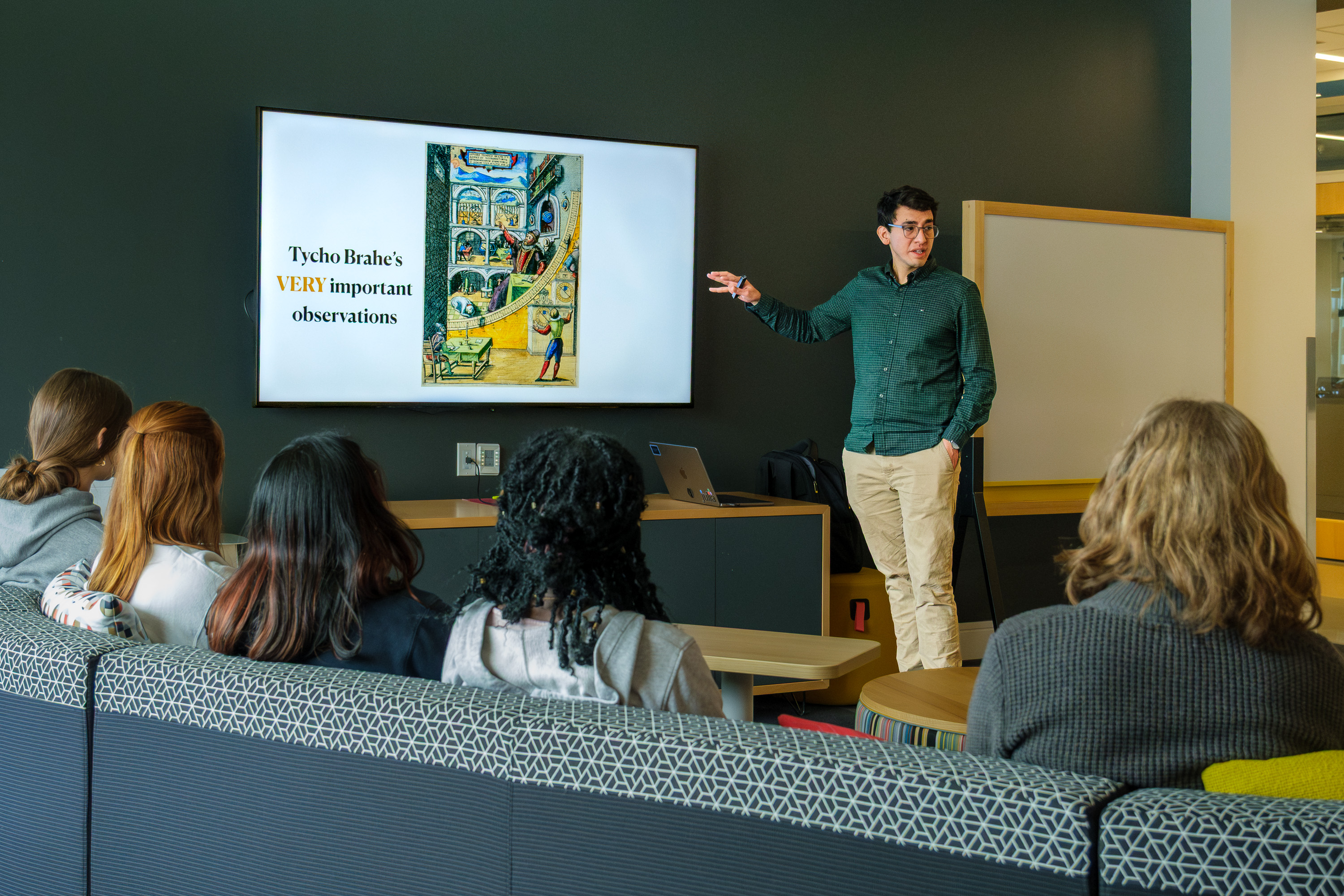
In a recent talk at the Physics and Astro Tea, Cárdenas-Avendaño shared the historical development of this problem, starting with Isaac Newton’s deterministic laws of motion and moving through the n-body problem, a generalized question about the long-term motions of gravitationally attracted objects. This problem famously has no analytical solution and must be done computationally.
So is the solar system stable? Will any planets suddenly be ejected? The best current answer is maybe, but not during our lifetime.
Hosted weekly by the Department of Physics and Astronomy, Physics & Astro Tea promises engaging discussions, thought-provoking ideas and a delightful spread of refreshments. Open to all students, faculty and staff, this gathering is the perfect opportunity to connect with fellow physics aficionados in a relaxed and informal setting. Meetings take place in the third-floor lounge of Innovation Hall at 3:20 p.m. on Wednesdays.