


Professor Prosanta Chakrabarty, the Edwin K. Hunter Chair for Communication of Science Research at Louisiana State University, shared wisdom with the university's newest members of the nation’s oldest academic honor society when he delivered the keynote address at an April induction ceremony.
“What’s so brave about being sick?”
It’s a question Prosanta Chakrabarty often asked himself in the early days of his ongoing fight against cancer. It wasn’t until initial treatment proved futile that Chakrabarty, who delivered keynote remarks on April 17, 2026, at a Phi Beta Kappa induction ceremony for dozens of top Elon students, better understood the praise.
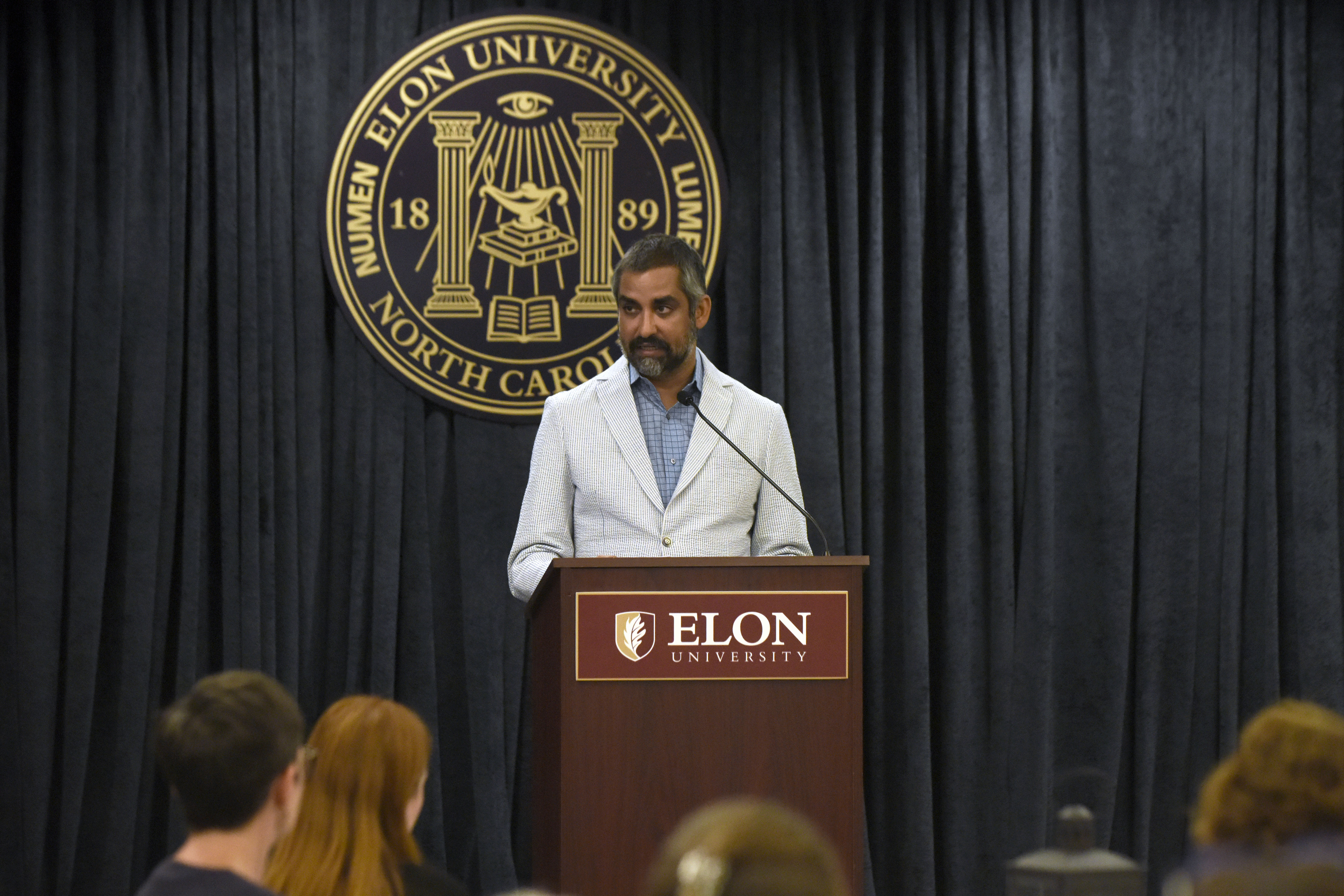
Bravery, simply put, can also be persistence. “When people tell someone battling an illness that they are brave, it’s because they’re continuing to fight – despite the odds, and despite the pain and suffering,” Chakrabarty said.
Drawing on lessons from his career, Chakrabarty emphasized for his audience in the Lakeside Meeting Rooms that both professional and personal success is often shaped by more than intellect. Habits, perspective, relationships – and, yes, courage – can lead to a wondrous and fulfilling life. He offered five strategies for students to consider:
- Act with efficiency: Address small tasks immediately to avoid unnecessary stress.
- Remain open to place and possibility: Career paths are often unpredictable and shaped by unexpected opportunities.
- Prioritize energy over time: Success depends less on hours available and more on how energy is directed.
- Redefine wealth and contentment: Financial pursuit alone does not lead to fulfillment.
- Invest in relationships: Simple gestures can strengthen meaningful connections.
Chakrabarty concluded his remarks with a charge for inductees to use their knowledge and their courage to improve the human condition.
“Find a way to be brave, fight evil, and injustice, and fight your own demons, whether they be cancer or mental health struggles,” he said. “Stand up for nature or for a cause, or for anything that you care about. Stand up for those who can’t. Stand up for yourself, and remember, not only to be smart, but to be also brave.”
Chakrabarty is the E.K. Hunter Chair for Communication in Science Research, professor and curator of fishes at the Museum of Natural Science and Department of Biological Sciences at Louisiana State University. He studies the natural history of fishes to better understand Earth history and evolution and has traveled to more than 30 countries to conduct that research.
Chakrabarty is an elected fellow of the American Association for the Advancement of Science, a national fellow of the Explorers Club, a fellow of the Linnean Society and a TED senior fellow. He is past president of the American Society of Ichthyologists and Herpetologists and is on the Board of Directors of the National Center for Science Education and the American Institute of Biological Sciences.
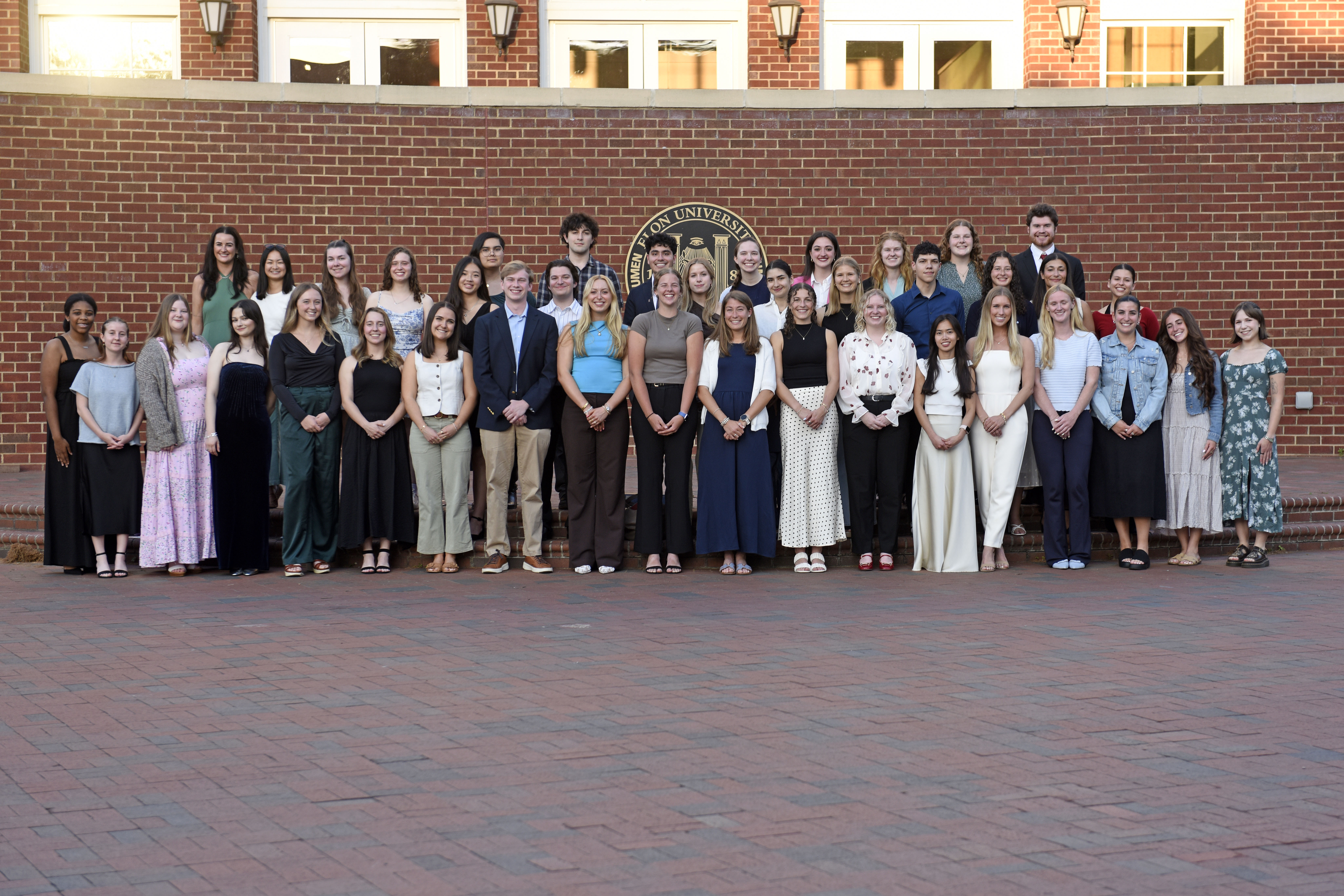
Sixty Elon University students were candidates for induction, and many attended the program accompanied by family members.
Phi Beta Kappa has established chapters at nearly 300 colleges and universities in the United States, representing only 10% of the nation’s institutions of higher learning. Each year, the top 10% of arts and sciences graduates at these institutions are selected for membership. Elon’s Eta Chapter of North Carolina was installed on April 13, 2010.
Inductees also heard from Associate Professor Anthony Rizzuto, president of Elon’s Eta Chapter of Phi Beta Kappa; Associate Librarian Shannon Tennant, the Eta Chapter’s historian, who shared the history, origins and traditions of Phi Beta Kappa; and Hilton Kelly, dean of Elon College, the College of Arts and Sciences and a professor of sociology.
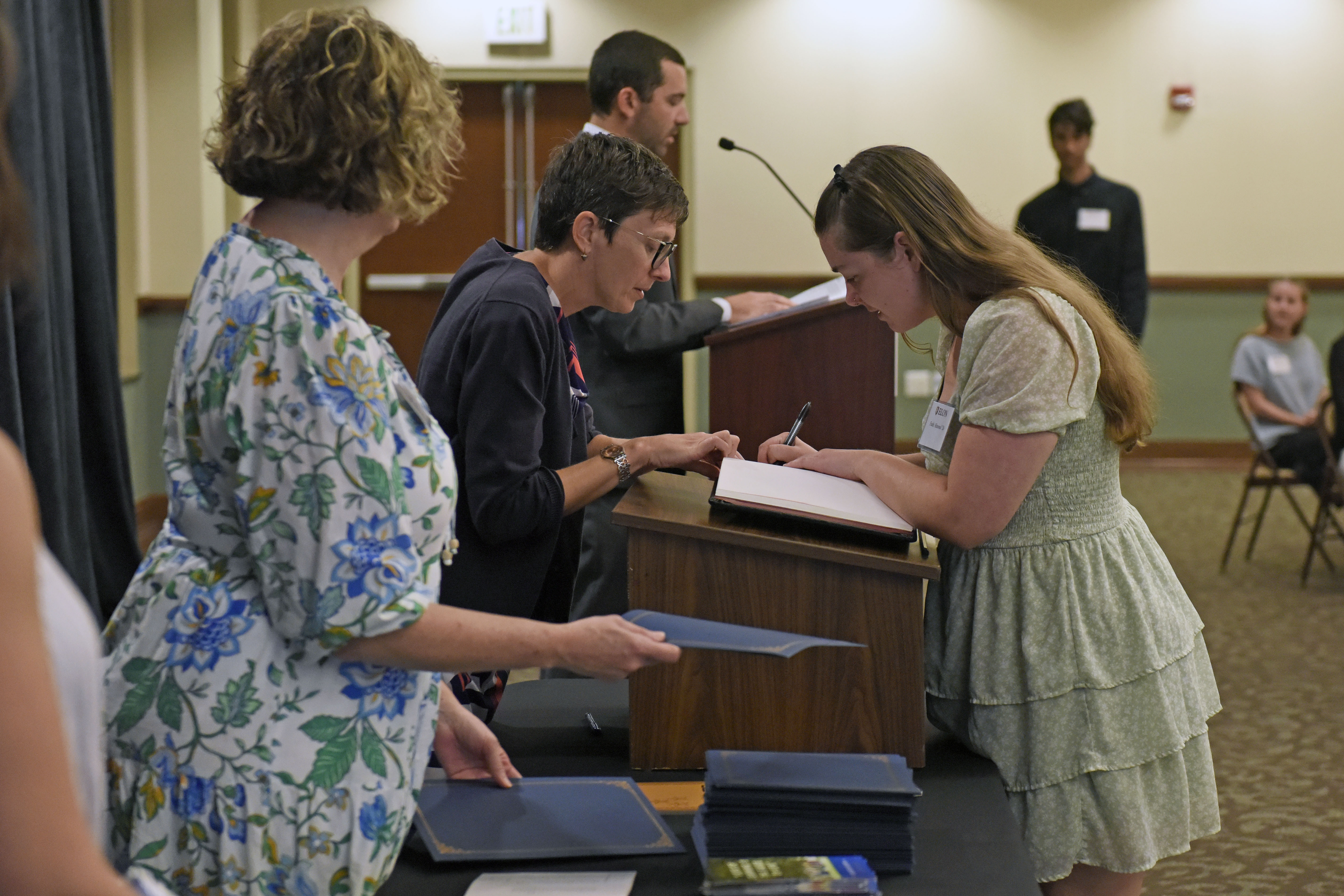
“Tonight is a celebration of excellence, a recognition of your remarkable achievements, and a testament to your dedication to academic pursuits,” Rizzuto said. “This induction is not merely a reflection of your intellect, but also your unwavering commitment to the pursuit of knowledge, truth, and understanding.
“Phi Beta Kappa is not merely a recognition of past achievements, it is a charge to continue striving for excellence, to embrace intellectual curiosity, and to use your knowledge for the better manner of society. Indeed, as members of Phi Beta Kappa, you are not only scholars but also stewards of knowledge entrusted with the responsibility to shape the future. In a world filled with complex challenges, your intellect, dedication, and perhaps, most importantly, creativity will be indispensable.”
Indeed, as members of Phi Beta Kappa, you are not only scholars but also stewards of knowledge entrusted with the responsibility to shape the future.
– Associate Professor Anthony Rizzuto
Kelly’s closing remarks underscored Rizzuto’s points.
“Your induction affirms not only your academic achievements, but also your commitment to engaging in the breadth and depth of learning that can transform worlds, asking hard questions, engaging diverse perspectives, pursuing truth, or multiple truths, and applying what you learn to real world problems,” he said. “In laboratories, in libraries, studios, and stages, classrooms, and communities, you have demonstrated what it means to think critically and to engage deeply in the liberal arts and sciences.
“It is your responsibility to continue embracing complexity through problem posing, and problem solving, to remain lifelong, disciplinary, and interdisciplinary learners, and to use your education not only for personal success, but for the common good.”
2026 Inductees into the Eta Chapter of the Phi Beta Kappa Society
Leah Alberga ’26
Psychology
Ella Allen ’26
Mathematics
Faith Almond ’26
English
Nicolas Alvarez ’27
Engineering and Mathematics
Lauren Bedell ’26
Political Science and Policy Studies
Kiersten Bergman ’26
Strategic Communications
Jo Bogart ’26
English and Classical Studies
Mary Boyd ’26
English
Anya Bratic ’26
International & Global Studies and Public Policy
Rebecca Bravman ’26
Psychology
Julia Bromfeld ’26
Human Service Studies
Nick Brown ’26
Psychology
Emma Call ’26
Exercise Science
Conter Cornwell ’26
Biochemistry
Margaret Crawford ’26
Human Service Studies
Maggie Dion ’26
Engineering
Maya Duarte Cherry ’26
Political Science and Philosophy
Emily Ecker ’26
Public Health Studies and International & Global Studies
Katherine Evans ’26
Biology
Reese Garrity ’26
Biochemistry
Nicole Genzink ’26
Biology
Jinelle Gonzalez ’27
International & Global Studies and Policy Studies
Izzy Greenstein ’26
Human Service Studies and Spanish
Olivia Guarino ’26
Psychology
Marykate Hart ’26
Environmental & Sustainability Studies
Ava Hellner ’26
Psychology
Diego Hernandez ’26
Engineering
Madeline Hewgley ’26
Music Theatre and Political Science
Fiona Hodge ’26
Psychology
Katie Hull ’26
Political Science and International & Global Studies
Brady Jackson ’26
Policy Studies and Political Science
Haley Johnson ’26
Psychology
Emma Kenney ’26
Environmental and Ecological Science
Ella Kinman ’26
English and Political Science
Maddie Kippe ’26
Exercise Science
Sam Kupka ’26
International & Global Studies and Religious Studies
Tori Layton ’26
History and German Studies
Murilo Lopes ’27
Computer Science
Annika Lotsch’26
Psychology
Abigail Manning ’26
Environmental and Ecological Science
Archie Meskhidze ’26
Philosophy and International & Global Studies
Gavin Michaud ’26
Psychology and Sociology
Molly Moylan ’26
Biochemistry
Pagnapech Ngoun ’26
Engineering
Anna Orlando ’26
Psychology
Allyson Parent ’26
Psychology
Mackenzie Perry ’26
Political Science
Braetan Peters ’26
Biology
Erin Pitman ’26
Biochemistry
Ruby Radis ’26
Human Service Studies
Caroline Reich ’26
Exercise Science
Zoe Richardson ’26
International & Global Studies and Philosophy
Matthew Rostan ’26
Political Science and History
Kailey Stark ’26
Public Health Studies and Psychology
Fayrah Stylianopoulos ’26
Psychology
Rahv Tupac-Yupanqui ’26
Engineering and Physics
Noelle Vaught ’26
History
Athena Vizuete ’26
History
Mia Webdell ’26
Biochemistry
Lawson Wheeler ’26
Exercise Science