


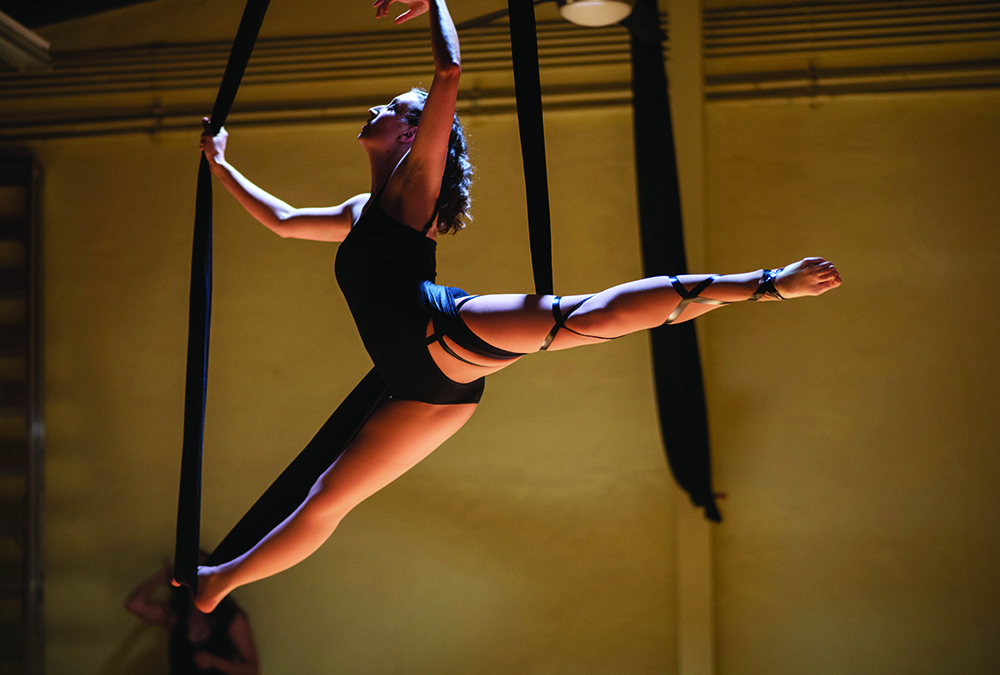
Mathematics and statistics faculty member Nancy Scherich explains complex mathematical theories through dance.
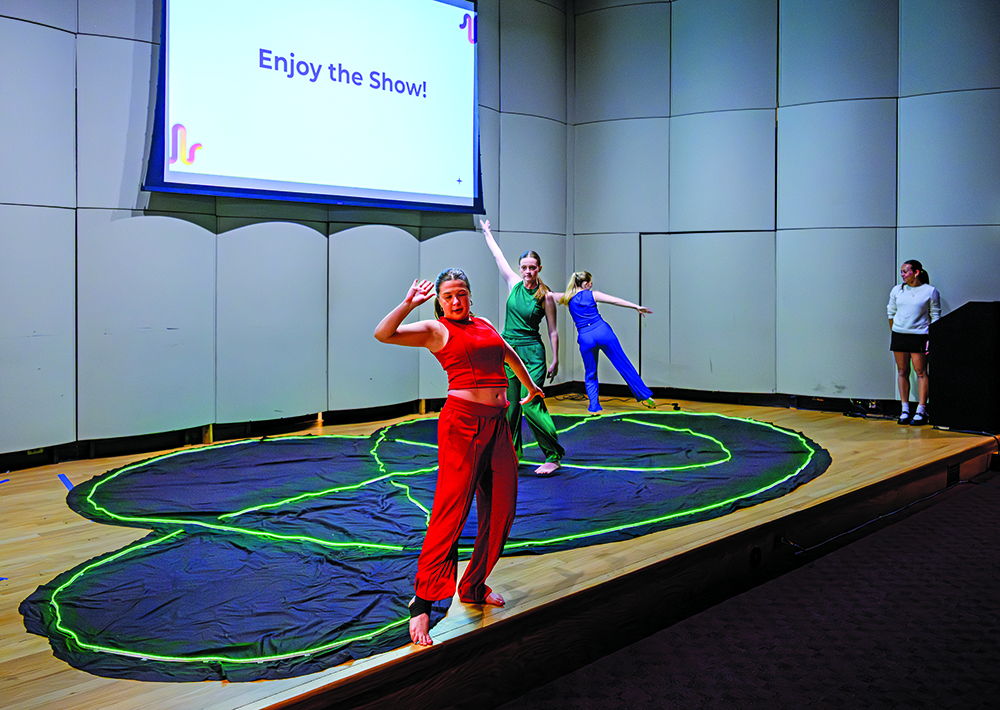
Music pulsates as the dancers’ bodies twist and flow through space, moving rhythmically in expertly choreographed sequences that mimic the intricate patterns of light that zip across the floor below them. It’s an engaging and visually dynamic performance on its own, but Nancy Scherich brings another lens to her work not often found in dance — the artful communication of abstract mathematical ideas.
“The research I do has nothing to do with dance,” says Scherich, the A.L. Hook Emerging Professor in Science and Mathematics and assistant professor of mathematics and statistics at Elon. “Dance is just the mechanism in which I communicate my research.”
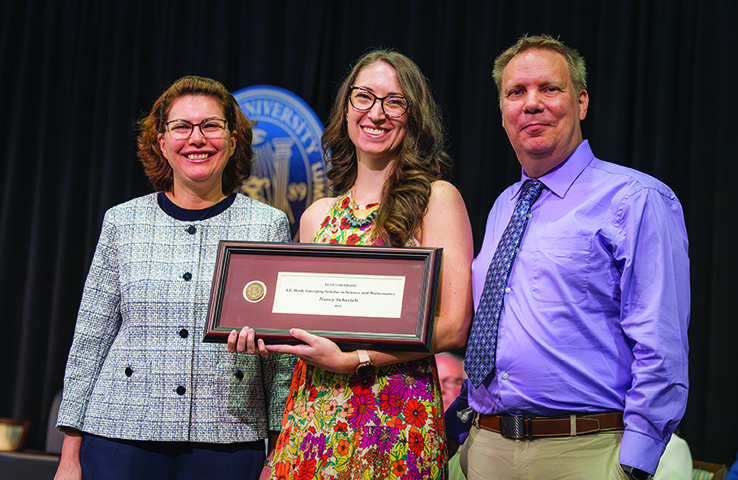
Scherich’s research focuses on topology, a branch of mathematics that studies flexible geometric shapes that remain preserved through deformation such as twisting, stretching or bending without opening holes, tearing or passing through themselves. More specifically, her research centers on knot theory, a field examining mathematical knots and braids.
Advanced mathematics requires years of foundational knowledge and technical language that can be difficult to explain to those outside the discipline. This challenge prompted Scherich to think creatively about how to share her work with broader audiences in an accessible way.
“Mathematics can be very abstract and uses a lot of specific jargon language,” Scherich says. “It can be difficult to tell somebody about your work, because first you have to define years’ worth of math before you can even get started. I was looking for ways to explain what math is in a way where you do not necessarily understand the technicalities, but you can get a flavor for what we are studying.”
Dance allows her to bypass that barrier, not by simplifying math but by translating it into a story with motion and emotion.
“Dance is a really effective way to emotionally story-tell,” she says. “I don’t really think in terms of dialogue. I think in terms of movement.”
Scherich’s work intentionally challenges stereotypes surrounding mathematics. Many of her videos feature female dancers and traditionally feminine aesthetics, in contrast to what has historically been a male-dominated field.
“When you think of a ballet dancer, you think of a woman,” Scherich says. “When you think of a mathematician, you probably don’t.”
The intersection of dance and mathematics flows into her work with students. She collaborated with Sol Addison ’25 and Lila Snodgrass ’26 on research examining how dancers move across a stage over time to define a new knot invariant called the danceability index.
In the classroom, Scherich uses videos of her dances as part of a larger narrative. She might begin a lecture by introducing different branches of mathematics such as algebra, geometry and topology through movement, giving students a conceptual framework before diving into formal definitions. One of her recent pieces uses pole dancing to explain Alexander’s theorem, a foundational result in knot theory. The videos do not replace traditional instruction but provide students with another way to grasp complex ideas.
Scherich’s path to mathematics was far from linear. Growing up in California, she left high school early to pursue performance opportunities and began college at 14, initially planning a future in performing arts. Encouraged by her father, a high school math teacher, she also enrolled in math courses as a backup plan.
I was looking for ways to explain what math is in a way where you do not necessarily understand the technicalities, but you can get a flavor for what we are studying. — Nancy Scherich
She changed majors several times — performance, French, biochemistry, chemistry — before mathematics finally stuck. The turning point came during a calculus class when she learned how to calculate the volume of a three-dimensional shape created by rotating a two-dimensional object.
“I was like, ‘I think I just became a mathematician; this is so cool. I’m in,’” Scherich says.
For years, Scherich kept dance and math separate. That changed during graduate school at the University of California, Santa Barbara when she learned about Science magazine’s “Dance Your Ph.D.” competition. Encouraged by a friend, she spent an entire summer creating a dance video inspired by her dissertation research. The project went on to win the competition.
“I feel like the video I created is probably my life’s masterpiece,” Scherich says. “So much love and passion went into that dance video. Since then, every time I am doing research or learn a new piece of mathematics, or I’m having trouble explaining math to someone, I think ‘Can I make a dance about this?’”
While the approach is unconventional, Scherich says the response from the mathematics community has been overwhelmingly positive.
“People will come up to me at conferences and say, ‘You’re the math and dance girl, right?’” Scherich says. “They appreciate that it’s making math accessible and fun.”
The 2025-26 academic year also marked major milestones in Scherich’s career. She was named the A.L Hook Emerging Professor in Science and Mathematics and received a $125,000 grant from the National Science Foundation to support her research and community building within Elon’s Department of Mathematics and Statistics.
Through her work, Scherich continues to demonstrate that mathematics is not limited to formulas and symbols on a page. By combining movement, storytelling and research, she offers students and audiences a new way to see mathematics — as dynamic, creative and deeply human.