



An alumnus from the first cohort of Elon’s game design minor returned to campus to share his experiences in VFX and technical art, offering industry perspectives and career advice to current Elon students.
Luke Kimball ’21, an alumnus of Elon’s game design minor, returned to campus on Sept. 11 to share his experiences working in visual effects (VFX) and technical art in the games industry.
Kimball was part of the first cohort of students to pursue the game design minor at Elon. During his time at Elon, he developed an interest in the technical and artistic sides of game development. Following graduation, he worked in the games industry in VFX and continued to expand his expertise and interest in technical art. He currently works with Let’s Make FX, contributing to VFX and technical art.
His return to Elon brought his professional journey back to where part of it began. Kimball spoke to students in GAM 2100: Game Design, a course he took when it was first offered as part of the game design minor in fall 2019, with Associate Professor Pratheep Paranthaman as his instructor. Years later, he returned to the same course to share his professional experiences and industry insights with current students.

During the guest lecture, Kimball discussed his path into the industry, the current state of game development and the importance of decision-making throughout the development process. Rather than focusing only on specific software or technical tools, he centered his advice around five lessons for students preparing to enter a rapidly changing industry.
Build connections
Kimball encouraged students to develop relationships with people in and around the games industry by participating in game jams, meeting other developers, attending industry events and reaching out to professionals. He explained that he learned about his first industry opportunity through a connection before applying for the position. His experience illustrated how a professional network can expose students to opportunities they might not otherwise encounter.
Develop depth in your fundamental skills
Another central theme was the importance of understanding how and why things work rather than learning only how to operate a particular tool.
Software, workflows and technologies will continue to change. Strong fundamentals can help developers adapt to those changes. Knowledge spanning game design, art, programming and production processes can also help students communicate across disciplines and transfer their abilities to different roles within game development.
Advertise yourself
Kimball also emphasized that producing strong work is only part of preparing for an industry career. Students need to make their work, interests and abilities visible. A portfolio, he explained, can communicate more than a polished final artifact. It can reveal the problem a developer was trying to solve, the decisions made along the way, the reasoning behind those decisions and how the work evolved through iteration.
The message to students was straightforward: show not only what you created, but also how you think.
Slow down and be human
Because game development is inherently collaborative, Kimball encouraged students not to become so focused on completing their individual tasks that they isolate themselves from the rest of their team.
Effective developers communicate, seek feedback, understand what other disciplines are working on and recognize the challenges their teammates face. Technical ability matters, but so do communication, collaboration and empathy.
Have some fun
Kimball’s final point encouraged students to leave room for experimentation and enjoyment.
Game development can be demanding and, at times, stressful. Students should give themselves opportunities to experiment, learn from unsuccessful attempts and enjoy the creative process rather than treating every development experience as a sprint toward the next deliverable. Challenges and failures, he noted, are part of developing expertise.
Questions from students
The talk concluded with a Q&A in which students asked about artificial intelligence in professional workflows, portfolio preparation, collaboration and strategies for improving their skill sets.
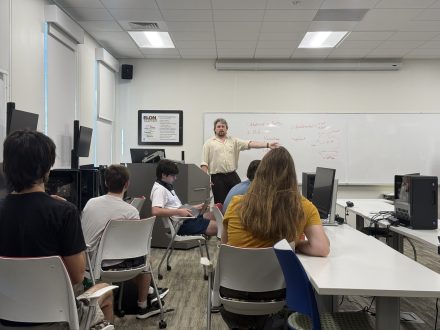
Two themes from the lecture resurfaced throughout the discussion.
The first was the importance of showing your thinking. When creating portfolios, students should capture their development process in addition to presenting the polished result. Showing how they approached a problem, evaluated alternatives, incorporated feedback and arrived at a solution can help others understand the skills behind the finished work.
The second was the importance of not developing in a silo. Students were encouraged to communicate with teammates before and throughout development and to seek perspectives from people working in different disciplines, including art, design and technical areas. Understanding the work and constraints of other team members can lead to better decisions about one’s own contribution.
For current game design students, the visit also provided an opportunity to hear from someone who had once been in their position – taking an emerging Game Design curriculum at Elon and exploring where those skills and interests might lead.
The larger lesson extended beyond any particular software package, development role or current industry trend. Tools, technologies and industry conditions will continue to change. More durable are the abilities to understand design concepts, reason through problems, communicate one’s process, collaborate across disciplines, develop professional relationships and continue learning.