


Maze has dedicated her career to providing books to disadvantaged communities
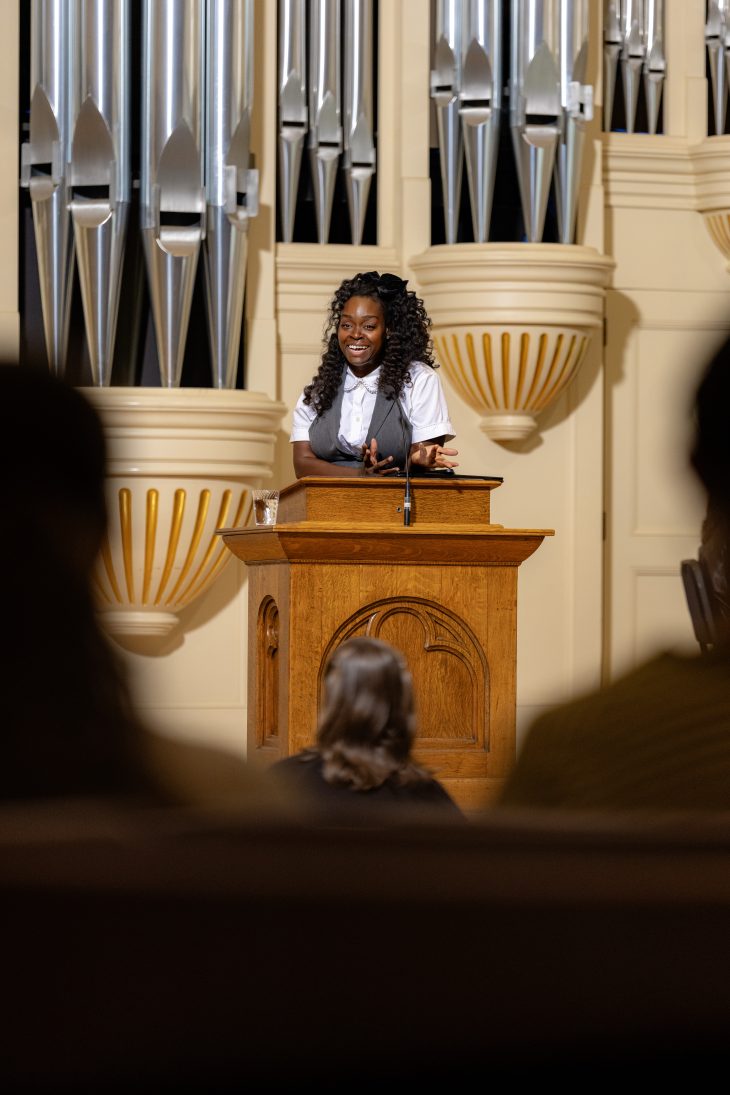
“Radical street librarian” Storybook Maze showcased the past, present and future of book barriers to Elon students, faculty, and community members during the Elon University Liberal Arts Forum on Oct. 6 in Whitley Auditorium.
The Liberal Arts Forum plans academic speaker events at Elon. Student members of The Liberal Arts Forum collaborate to discuss potential speakers and budget management before voting at the end of each semester.
Since its founding in 1958 by James P. Elder Jr. ’60, the Liberal Arts Forum continues to bring unique academic speakers to Elon and encourage meaningful conversations around the arts and humanities, mathematical and natural sciences, and social sciences, inside and outside the classroom.
During her speech, Maze gave the audience background on how her work started as a “radical street librarian.” She used this term to refer to someone who improves access to literary resources in underserved communities through unconventional ways.
Maze started at her home front stoop, reading books to her nieces in Baltimore. However, kids from the neighborhood began to join, begging Maze to re-read books.
After a couple of rounds, she would say, “Okay, you guys go home and read a book at home.” The children would respond, saying, “We don’t have any books at home.”
She then started Stoop Storytime where she’d read to neighborhood children on Saturdays, giving away books she had available. Eventually, she began a career in libraries but noticed that the children who visited her stoop weren’t the ones coming into the library.
Maze says she then did some research and came across the term “book desert,” a geographical area where access to reading materials is limited or challenging. She found that Baltimore experiences one of the highest levels of book deserts, with one child to every 300 books.
Although libraries are an option, Maze says barriers such as transportation, costs, fixed addresses and a valid ID to get a library card prevent young children from accessing them.
In the past, librarians fought against these barriers. Maze referenced work from pack horse librarians in the 1930s, where they would take pounds of books in pillowcases on mules or horses for children in the mountains.
“They traveled in rain and snow and heat because there weren’t roads,” she said. “They navigated through creek beds and rivers and animal trails along fence lines, often covering 20 miles a day.”
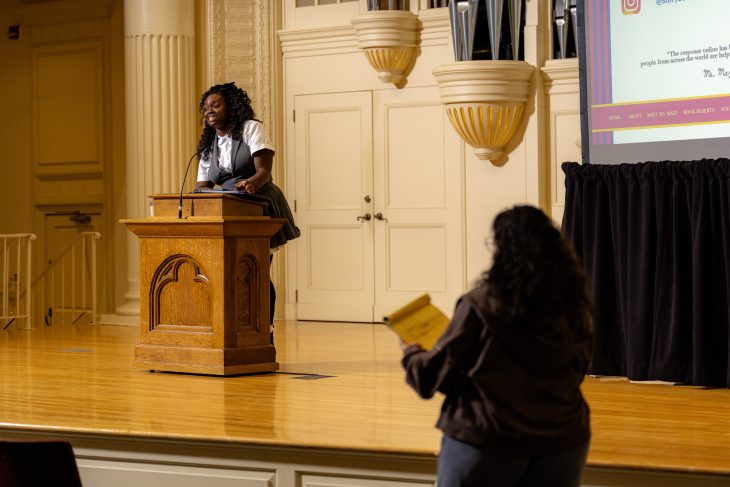
Maze brought to light the barriers that Black communities specifically have faced with books and reading.
“Those who were caught were often violently punished or sold or even killed,” she said. “Enslaved people had to be strategic and resourceful when learning to read and write.”
The barriers and violence that Black communities experienced didn’t legally stop until 1960, when the last anti-literacy law against Black individuals was repealed.
“My mom was born in the ’50s, so sometimes we’re just one generation away from these circumstances,” she said.
Because of these barriers, both current and past, she needed a solution.
Maze gave TikTok a try. She posted a video that described her journey of providing books to local children. The next morning, the video had over one million views, and she had messages from people she didn’t know before.
She went to work at the library and came home to find piles of books from her Amazon Wishlist at her front door.
“It was super overwhelming,” she said. “It just kept coming and coming and coming until the whole garage was filled”
Through her journey, Maze created free public book vending machines, pop-up free bookstores and street-corner storytime. She even started Storybook Trolley, a mobile vehicle with a built-in library.
To date, she has distributed 7,000 books, and her goal is to give away 500,000 books in Baltimore and nationwide over the next five years.
“We’ve built a foundation,” Maze said, “and we’re going to scale our little free libraries and our book vending machines and our trolleys. And I want to launch an army of radical street librarians all over this nation.”