


Student researchers and faculty mentors shared projects exploring education, immigration, environmental stewardship and other global topics during International Education Week.
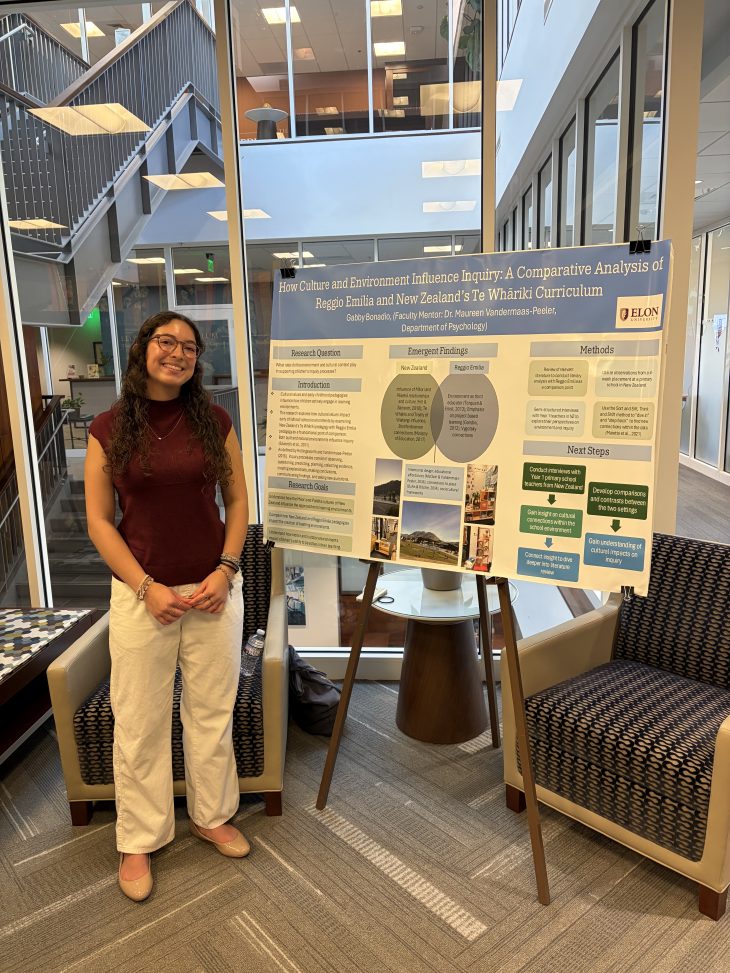
For Gabby Bonadio ’28, a classroom placement in New Zealand offered an opportunity to explore how culture influences how children learn, the questions they ask and the answers they seek.
The Elon Teaching Fellow shared her project during the Research in Global Contexts: Student & Faculty Symposium and Reception on Nov. 9 in Sato Commons. Through posters and a panel discussion, student researchers and their faculty mentors presented projects in a wide range of areas, including education, environmental stewardship, immigration, agriculture, history and health.
Held as part of International Education Week, the event focused on faculty-supervised research, the benefits of international experience, and the relationships formed with the local community. The panel comprised four projects funded by the Center for Research on Global Engagement.
Speaking during the poster session, Bonadio described how her research grew out of her experience in a year one classroom in New Zealand during the spring of her sophomore year. She wanted to understand how culture influences the learning environment and children’s inquiry processes.
Looking in the classroom gave her real insight into an approach to education that went far beyond the academic curriculum. She was keen to see how Māori and Pākehā worldviews informed the curriculum and how the children were being developed as whole people.
“It really focuses on building them as citizens and building them in connection with the environment,” Bonadio said.
Her faculty mentor, Maureen Vandermaas-Peeler, professor of psychology and director of the Center for Research on Global Engagement, helped her develop a foundation for the project through an early childhood development course and supported her observations and research planning. Bonadio also planned to interview a teacher from her placement to better understand the relationship between culture and the classroom environment.
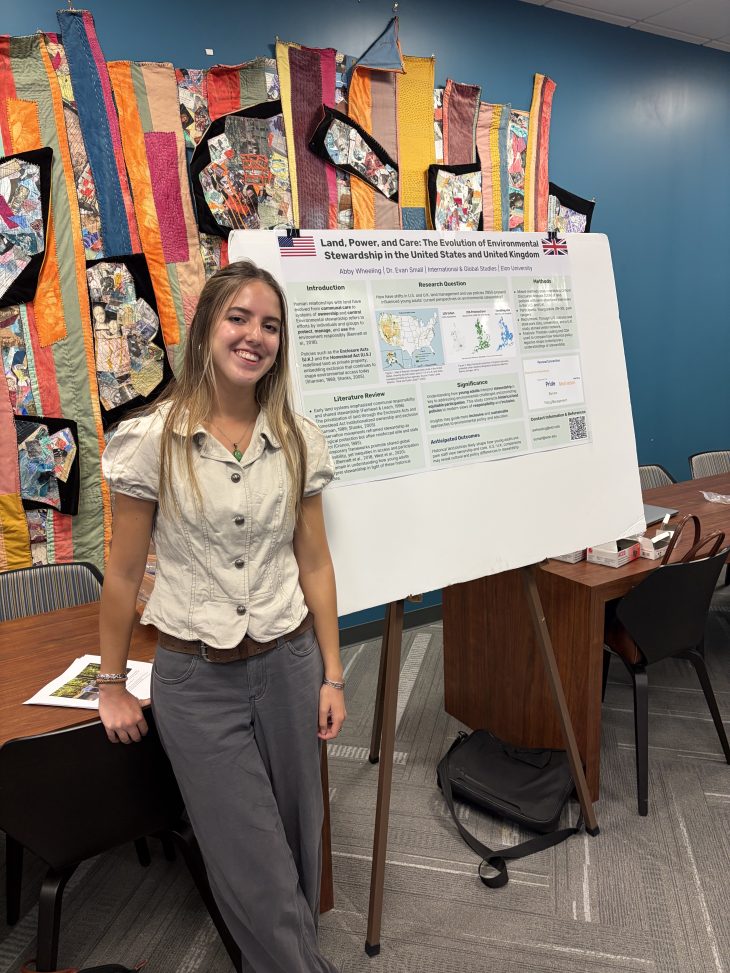
For Abby Wheeling ’27, time spent outdoors and a study abroad experience in London inspired a comparison of environmental stewardship in the United States and United Kingdom.
During the poster session, Wheeling talked about her project, which examines how young adults understand stewardship in the context of land management policy. She grew up with a real awareness of differences in access to national parks, state parks and other public lands. A trip to the UK and its heritage sites encouraged her to look at those differences more closely.
Wheeling said her mentor helped her choose research methods, including semi-structured interviews and policy analysis, and supported her participation in the Summer Undergraduate Research Experience.
One insight from her work was that people may understand environmental stewardship better than they realize.
“A lot of people really want to preserve it, not only for them, but for younger generations,” Wheeling said.
She also observed that different generations have very different views on environmental protection, so the value of talking across generations is evident.
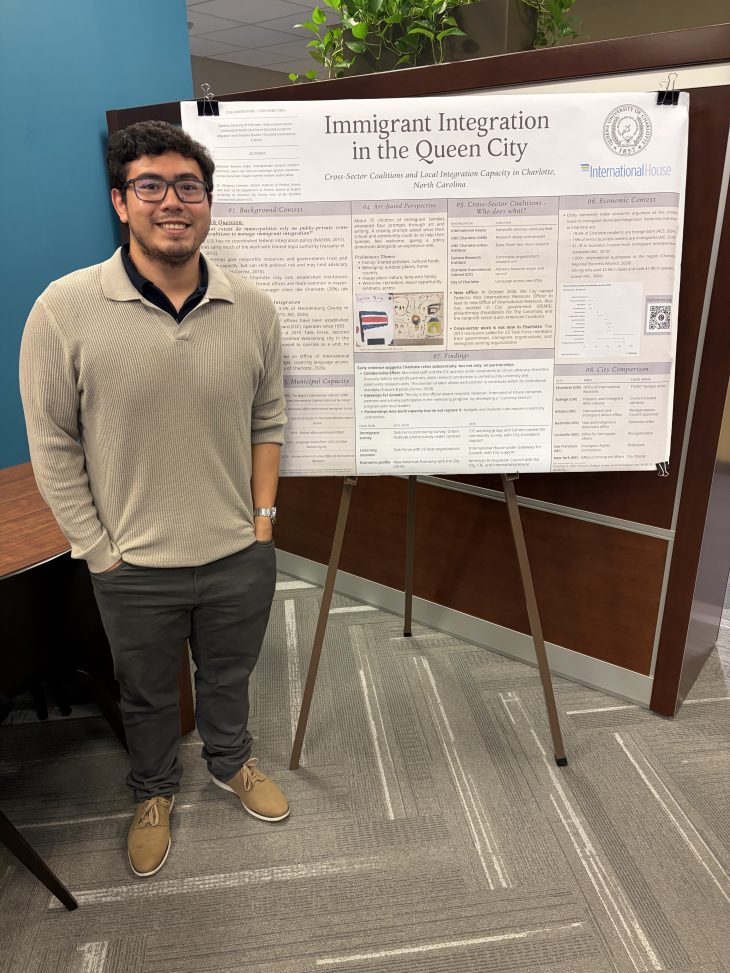
Another poster brought the event’s global focus closer to home. Sebastian Enrique Ramirez Araya ’27, an international studies major at Queens University of Charlotte, examined immigrant integration in Charlotte.
An international student from Chile, Ramirez Araya said the topic aligned closely with both his academic interests and his own experience. His project focused on the role of organizations in promoting integration, and he compared Charlotte with other U.S. cities.
The collaborative aspect of that work was what struck him most.
“It’s not just the city of Charlotte,” Ramirez Araya said. “There are also different organizations that are getting involved in this process.”
He described his mentor as central to the project because of her relationships with participating organizations and her experience bringing them together.
The panel sessions looked at the role of community relationships in research. Projects included conservation agriculture among refugees and host families in Uganda; WWII remembrance in Germany, Japan and the US; and the relationship between physical activity, reproductive status and metabolism in women in northern Kenya.
Presenters discussed challenges including incomplete data, the limits of preliminary findings and the importance of understanding the communities involved in their work.
During the panel, Christina Skelly ’27 presented research on Moroccan Muslim women’s views on agency and modernity. She spent four and a half months in Morocco as part of the project, living with a host family, interning with a feminist organization and conducting 14 interviews with women of different generations.
Skelly said the experience challenged her assumptions about the project. Her research was about how women understood independence, religion, family and opportunity in their own terms.
Asked in the Q&A how others could deal with their own biases, Skelly stressed the importance of curiosity and a readiness to admit what you don’t know.
“A lot of bias comes from misunderstanding,” Skelly said.
For her, it was about asking questions to learn from the people whose lives were the subject of her research.
“I just think the best way to combat that is just for people to ask questions and educate themselves,” Skelly said.