


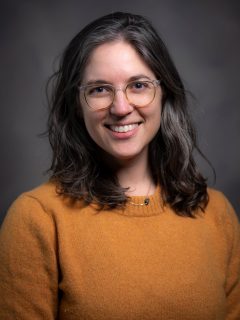
Research by Assistant Professor Amanda McGrosky finds that weight gain is due mainly to overeating and not decreased physical activity.
Obesity is often blamed on decreased physical activity, but is that true?
A recent study co-led by Assistant Professor Amanda McGrosky in Elon University’s Department of Biology suggests otherwise. The findings show that excess body weight is more closely associated with diet and caloric intake, not physical activity and how many calories are burned.
The study involved international collaborations with data collected by researchers from around the globe. First published in Proceedings of the National Academy of Sciences, the team’s work has since been featured by Science, Fox News, NPR, and Men’s Journal, among other news organizations.
McGrosky and her co-authors collected energy expenditure and body composition data from more than 4,200 people worldwide living various lifestyles — farmers, hunter-gathers, office workers — to investigate whether differences in energy expenditure between populations was linked to differences in body fat percentage. The researchers studied daily energy expenditure, body fat percentage and body mass index and incorporated measures of lifespan, prosperity and education.
“Even when people live different lifestyles, once we account for the effects of body size, we do not see meaningful differences in the total number of calories people burn,” said McGrosky. “A key takeaway from the study is that increases in body fat that accompany changes in lifestyle are primarily linked to changes in energy intake, or diet. Physical activity is still very important for all-around health and should be considered complementary to diet.”
Because body fat is due to a mismatch between calories consumed and calories burned, the increase in body fat that accompanies economic development is primarily due to increased calorie consumption — not decreased activity expenditure.
“If you are worried about excess body fat, focus on calories in, not calories out,” said McGrosky. “It is harder to meaningfully change the total number of calories that you burn than it is to change the number of calories that you consume.”
McGrosky said the most energizing part of the research process was working directly with collaborators and participants. “This study is the product of international collaborations and includes data collected by researchers from around the globe, but I was fortunate to have been able to work directly with participants and collect some of the data firsthand,” she said.
What gives McGrosky hope in the fight against obesity is that much of the issue stems from diet — which means progress can be made by reducing ultra-processed foods and increasing access to healthy, affordable food choices.
McGrosky studied patterns of growth and development in primates and human ancestors during her graduate studies at Arizona State University. As a postdoctoral researcher at Duke University, she became interested in how growth and development are linked to energy budgets, which led her into the field of total energy expenditure.
McGrosky said she is grateful to have been exposed to science and encouraged to be curious and ask questions from a young age, which led to a natural progression of taking interest in research.
“There is no replacement for the excitement of exploring something that you do not know the answer to,” said McGrosky. “Research allows you to be creative, push the limits of what we know and, in many cases, provide valuable insights even if you fail to answer the question that you set out to answer.”
McGrosky said she enjoys working with Elon University students, especially in lab settings.
“What I like most about working with students are the new angles and insights they bring,” she said. “As students at a liberal arts university where they are exposed to ideas across the sciences, social sciences and humanities, Elon students have the background necessary to make connections across disciplines, and these connections enrich the questions that they’re able to ask in the lab.”