


Dave Parker, Dave Gammon, Jen Uno and Jessica Merricks developed the case study to help students re-trace ancient human migration patterns using genetic evidence.
Back in 2019, Biology Department faculty teamed up with the Core Curriculum to enhance first-year students’ exploration of that year’s Common Reading, FutureFace. Seven years later, their original idea has now been published by the National Center for Case Study Teaching in Science.
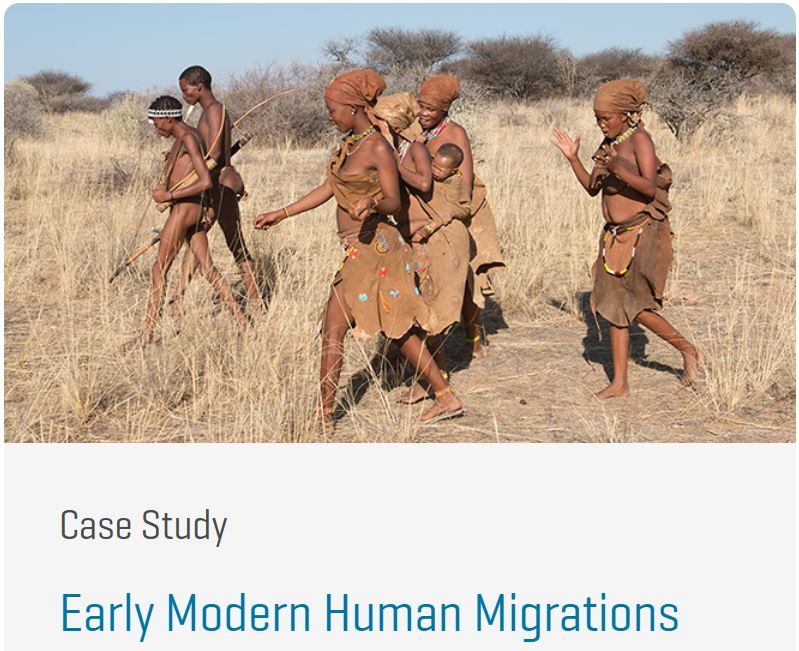
Led by Parker and Gammon, the team created a 100-person simulation to help students re-trace the footsteps of ancient human populations as they migrated within and out of Africa, eventually becoming the indigenous populations around the world. Using a large chalk-drawn map, students “walk the path” used by humans over the past 100,000 years, while tracking changes in DNA sequences relative to modern human DNA. By the end of the simulation, students can use genetic evidence to identify major migration routes of humans.
In addition, the simulation offers opportunities to learn the difference between genetic features that relate to biological traits (e.g., genes that determine traits like blood type or eye color), and those that do not (e.g., ancestry-informative markers or AIMs). Finally, instructors guide students through reflective prompts and discussion about the diversity of modern human populations and race as a social construct.
The published case study provides the materials needed to recreate the simulation, including a customized card deck representing snapshots of the geographic movements and genetic changes of human populations over the last 100,000 years, and detailed teaching notes to support the accurate teaching of these scientific concepts.
“Early Modern Human Migrations: A Simulation Game” is available for download now. Viewers can access the student-facing case study materials for free, but membership is required to access the teaching materials.