


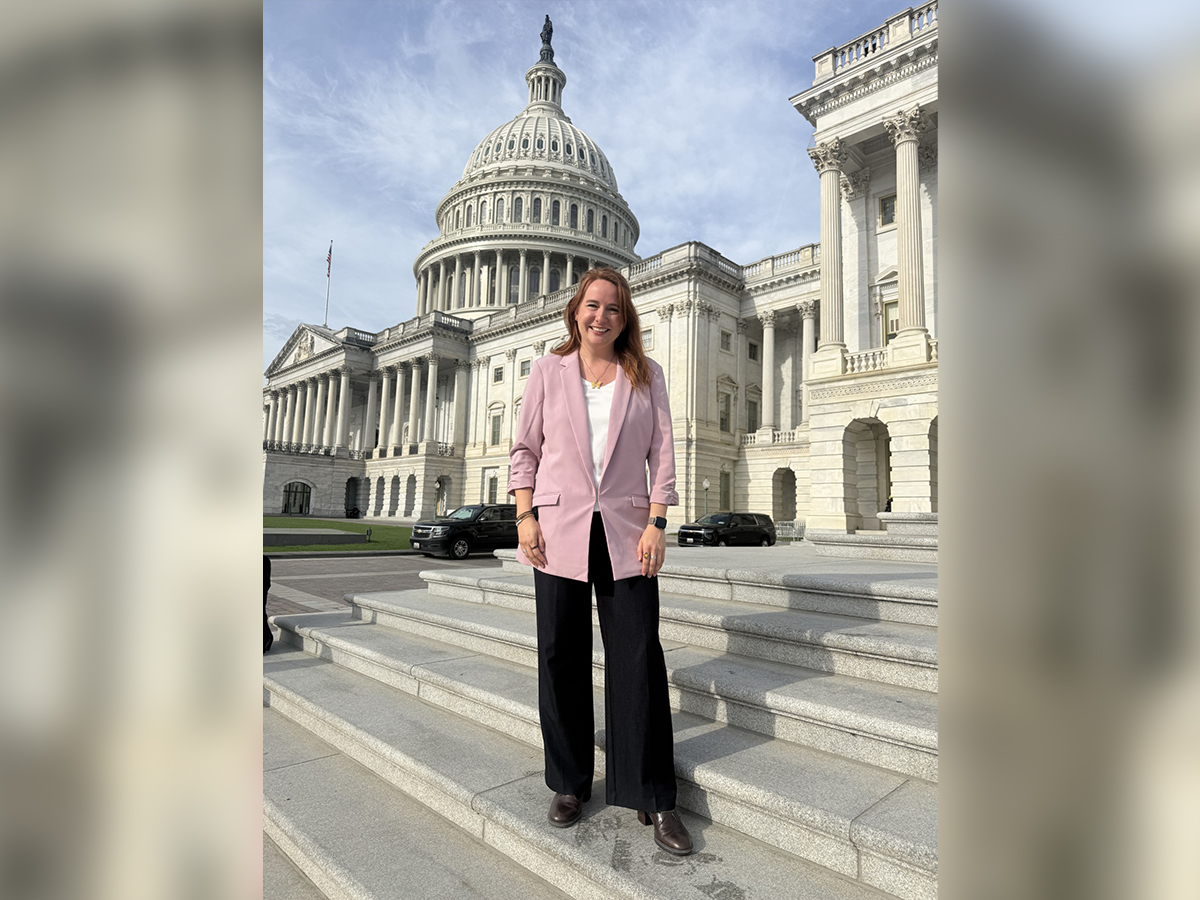
Anna Smith, Elon's Study USA coordinator, met with several congressional offices to advocate for legislation addressing tech-enabled sexual abuse, strengthening child protection laws and securing funding for the National Sexual Assault Hotline.
As Elon University marks Sexual Assault Awareness Month in April, one staff member is extending that commitment beyond campus, bringing survivors’ voices directly to lawmakers in Washington, D.C.
Anna Smith, Elon’s Study USA coordinator, recently participated in RAINN’s 4th Annual Congressional Day of Action, joining about 40 survivor advocates on Capitol Hill to push for stronger protections against sexual violence.
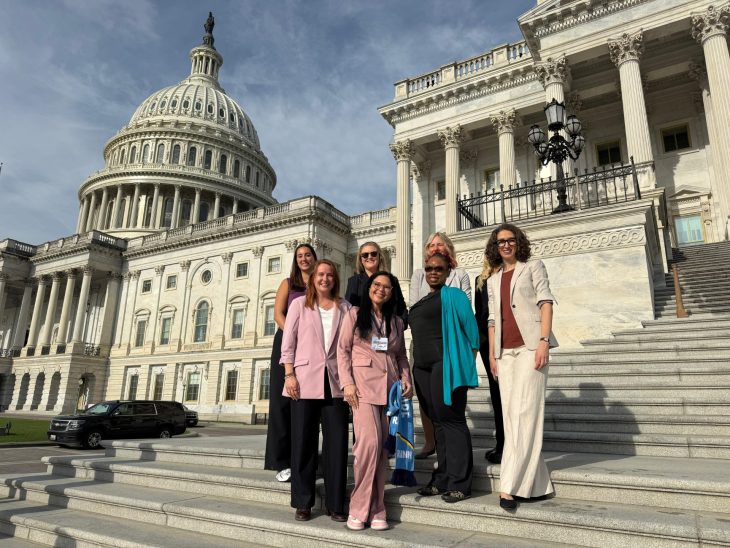
Throughout the day, Smith met with several congressional offices, including Rep. Erin Houchin, Rep. Madeleine Dean, Rep. Robert Aderholt, Rep. Lucy McBath (GA), and Rep. Jim Costa, to advocate for legislation addressing tech-enabled sexual abuse, strengthening child protection laws and securing funding for the National Sexual Assault Hotline.
A key focus of her advocacy was the Statutes of Limitation for Child Sexual Abuse Reform Act (H.R. 2920), which encourages states to eliminate time limits that often prevent survivors from seeking justice.
“In 2022, I received justice for a crime that had been committed nearly twenty years earlier,” Smith said. “I quickly realized how rare that outcome is.”
Fewer than 3% of perpetrators of sexual violence serve prison time. Anna’s case moved forward only because North Carolina does not have a statute of limitations for felony offenses, something she says should not depend on geography.
“Encouraging states to eliminate outdated statute of limitation laws is a simple way to ensure survivors, no matter where they live, have the opportunity to seek justice when they feel ready,” she said.
During her conversations with lawmakers, Smith also worked to challenge common misconceptions about survivor disclosure.
“Many people assume survivors come forward immediately, when in reality that is extremely rare,” she said. “For those abused in childhood, the average age of disclosure is 52. “Our laws need to reflect that.”
While her advocacy reached a national stage, its roots remain deeply connected to her work at Elon. Smith says being on a college campus often reminds her of her own experience, when she first felt safe enough to share her story.
“I was in college when I first disclosed, almost seven years after the crime occurred,” she said. “I think back to that version of myself, who felt lost and confused, and I know she would be in awe of the person I’ve become.”
That perspective is shaping how she shows up during Sexual Assault Awareness Month on campus. Smith plans to participate in Denim Day and attend programming such as the Elon workshop on addressing sexual violence among college students on April 30, hosted by Chris Linder, professor and chair of the Department of Educational Leadership at the University of Utah, using those spaces to stand in solidarity with others.
“I will be there in support of all survivors, across the many stages of healing,” she said. “Those who have spoken their truth, and those who are not yet ready, or may never choose to.”
The experience on Capitol Hill, she says, was empowering, emotional, and deeply meaningful, but it also reinforced a belief she carries into her everyday work at Elon.
“Stories are our most powerful tools for change,” she said. “A statistic is nameless and faceless, but when a lawmaker sits down with a survivor and listens to their story, they are more likely to act.”
From campus conversations to congressional offices, Anna is helping ensure those stories are heard, reminding the Elon community that awareness is only the beginning, and advocacy is what drives change.