


This year’s endowed lecturer brings human-divine relations in Himalayan Hindu communities to life for a campus audience
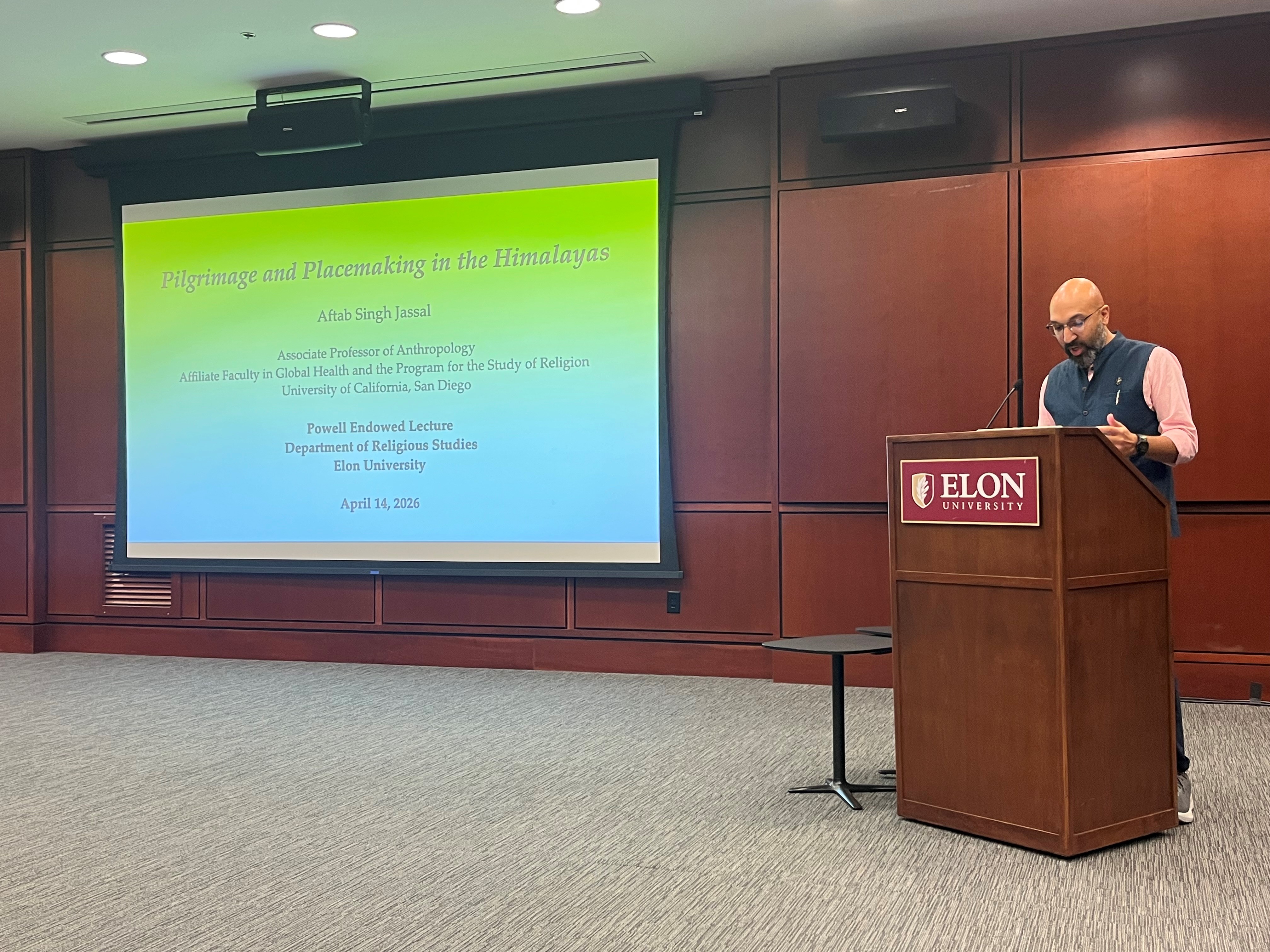
Elon University welcomed Aftab S. Jassal, associate professor of anthropology at the University of California San Diego, as this year’s speaker for the Rex G. and Ina Mae Powell Endowed Lecture in Religious Studies. Known for his rich fieldwork and evocative ethnographic storytelling, Jassal delivered a compelling talk drawn from his recent book Gods in the World: Placemaking and Healing in the Himalayas.
Jassal’s research centers on the dynamic relationships among person, place and divinity in South Asia, particularly in the Himalayan region of Uttarakhand in northern India. Through years of ethnographic fieldwork, he has explored how Hindu communities actively construct and experience sacred worlds through ritual practices such as shrine-building, pilgrimage, festival celebrations and spirit possession.
A key theme of the lecture was the idea that Hindu deities are not fixed but relational and mobile, often requiring “placemaking” practices to remain connected to human communities. Jassal discussed how rituals—including the relocation of deities to more suitable or accessible sites—serve as what he described as “technologies of healing” that reshape social realities. These practices, he argued, reveal the agency not only of human participants but also of non-human actors, such as deities themselves.
In addition to the lecture, Jassal shared a short documentary film, offering students a vivid, sensory perspective on his research. The film emphasized the importance of sound, movement, and atmosphere—elements that written ethnography alone cannot fully capture. Students noted that this visual component deepened their understanding of the material, making the lived realities of ritual practice more tangible.
The day prior to his lecture, Jassal participated in a casual lunch with students, creating space for informal conversation about his work, academic journey and the role of storytelling in research. Attendees described him as engaging, passionate and genuinely enthusiastic about student curiosity and dialogue. Following lunch, Jassal also visited Amy Allocco’s 4000-level Religious Studies seminar, “Ghosts Demons, and Ancestors in Asian Religions,” where students had been assigned chapters of his book and came prepared to engage directly with his research. During the class, students asked questions about Jassal’s fieldwork, methods, and key concepts like placemaking, creating an interactive and discussion-based environment. The session allowed students to connect course material with a guest scholar, deepening their understanding through conversation and critical engagement. Jassal emphasized the importance of intellectual openness and positionality in ethnographic research. His reflections encouraged students to think critically about how knowledge is produced and whose voices are amplified.
By the end of the lecture, it was clear that Jassal’s work not only expands scholarly conversations about religion and anthropology but also resonates deeply with students exploring questions of culture, practice, and representation. His visit left a lasting impression the importance of bringing diverse worlds into conversation.