


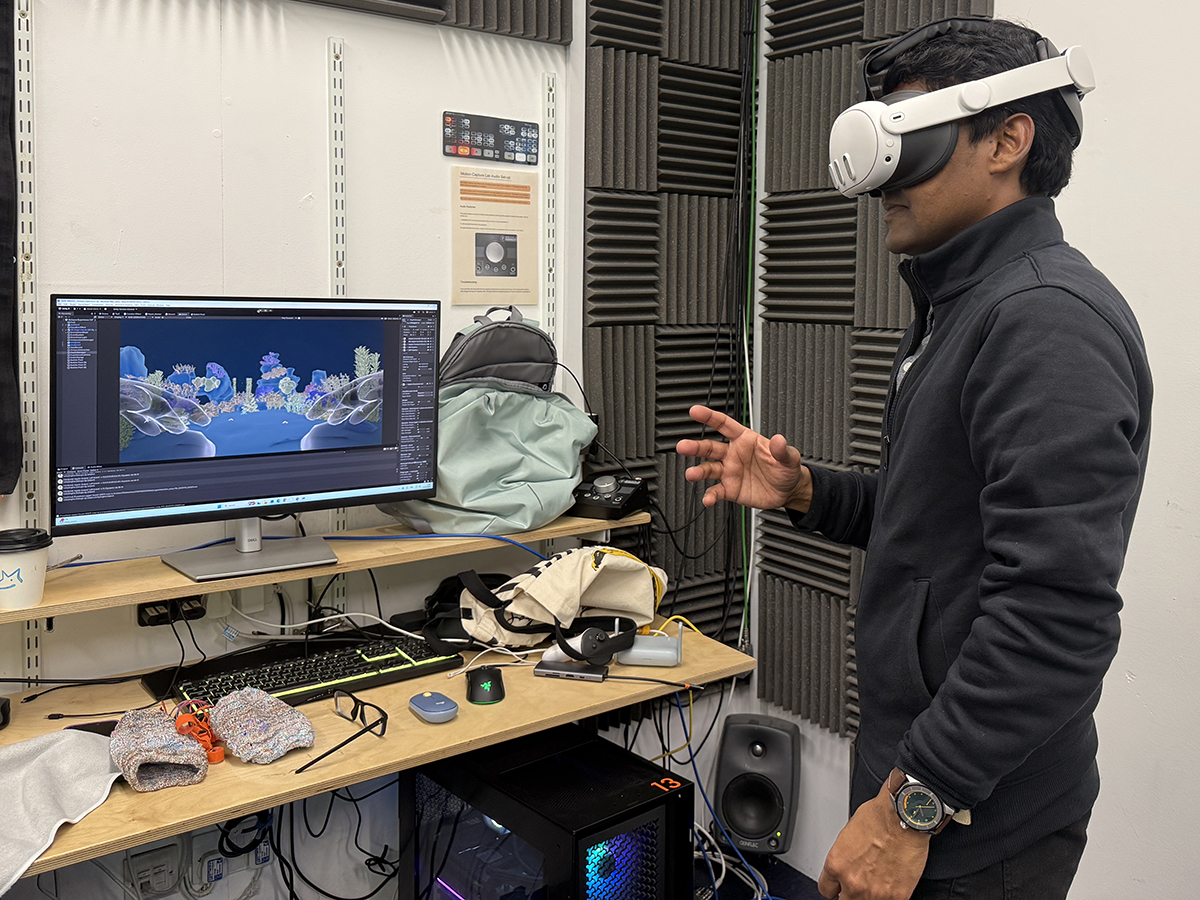
Computer science professor Pratheep Paranthaman’s visit to London strengthened international research partnerships, showcased the Game Design program’s project-based approach and opened possibilities for students to explore emerging technologies and study abroad.
When Henry Agyemang ‘24 saw a photo of his undergraduate and graduate research mentors standing side by side, he had one reaction, “It’s crazy seeing you guys together – it’s like a universe crossover episode.”
Agyemang, an alumnus of Elon’s Game Design minor program, is currently a student at Goldsmith’s University of London where he is pursuing a master’s degree in AR/VR. The picture shared a moment from a recent trip to London by Pratheep Paranthaman, associate professor of computer science, who attended the AI and Games Conference, gave an invited talk at Queen Mary University of London and met with Goldsmiths faculty about research and potential study abroad opportunities.
These experiences have the potential to lead to new collaborations and opportunities for Elon students as well as providing ideas for Paranthaman to bring back to the classroom.
Learning from the games industry
At the AI and Games Conference, talks showed how the games industry is building artificial intelligence into its development pipelines, from “non playable character” (NPC) behavior design and crowd simulation to reinforcement learning.
A presentation from Simona Petravić of the ARC Raiders team was one of the highlights of the conference. Petravić’s team tackled a production challenge by letting the game’s robot enemies learn to move by interacting with the world instead of assigning animations. “It was a great inspiration for my upcoming offering of CSC 4530, Game Programming,” Paranthaman said.
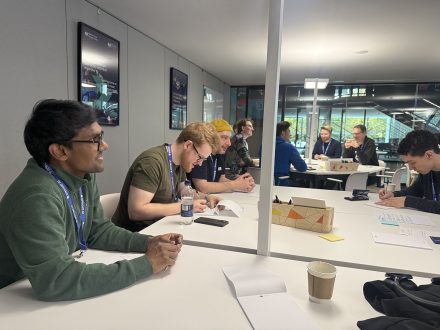
He was able to participate in a small workshop about the challenges of using AI systems in gameplay and left with two standout themes. Those themes were how AI agents sense their environment and how designers can make sure gameplay AI is still enjoyable.
Paranthaman attended alongside his longtime research collaborator, Nikesh Bajaj of Queen Mary University of London and discussed future collaboration efforts. The pair is currently working on four active projects and are including Elon undergraduate students in the research process. The duo has previously published papers at international conferences with Elon students as co-authors. Research efforts have focused on player experience in video and VR games, as well as analyzing the brain activity of players.
Sharing the capstone model
Paranthaman was invited to present a talk titled “Strategies for Collaborative Projects in Academic Courses” at Queen Mary University of London. This allowed him to share how he teaches the Game Design minor’s capstone courses in which student teams take a game from concept to a published release on Steam in about five months.
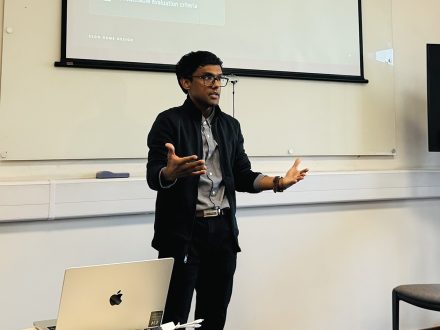
The talk centered on working under constraints of time, resources and budget.
“Working under constraints is the heart of our capstone. Every limit forces a design decision,” Paranthaman said. “Our students take concepts from paper to Steam in five months.”
He shared charts and visualization tools he uses to make student work visible, along with samples of student games that have been published on Steam. That led to discussion on strategies such as making individual contributions visible in team projects, managing team makeup and workload, and using idea budgets to keep a project’s scope manageable.
A visit to Goldsmiths
At Goldsmiths, Paranthaman met with Tara Collingwoode-Williams and Professor Marco Gillies, who showed him their facilities and introduced him to Ph.D. student research on haptics. He was also able to playtest a VR application that was developed by a student.
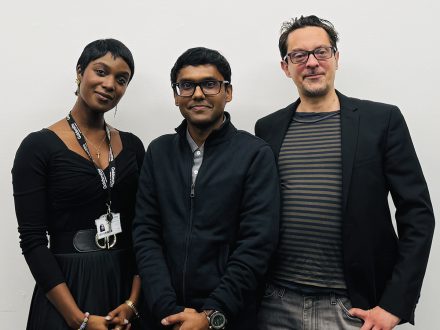
Most of the visit focused on how the two programs could build a working relationship that may lead to Elon students spending time at Goldsmiths. Paranthaman introduced Elon’s project-based Game Design minor, and the Goldsmiths faculty described their game design and AR/VR programs and the opportunities they could open for Elon students, including hands-on work in immersive technologies and exposure to graduate-level research.
With Elon’s emphasis on study abroad, the conversation led to possible opportunities for Elon students to spend time at Goldsmiths, a possibility that they were open to. Such an opportunity would provide students with a multicultural experience alongside their game design education.
“Game development is one of the most cross-disciplinary fields there is, and the skills flow both ways,” Paranthaman said.
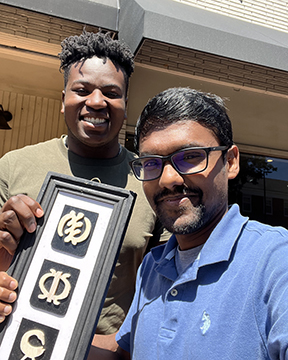
The visit also had a personal side. Agyemang’s mentor at Goldsmiths is Collingwoode-Williams, and the three are working together on a research project on obstacle consequentiality in virtual and mixed reality. Agyemang has built the applications, and the team is preparing for user studies.
“Seeing a former student continue his research at Goldsmiths, and still collaborate with us, is exactly what we hope for in the Game Design program,” Paranthaman said.
Paranthaman returned to Elon with several takeaways. Despite the rapid growth of AI, he noted, the developer’s creativity remains at the center of the process. AI systems speed up parts of the workflow, but the design vision still comes from people.
“AI accelerates development. It doesn’t replace the designer,” Paranthaman said.
He also saw how much the field can do for transferable skills, which move in both directions. Game design skills carry over into other fields, and experts from other fields bring their knowledge into games. A robotics engineer, for example, might help design the dynamics of how robot characters react in a game.