’24-’25
Alyssa Carney | Echoes of al-Andalus: Islamophobia and Migration Contemporary Spain
Mentor: Dr. Sandy Marshall
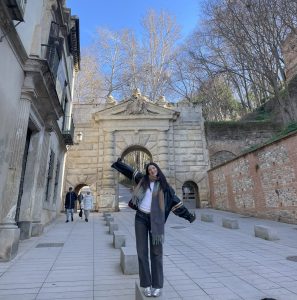
Alyssa in front of the entrace to Alhambra in Grenada
Alyssa Carney, with support from a CRGE Student Grant, explores the place of Islam in Andalusian society today, examining how historical memory of al-Andalus shapes contemporary Muslim identity and belonging in Spain. Originally centered on Arab-Muslim migration and how migrants situate themselves within Spain’s historical memory of al-Andalus, the research evolved when fieldwork revealed silences and communities unwilling or unable to speak on record, which became part of the dataset itself. This led to two broader research questions: how does the far-right in Spain mobilize historical memory to discuss Muslim migration, and how do Muslims understand their place in Spanish society given this historical memory?
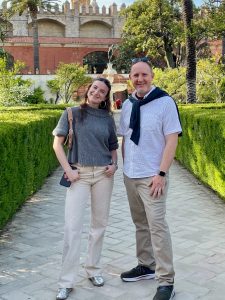
Alyssa and her mentor, Dr. Marshall, in Sevilla, Spain
During a semester abroad in Sevilla, Carney conducted ethnographic fieldwork that included collecting fieldnotes on everyday encounters, observing far-right Vox Party propaganda, and seeking out spaces that claim to embody “convivencia (‘coexistence’).” The methodology encompasses keynote interviews and compilation of a growing archive of political discourse, with early coding of the material highlighting themes of identity and respectability, specifically examining “who gets to claim belonging and under what terms.” CRGE funding made this project possible by supporting travel to other Andalusian cities, research equipment for interviews, and flight costs to Sevilla, enabling both expanded geographic scope and deeper regional contextualization of findings. Future research directions include refining analysis of nationalist discourse and sharing findings with both academic and community audiences.
Drew Fetterolf | The Elephant in the Room: Being Maasai, Tourism, and Conservation
Mentors: Dr. Sheila Otieno & Dr. Waseem Kasim
Drew Fetterolf investigates how the boundaries between indigenous religion, culture, and species conservation intersect through the lifestyles of the Maasai people in southern Kenya’s Amboseli region. Focusing on their interactions with African elephants, the research examines how Maasai spiritual and cultural practices shape conservation efforts in a rapidly changing ecological landscape. The work explores four central arcs: the influence of indigenous religious beliefs on Maasai perspectives toward land use, wildlife, and conservation; ethical questions surrounding conservation responsibilities and the Maasai’s role in land protection; the often-overlooked role of animals in anthropocentric land-use decisions; and the impact of tourism on conservation efforts.
Employing narrative inquiry, conversation-style interviews, and direct observations during fieldwork, Drew analyzes the complex interplay between religion and ecology while considering “how mobility—across geographical, cultural, and ethical boundaries—shapes conservation in this region.” In an era defined by global environmental crises and the movement of both people and ideas, the study reveals how local indigenous practices and religious beliefs contribute to global efforts in species protection, challenging traditional divides between science and religion, space and mobility, and human and non-human actors.
Kaleigh Jenkins | Injury Prevalence in Indian Classical Dancers
Mentor: Dr. Srikant Vallabhajosula
Kaleigh Jenkins (CRGE’s first graduate student grand recipent!), supported by a CRGE Student Grant, examines injury patterns in Indian classical dance, a 2000-year-old performance tradition now practiced globally. The research focuses on the physical toll of this dance form’s characteristic forceful, repetitive lower extremity movements, documenting injury types, their frequency among practitioners, and current prevention strategies dancers use.
Through an ongoing survey study, the project has gathered data from 19 participants, revealing insights that will be compared against injury patterns documented in other dance styles and athletic activities. Beyond cataloging physical injuries, the research investigates cultural attitudes toward physical therapy—how dancers perceive and access care for injury prevention and treatment within their communities. The CRGE grant enabled critical project components: consultation with an epidemiology expert for methodological guidance and participant incentives through gift cards. As the survey continues, the work aims to build a more comprehensive dataset, complete cross-disciplinary comparisons, and illuminate the intersection of cultural practice and injury management in classical dance communities.
More Student Grant Awardee Profiles to Come!