CRGE Student Grant Awardees
Scholarship on Global Engagement
The Center for Research on Global Engagement seeks to facilitate and showcase innovative scholarship on global engagement. The current ’25-’26 CRGE grant awardees are highlighted here.
Jo Bogart | Dux Femina Facti: Feminist Translation and Re-Vision of Vergil’s Aeneid
Mentors: Prof. Margaret Chapman and Dr. Kristina Meinking
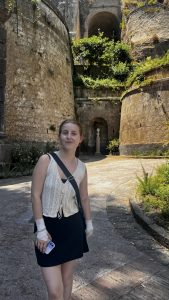
Jo in front of Vergil’s Tomb
Jo Bogart, an Elon College Fellow and Lumen Scholar, conducts interdisciplinary research spanning Creative Writing and Classical Studies. With support from a CRGE faculty-mentored undergraduate research grant, her project combines the translation of approximately 1,100 lines of Vergil’s Aeneid with an original feminist retelling of the epic poem told from the perspectives of female-identifying characters Anna and Dido. Written in 19 BCE under the patronage of Emperor Augustus, the Aeneid tells the story of Aeneas, the mythic ancestor of the Roman people, embedding deeply held ideas about Roman identity and tradition throughout. It is within that framework that Bogart found her idea, centering two non-Roman women who play a significant role in the epic but whose inner lives Vergil had little reason to explore.
Bogart drew on multiple funding sources to support her work, using Lumen funds and a SURE stipend to travel to Rome in the Summer of 2025 to practice writing in place (composing her retelling in the same city where Vergil wrote the Aeneid thousands of years ago). CRGE funding made a crucial addition to this experience by enabling her mentor, Dr. Meinking, to travel to Rome alongside her. Dr. Meinking’s on-the-ground guidance shaped how Bogart approached her time in the city, introducing an archaeological lens to her research process through visiting ancient sites and interpreting their symbolic significance in ways that deepened the creative and scholarly dimensions of the project.
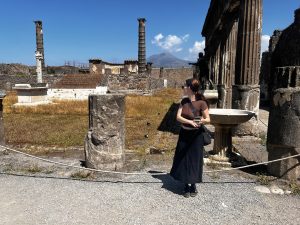
Jo in Pompeii
Future directions for the work are ambitious and wide-ranging. What began as a planned novella has since grown organically into a full novel-length retelling. Bogart aims to complete and publish this work and pursue graduate studies in writing. She is currently a Fulbright semi-finalist for an MA program at the University of Manchester. Looking further ahead, she envisions a second book continuing Anna’s story beyond the Aeneid, drawing on Ovid’s writings.
Matthew Brantley | The History of Memory: World War II Commemorative Practices in Germany since 1945
Mentor: Dr. Andrea Sinn
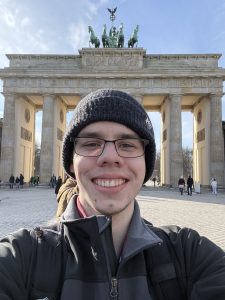 Matthew Brantley is an Honors Fellow studying History and International and Global Studies (IGS), with minors in Public History and German. His research examines how Germany, Japan, and the United States have chosen to commemorate World War II and the Holocaust since 1945, and how those narratives have shifted across generations. With support from a CRGE faculty-mentored undergraduate research grant, his work centers on a research trip to Nuremberg and Munich to supplement ongoing museum fieldwork he has conducted in Berlin.
At each site, Brantley works through a structured set of research questions, examining who created the museum, who the intended audience is, and how each institution contributes to Germany’s collective memory of World War II. His itinerary included the Nazi Rally Grounds, the site of the Nuremberg Trials, the Dachau concentration camp memorial, the White Rose Memorial, a local cemetery, and Munich’s Documentation Center for National Socialism. The choice of these two cities is deliberate: Munich represents the geographic and ideological birthplace of the Nazi movement, while Nuremberg carries particular weight in the collective memory of the war as it is home to the infamous race laws of 1935 and the postwar trials that introduced the concept of political and moral guilt onto the German people.
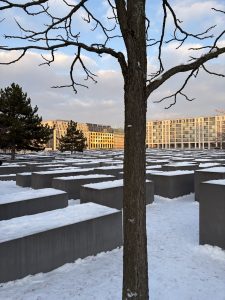
Memorial to the Murdered Jews of Europe
Central to his research is the German concept of Aufarbeitung der Vergangenheit (loosely translated as coming to terms with or working through the past) and its related idea that the past is not something to be resolved and set aside, but something that must be continuously worked through and carried forward. By tracing generational shifts in memory culture since 1945, Brantley investigates what Germany, Japan, and the United States might learn from one another in how they institutionalize historical reckoning through public commemoration.
CRGE funding made the Nuremberg and Munich research trip possible, expanding the geographic scope of fieldwork that had previously been centered on Berlin. Future plans include presenting findings at SURF, incorporating this research into his honors thesis and collaborating with Dr. Sinn in his senior year to develop a public exhibition at Elon that brings his findings to a broader campus audience.
Jenna Abousaab | From Hope to Home: Aspirations of Syrian Refugees and the Prospects for Return and Reconstruction
Mentor: Dr. Sandy Marshall
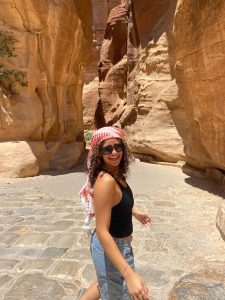
Jenna in Petra, Jordan
Jenna Abousaab is a junior majoring in Psychology on a pre-med track, bringing an interdisciplinary lens to her research in Peace and Conflict Studies. Her project explores how Syrian refugees conceptualize home, belonging, and their aspirations for Syria’s future, including whether they envision returning or contributing to post-conflict reconciliation from abroad. The research takes on particular urgency given that December 2024 marked the fall of a dictatorship regime that had governed Syria for nearly 50 years, making this a uniquely pivotal moment to examine how displaced communities are thinking about their relationship to home and national rebuilding. The study also examines how these perspectives differ across genders and generations, framing the work as an intergenerational inquiry.
Methodologically, the project blends narrative interviews and focus groups with a creative and visual component: a photovoice activity in which participants are given cameras and asked to photograph what resembles home to them meaning anything in their daily lives that evokes belonging, memory, or identity. The goal is to compile these images into a public photo exhibit that brings the lived experiences of Syrian refugees to a broader audience. Because most participants are Arabic-speaking, CRGE funding is being used to cover professional transcription and translation services, ensuring the integrity and detail of each account. Funding also supports audio recording equipment and materials for the photo exhibit itself, including printed photos, frames, and drawing supplies for participants who wish to express their sense of home visually.
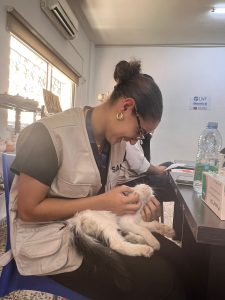
Jenna at a refugee camp in Jordan
The project bridges Abousaab’s dual interests in medicine and human experience in a deliberate way. As a future physician, she sees the ability to understand patients as whole people, not just medical cases, as an essential and undervalued clinical skill. Engaging deeply with the lived experiences of displaced communities, she argues, builds the kind of cross-cultural empathy that makes for more effective and humane care. This perspective was further shaped by a week she spent in the summer of 2024 at the Zaatari refugee camp in Jordan.
Future plans for the project include presenting at SURF, submitting a review article for publication, and mounting the photovoice photo exhibit to raise awareness about how displacement affects identity and mental health. Longer term, Abousaab and Dr. Marshall are exploring the possibility of a virtual exchange program that would connect Syrian refugees with Elon students. This would create a channel for direct dialogue between the Elon community and the communities at the center of her research.
Maiah Giampietro | Perceptions of Health Among Youth in the Dominican Republic: A Photovoice Study
Mentor: Lori Hubbard
Maiah Giampietro is a senior nursing student graduating in May. Her research project uses photovoice methodology to explore how youth in the Dominican Republic perceive the influences on their mental, physical, and spiritual health, examining both their home environments and the broader communities in which they live.
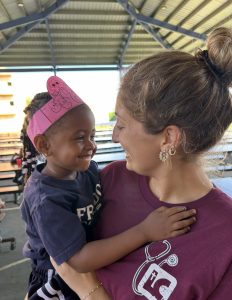
Maiah with a child at Freedom International Christian School
The study was conducted at Freedom International Christian School, a K–12 institution in Ramón Santana, Dominican Republic. Giampietro traveled to the school as part of an interdisciplinary medical team that conducted health assessments on approximately 400 students and staff. Alongside that clinical work, she carried out the photovoice study with the school’s senior class, the first graduating cohort in the school’s history, many of whom have been enrolled since they were three years old, when the school was operating out of a small structure in one of the local sugarcane plantation communities.
Photovoice is a participatory research method that distributes cameras to study participants and invites them to photograph the things they feel benefit or harm their wellbeing. Rather than relying solely on surveys or interviews, photovoice positions participants as active agents, empowering them to document their own lives and bring those images into conversation with researchers, administrators, and community members who may not share their lived experiences. Giampietro sent cameras and reflective booklets home with the senior students, asking them to respond to prompts about what they saw as supporting or undermining their health across three dimensions: mental, physical, and spiritual. A focus group followed the data collection phase, giving students the opportunity to discuss their photos and findings together.
Analysis of the photographs and booklets led to four overarching themes. The first, sites and sounds, captured the way students found peace in nature while identifying loud speakers in their community as a source of distress. The second theme, fueling health and wellness, included sub-themes around fresh food for nutrition, concerns about overindulgence in unhealthy snacks, and the role of books in personal growth. A third theme, digital divide, surfaced students’ awareness of how phones and technology create stress and distraction in their daily lives. The fourth theme, importance of infrastructure, pointed to homemade outdoor exercise equipment and church fellowship as meaningful contributors to community health.
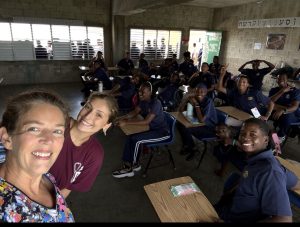
Maiah and her mentor, Lori Hubbard, with senior class at Freedom International Christian School
CRGE funding made the trip to the Dominican Republic possible, covering travel expenses as well as the cameras and printed booklets distributed to students. For Giampietro, the funding served two purposes: it enabled the research itself but also gave her hands-on clinical experience conducting pediatric health assessments, practice she describes as directly valuable for her nursing career. The entire arc of the project, from initial conception through IRB training, study design, focus group facilitation, qualitative coding, and manuscript construction, was built collaboratively with her mentor over the course of the year.
Future directions for the project include potentially using the findings of this study to develop a health education program that could be integrated into the school’s existing science or health curriculum. A fellow nursing student who participated in the trip will be returning to the school as an intern this summer, creating a potential pathway for the work to continue on the ground. The team is also in the process of writing a manuscript they plan to submit to the Journal of Christian Nursing for publication.