


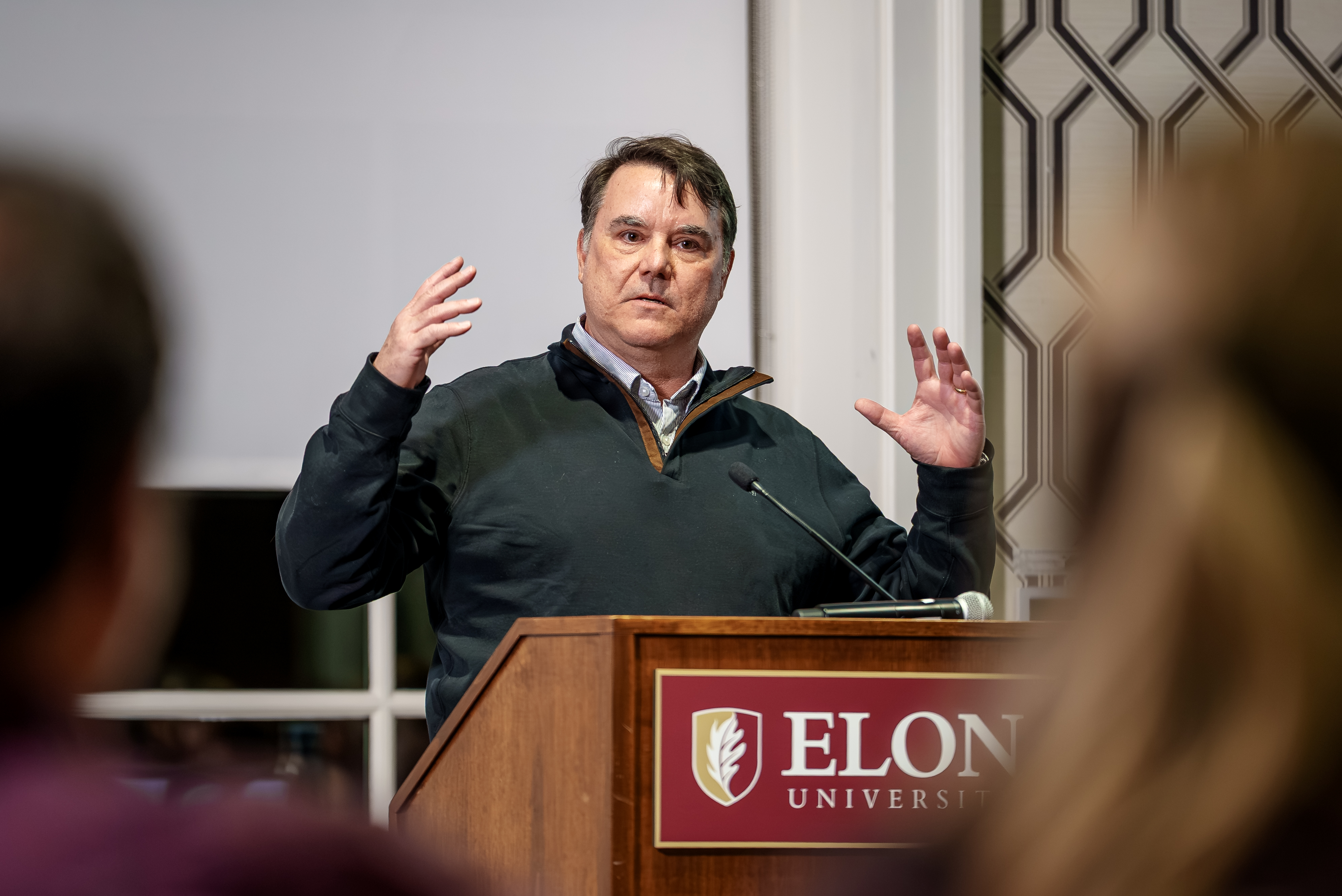
The professor of biology and environmental studies received the Distinguished Scholar award, Elon’s leading faculty research award, in Spring 2025.
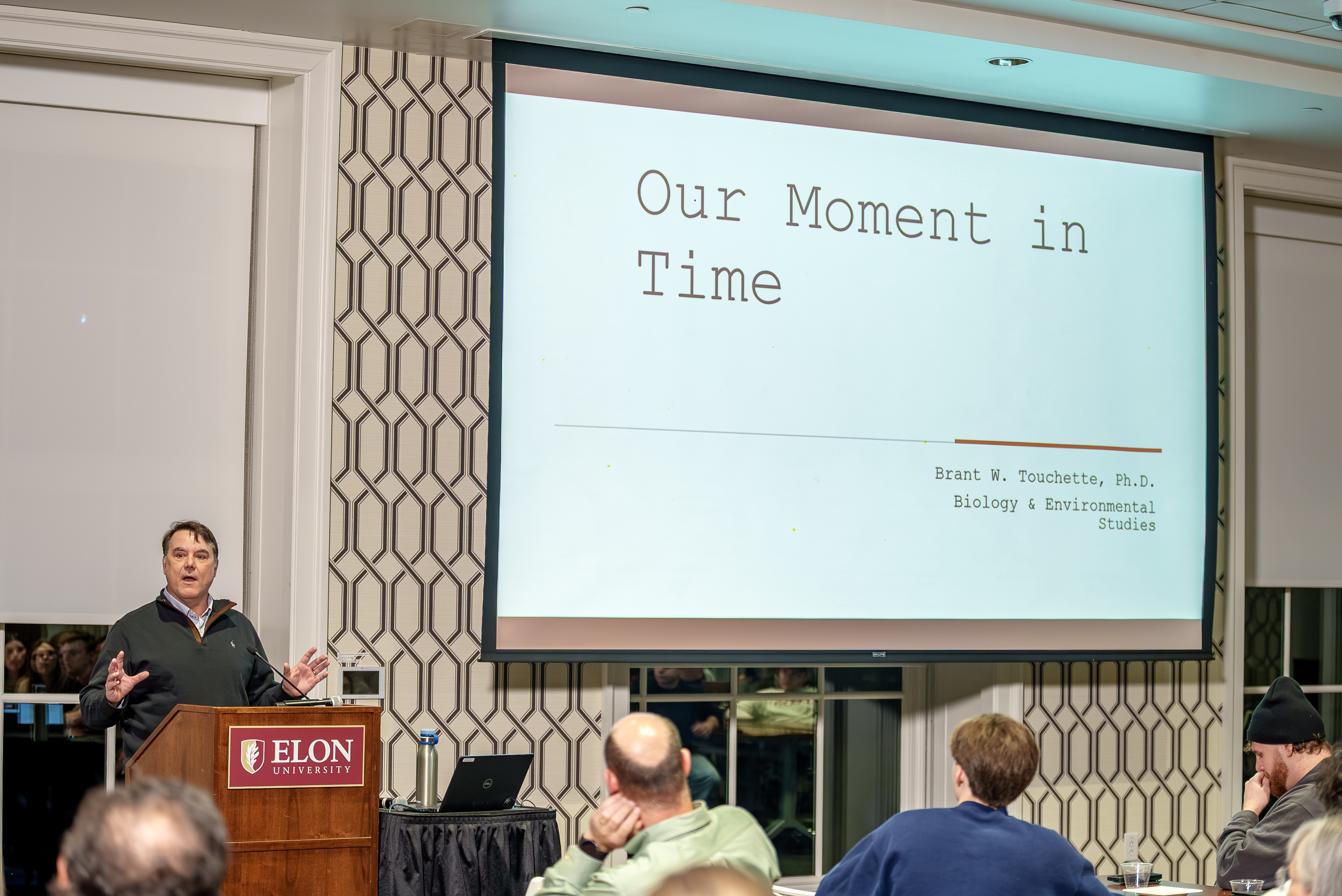
In his Distinguished Scholar Lecture on Feb. 12, Professor of Biology and Environmental Studies Brant Touchette gave listeners a firm reminder of the human impact, one that extends to Earth’s past, present and future.
“There’s a continuum from the very beginning, and we are a part of it,” Touchette said. “And we have a role that will now influence the future of this direction of the planet.”
The Distinguished Scholar Award is given to Elon faculty members recognized by the Elon community and the larger community in their discipline for excellence in scholarship. Touchette earned the award in Spring 2025.
In the hour-long lecture, Touchette discussed Earth’s many eras, stretching from the Big Bang all the way to the modern-day Anthropocene, or human-dominated era, that we are currently living in. He described the conditions, species and eventual mass extinctions of each period, placing emphasis on how climate change has the power to completely alter life on Earth. “We see this pattern a lot,” Touchette said. “You change the climate, you’re going to lose species.”
Touchette joined Elon’s faculty in 2001 and has made many contributions to ecological science. With the goal of discovering how plant communities react to stressors such as drought, pollution, salinity and climate change, he has created a research program that combines fieldwork, laboratory science and environmental policy. Besides advancing ecological science, this program has also framed conservation practices and fostered student research.
During the lecture, Touchette explained his research on dodder, a parasitic plant that looks for a host to latch onto when it germinates. He and his team of student researchers found that dodder only chooses to parasitize plants that are most beneficial to it. These findings were corroborated by the results of other research projects, affirming the plant’s ability to choose and control its own host.
“It’s just a remarkable creature in terms of what it can do,” Touchette said.
Besides revealing the amazing aspects of Earth’s species, Touchette’s research has brought up a question: what can humans do to protect them from extinction?
“Climate change is one of the bigger risks we have for biodiversity,” Touchette said. “This is one of the number one concerns scientists have in terms of life on this planet.”
Touchette explained that extinction is a normal process, with 10 species naturally disappearing from our planet each year. Because of natural speciation rates, however, the Earth also gains 10 species each year, effectively replacing the lost. Humans have completely upset this balance, causing Earth to lose between 27,000 and 30,000 species each year instead of just 10.
“80 species a day,” Touchette said.“Four species have disappeared while I’m up here talking to you about species disappearing. That’s tragic.”
He also highlighted that climate change is not just impacting plants and animals, but humans as well. Statistics from his research reveal that 2 billion people on Earth do not have access to clean drinking water, and that 1,000 children under the age of 5 die each day from consuming contaminated water.
“More people die each year from unsafe drinking water than all other forms of human violence, including war,” Touchette said.
Other concerns relate to air pollution. According to Touchette, 8.1 million people die prematurely from inhaling polluted air, making it a more ruthless killer than tobacco.
When talking about the value of plants, the biology professor brought up the important point that many of our medicines are derived from their properties.
“We have to recognize that 25% of all medicines come directly from plants. Fifty percent of our medicines have at least some compound that has been dried from plants,” Touchette said. “And that’s in developed countries. In countries that are developing, 80% of people use plants for medicine.”
Touchette concluded his Distinguished Scholar Lecture with an inspiring call to action. Besides explaining the importance of passing legislation that will reduce emissions, protect endangered species and get people closer to relying on cleaner energy sources, he left listeners with a few questions to think about.
“How can we coexist with other living creatures? How can we manage a planet for the betterment of future generations and the natural environment?” Touchette asked the audience. “And finally, how can we preserve these wonderful creatures, these arrangements of stardust, that began when the universe was started?”