


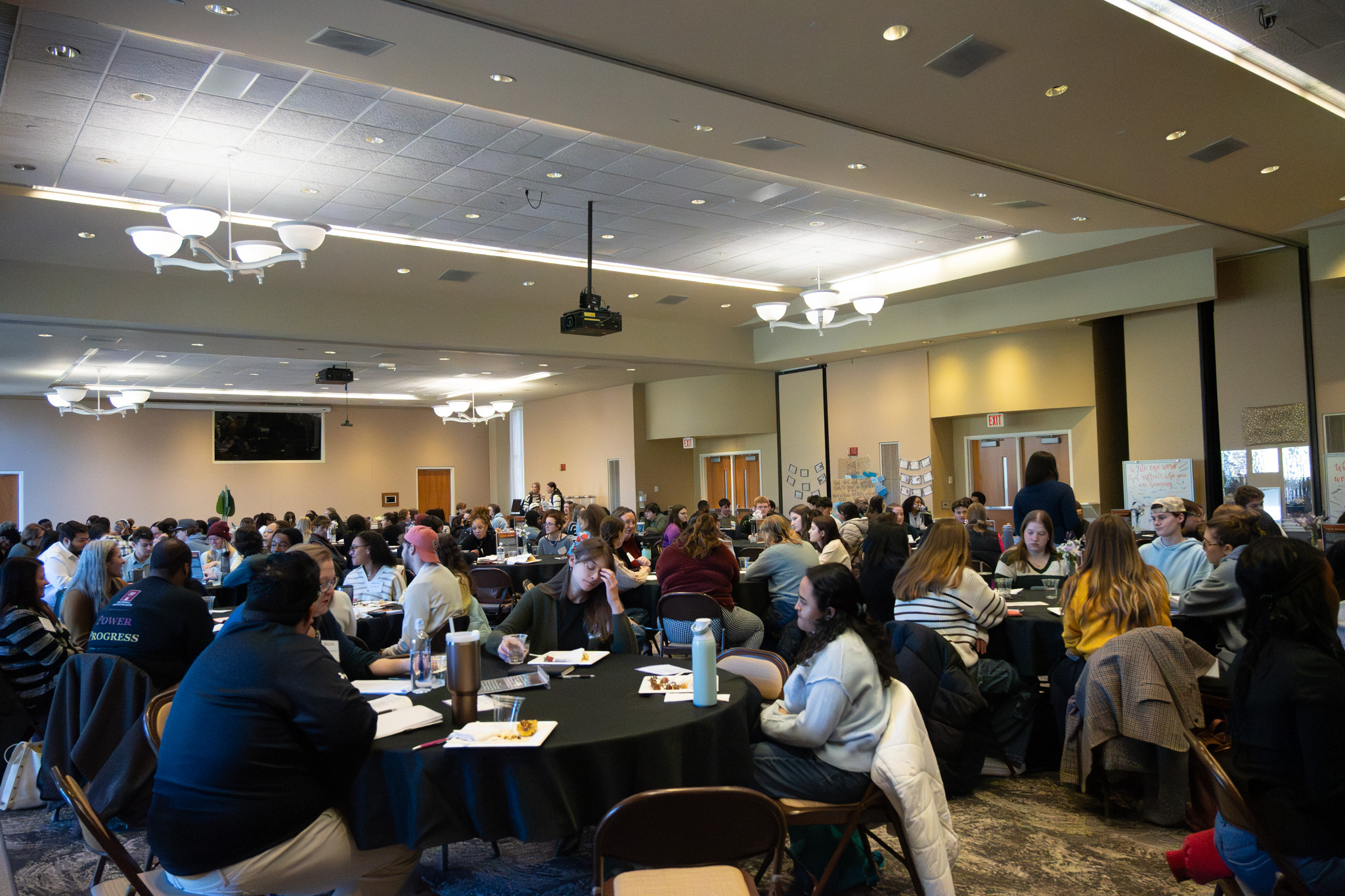
Students gathered to have candid conversations on collective healing, accountability, and understanding.
This year’s Intersect Conference coincided with the National Day of Racial Healing on Jan. 20, offering students space to reflect on how healing happens at both personal and collective levels.
The conference featured a keynote address by playwright, director and activist Spirit Tawfiq, who spoke about the role of storytelling, courage and intentional dialogue in bridging the gap between the civil rights movement and modern social justice. Tawfiq is the founder of the “Let Your Light Shine” program and the daughter of Minnijean Brown-Trickey, one of the Little Rock Nine who desegregated Central High School in 1957.
She shared that her work is deeply rooted in her family’s history and her commitment to continuing conversations around justice, accountability and healing. Throughout the talk, Tawfiq returned to a central question: Who is holding the pen?
She encouraged students to consider whose stories are told, whose voices are amplified and how silence can contribute to continued harm.
Referencing the bravery of the Little Rock Nine, Tawfiq emphasized that healing requires confronting generational trauma rather than ignoring it. She challenged students to view history as an ongoing process and to recognize their role in shaping what comes next. Healing, she said, must be intentional and rooted in understanding, accountability and a willingness to ask difficult questions. Tawfiq described humanity as a quilt, made up of individual stories and experiences stitched together to form a shared whole.
“We each bring a patch and we put these patches together to make a beautiful, warm quilt, but racism doesn’t want our patches connected,” she said.
Students were encouraged to become comfortable navigating discomfort, which Tawfiq described as a necessary step toward healing and growth. Learning about experiences that differ from one’s own, she said, “helps foster empathy and connection and tear the structures of racism down.”
The event also included a gallery walk, where attendees moved around the room and wrote words and phrases on the walls that represented what gives them courage. Responses included family, shared legacy, honesty, storytelling, helping others and giving power to the powerless. Faculty boldly and vulnerably shared stories on the wall of things that have healed or are currently healing from. The through line being that human connection and conversation were the key to healing.
Students reflected on the impact of the discussion and the importance of listening as a form of action.
“The most impactful thing I learned is that everyone has their own story and we should do our best to listen and understand them,” said Luke Bonifacio ’28.
Another student highlighted the role of dialogue in the healing process.
“They are trying to bridge the gap through physical and mental healing, and conversations like this are the start of that,” the student said.
As the event concluded, students were encouraged to continue the work of healing beyond the conference by engaging in difficult conversations, resisting silence and using their voices to support those around them.