


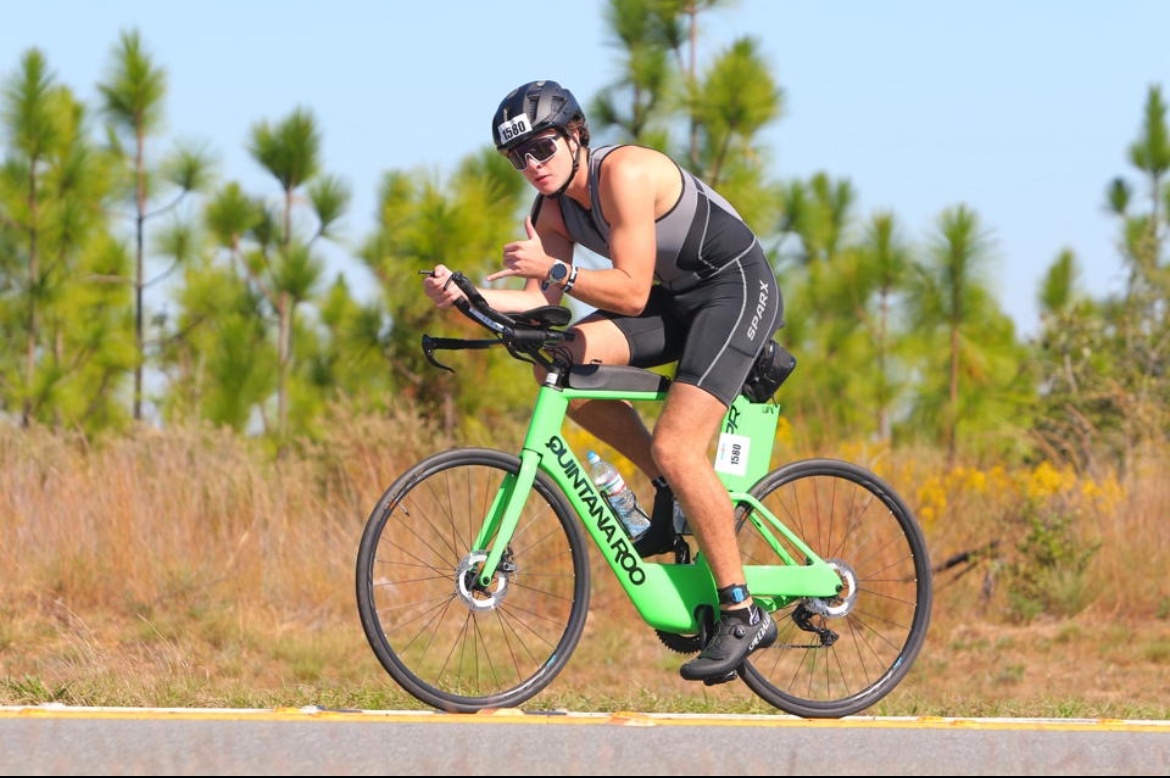
Matthew Taylor '28 discovers the power of perseverance and importance of health through the Ironman race, while balancing his academic responsibilities.
Matthew Taylor ’28 devoted much of his time in high school to his local rowing team. This demanding sport provided Taylor with an exciting way to exercise, so when he came to Elon University, he was struggling to find a sport that matched the training intensity he was used to.
“I was in this no-man’s land of just going to the gym recreationally because I had nothing to train for, and since rowing was so demanding, the gym was simply not enough,” Taylor said.
Growing up, Taylor’s mother ran marathons and suggested running and triathlons to satisfy Taylor’s fitness needs. However, Taylor, who describes himself as an “overachiever,” believed running was not enough and started researching Ironman races.
An Ironman race is a full-distance endurance event consisting of a 2.4-mile swim, 112-mile bike ride and 26.2-mile run. SportsEvents Magazine characterizes it as one of the world’s most challenging one-day endurance events, totaling 140.6 miles with an average 17-hour time limit. Taylor saw this as a great opportunity to challenge himself and keep his physical health and fitness at the top of his priorities. In 2024, Matthew Taylor signed up for The Ironman 7.3 Eagleman race in Cambridge, Maryland. The Eagleman race is half the distance of the full Ironman, featuring a 1.2-mile swim in the Choptank River, a 56-mile flat bike course through the Blackwater National Wildlife Refuge and a 13.1-mile flat run.
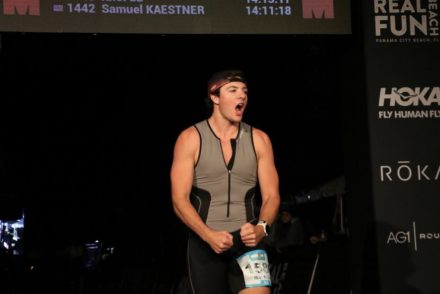
As a finance and entrepreneur double major, an Innovation Scholar, and a servant leader for Elon University’s Catholic Campus Ministry, Taylor had six months to train for the Eagleman. He used the Beck Pool in the Koury Athletic Center for his morning swims, and the Jerry and Jeanne Robertson Track and Field Complex to practice his long-distance runs. When the day of the Eagleman came, and Taylor crossed the finish line, he knew he was ready for the full Ironman race.
“This wasn’t my first time testing my limits in a triathlon. Crossing that finish line was one of the most rewarding experiences of my life. It proved to me that I was capable of pushing past the point of exhaustion and that the real challenge wasn’t only physical, it was mental,” Taylor said
Since that day, Taylor’s training has only intensified. The 70.3 Eagleman taught him that success in endurance racing is built on discipline, consistency and the ability to embrace discomfort. Balancing college life with the demands of Ironman preparation was one of his greatest challenges. Between early morning swim sessions before class and hour-long bike rides on the weekends, Taylor realized that recovery became as important as the workouts themselves. Nutrition, sleep, and mindset all became part of the equation. Taylor values Elon University’s Health EU initiatives, not only because health is a big part of his identity, but he also wants his generation to become healthier.
“Growing up, especially with the strain of screens, had taken a toll on my generation’s mental and physical health. So, it is reassuring that Elon pushes mental and physical health and provides many resources for students to get active and feel better,” Taylor said.
On Nov. 1, 2025, he stood at the edge of the Gulf of Mexico in Panama City Beach, Florida, waiting for the horn to sound. At 20 years old , Taylor dove into the Gulf waters at sunrise and crossed the Ironman finish line after sunset. The moment marked the culmination of a journey that began a year earlier and was shaped by every early morning run, every swim lap and every mile pedaled on tired legs.
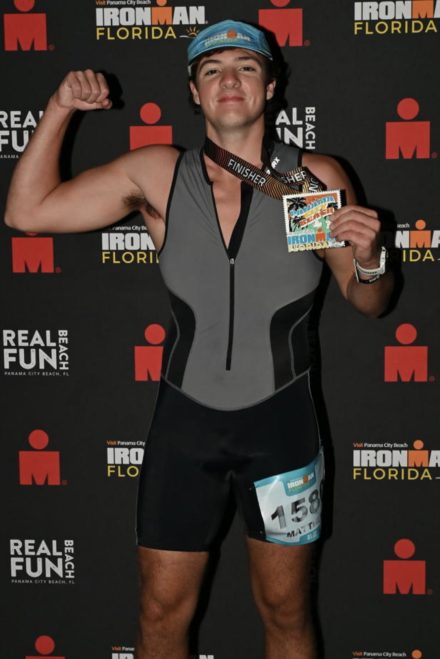
“It was unlike anything I’ve done before. I knew there would be moments of struggle, when fatigue set in and doubt crept up. Every mile I accomplished reflected months of dedication and determination,” Taylor said.
During this experience, Taylor was able to connect with many of his peers who were also training for similar races and researching health studies. Taylor had the opportunity to participate in a caloric burn research study with Assistant Professor Amanda McGrosky, which utilized carbon dioxide levels from a person’s breathing to determine the number of calories being burned. Through Taylor’s participation and McGrosky research, they were able to discover weight gain should be credited towards overeating, rather than decreased physical activity. Taylor is also a member of the recently founded Elon University Triathlon Club.
“For me, this race wasn’t just about athletic achievement. It was about proving what’s possible when you commit fully to a goal. It was about representing the power of perseverance and showing that even as a student balancing studies, commitments, and training, you can still chase something extraordinary,” Taylor said.