


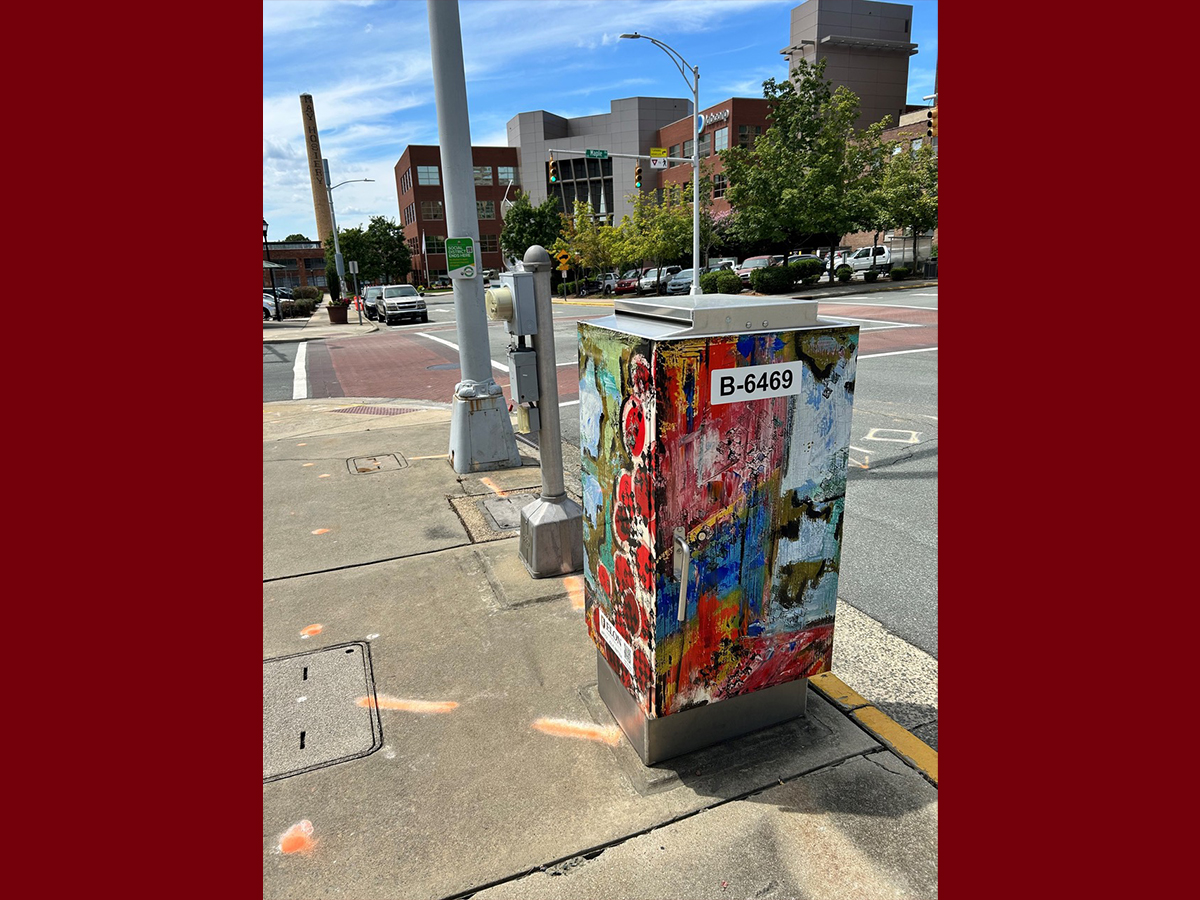
Elon University’s Department of Art and downtown Burlington collaborate to install traffic control signal boxes featuring student artwork.
On the corner of South Spring and East Davis Streets in downtown Burlington, there sits a large metal box. Positioned between a lamppost and a speed limit sign, it would be an unremarkable part of the urban landscape were it not for the bright splash of color it brings to its concrete surroundings.
Circles of varying shades of red creep up the box’s side, while daubs of deep blues, bright greens and icy whites give passersby something new to notice every time they see it. Has Burlington commissioned a new piece of modern art for its downtown? No, this colorful beauty is entirely practical; it’s a traffic control signal box. The first in this collaboration.
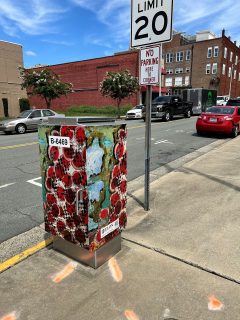
A traffic control signal box may not be most people’s first thought for an art installation, but downtown Burlington has chosen it to be the new medium to host a collaboration with Elon University’s Department of Art. Samantha DiRosa, professor of art and environmental studies and chair of the art department, acted as their liaison, choosing student work to be shown to a committee, from which they selected the finalists.
“It’s energizing to see this partnership between Elon’s Art Department and downtown Burlington,” DiRosa said. “Public art has the potential to spark dialogue, invite curiosity and strengthen community identity. We’re excited about the possibilities for more students to participate and to see their work enliven the streets of Burlington.”
The signal box initiative is the latest of downtown Burlington’s efforts to incorporate local art into public spaces, with previous installations including Hervey Garcia’s mural “Between Us,” Beechwood Metalworks’ “Heart of Downtown” and Gina Elizabeth Franco’s “Dance It Out.”
“We value local art and we wanted the downtown to have locally generated art and reflect the community,” said Adam Shull, economic development director for the City of Burlington. “The signal boxes were chosen as a canvas since they are in plain sight, because once you see them, you notice them everywhere. We wanted to bring more whimsy in everyday life.”
The first box to be installed is the work of Jolie Patten ’25, an art major and expressive art minor. Patten’s work emphasizes finding wonder in the mundane, a concept she brings to fruition through this project. Chosen for its ‘vibrant color and abstract qualities’ Patten’s design was printed onto vinyl, which was then installed onto the signal box. This combination of durability and vibrancy ensures that the artwork will remain available to the Burlington community for years to come.
Patten’s box was the first of nine signal boxes designed by Elon students and alumni. Art major Sarah Allan Straight’s ’26 artwork is also on display.
“Some work I did in class happened to be a good fit for the signal boxes, Straight said. “I’m happy the piece was a good fit, and it got to have a life outside of being just classwork. It’s exciting that I get to have my work displayed in Burlington. I’m happy to be able to contribute.”
DiRosa views the opportunity for civic partnership as an extension of the Department of Art’s mission.
“At Elon, we empower students to reach their potential as makers, thinkers and global citizens,” DiRosa said. “It reflects our emphasis on curiosity, material exploration and community engagement — showing students that their art has the power to shape public spaces and spark creative transformation beyond the classroom.”
The city of Burlington has received positive feedback on the artistic signal boxes.
“Businesses and residents really like the signal boxes, and it gives Burlington a nice and cultural feeling that adds to the downtown,” said Maggie Hogan, City of Burlington downtown manager. “As a student, seeing your art on something public is really exciting. We hope to continue to build that relationship with Elon.”
Elon University and the City of Burlington both see this collaboration continuing to display student artwork.
“We see this as a growing collaboration,” DiRosa said. “More students and alumni will be able to showcase their work in highly visible, community-centered ways, whether through additional signal boxes or other downtown art initiatives. It’s an opportunity not only for professional exposure but also for students to see their art making a tangible difference in the place where they live, work and study.”