


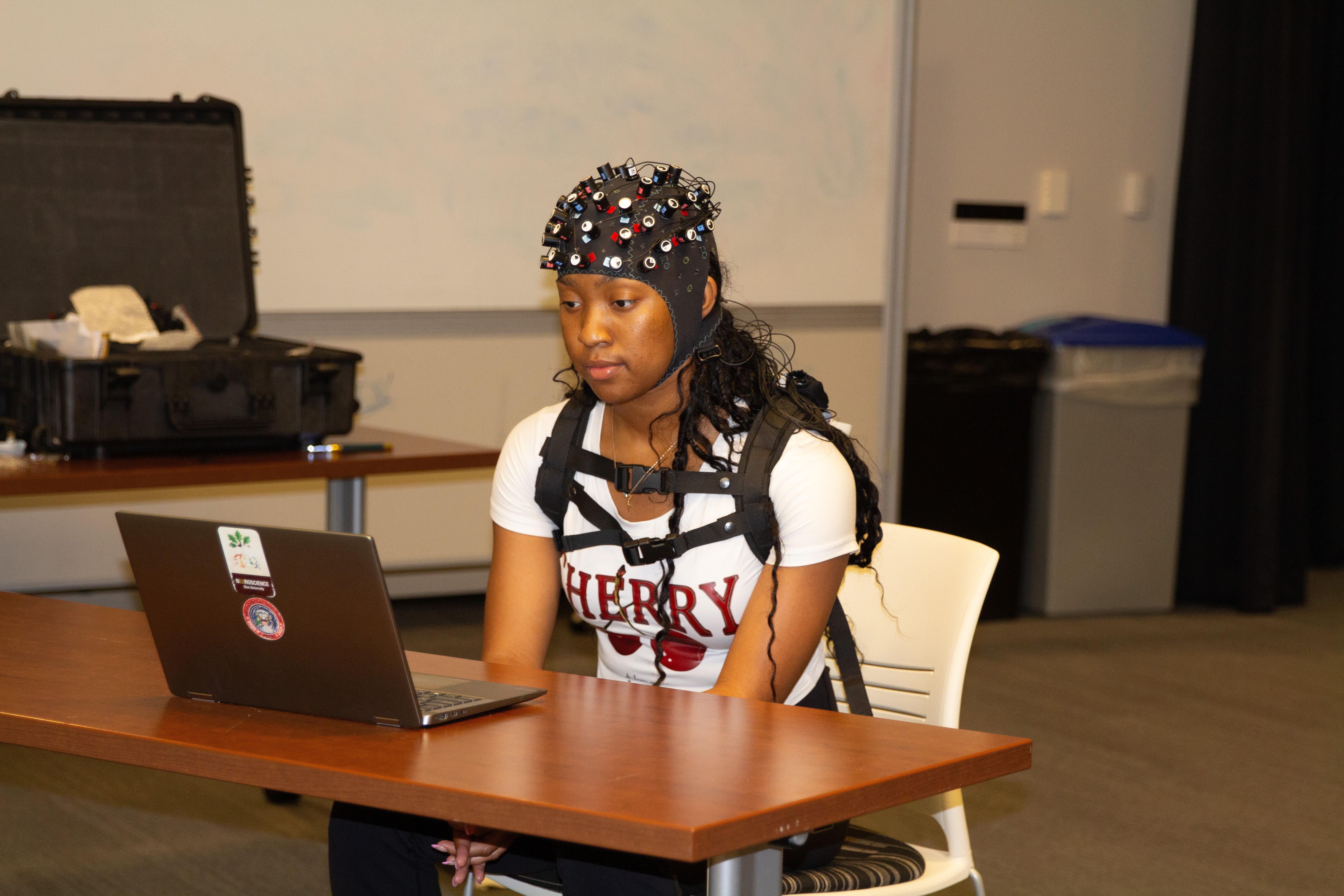
Sanai Crosby ’28 is using specialized neuroscience equipment to understand how movement shapes brainwaves during choreographed dance.
For Sanai Crosby ’28, dance is more than movement and performance – it’s a way to better understand how the brain works.
Crosby, an exercise science and dance science major, Honors Fellow and Lumen Scholar, is researching how neural activity differs between creating and performing dance, exploring the connection between movement, creativity and brain function.
Through her Lumen Prize project, Crosby will investigate which areas of the brain are most active during dance and how different environments, such as performing on stage or outdoors, influence neural processes.
“What excited me most about this research is the creative process and measuring something that is usually seen as subjective,” Crosby said. “This research allows me to study dance not just as an art form, but as a complex neurological process.”
Crosby’s project combines two passions that have shaped her life. She has been dancing since she was seven years old and later attended Weaver Academy, a performing and visual arts school in Greensboro, North Carolina, where she focused on dance while studying technique, choreography and anatomy.
Now, she is combining her dance background and scientific interests to examine questions about cognition and movement.
Using electroencephalography and functional near-infrared spectroscopy technology, from internal and external resources, Crosby plans to track brainwave patterns while participants dance and engage in creative movement tasks. The data will help identify which regions of the brain are active during different stages of movement and choreography, offering new insight into the relationship between physical movement and neural function.
Crosby plans to use a portion of her Lumen Prize funding for research-related equipment and data collection.
“Having access to EEG and fNIRS equipment is essential because it allows me to collect real-time data on brain activity during movement,” Crosby said. “Without it, I wouldn’t be able to objectively measure what’s happening in the brain during dance.”
Crosby had the recent opportunity to experience the technology firsthand when representatives from NIRx Medical Technologies and ANT Neuro visited campus to demonstrate specialized neuroscience equipment that could expand opportunities for student learning and research.
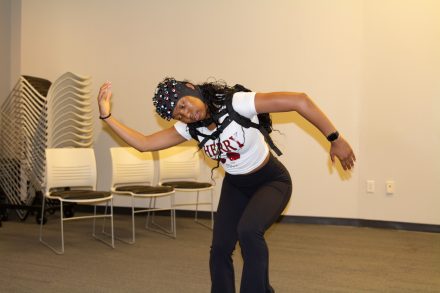
During one demonstration, Crosby wore a portable fNIRS device while dancing and moving freely as software collected real-time brain activity. Unlike traditional neuroscience equipment, which is tethered to amplifiers and computers, the demonstrated technology was fully mobile, allowing Crosby to collect data in natural environments rather than limiting studies to laboratory settings.
“Having access to this portable equipment is important because it allows researchers to study movement in dynamic, real-world environments rather than limiting research to traditional laboratory settings,” said Associate Professor Matt Wittstein, director of neuroscience at Elon University and Crosby’s research mentor.
For Crosby, the portability of the equipment could be transformative. Rather than studying participants in controlled laboratory environments, researchers can collect data while dancers move naturally in rehearsal spaces or other settings that more accurately reflect real-world experiences.
The demonstrations also highlighted broader opportunities for interdisciplinary research across campus. Students and faculty observed how the technology captures and analyzes neural activity in real time, creating possibilities for research projects that connect neuroscience, exercise science, dance and psychology.
“Getting access to this equipment opens the door for more interdisciplinary research,” Crosby said. “Students in exercise science, dance, psychology and neuroscience can all use it to explore different questions about movement, performance and the brain. It allows for more innovative and data-driven projects that go beyond traditional research methods.”
Beyond individual research projects, the technology could support new courses, mentorship opportunities and collaborative experiences for students interested in neuroscience. The equipment also creates opportunities for community outreach and partnerships with industry leaders, helping students gain experience with tools commonly used in professional and research settings.
“Access to this equipment also opens the doors for more unique studio projects, mentorship and courses such as a lab-based psychophysiology course,” Wittstein said. “As the program continues to grow, a goal is to have a capstone seminar for students to all create a miniature neuroscience project, and equipment like this would make that possible.”