


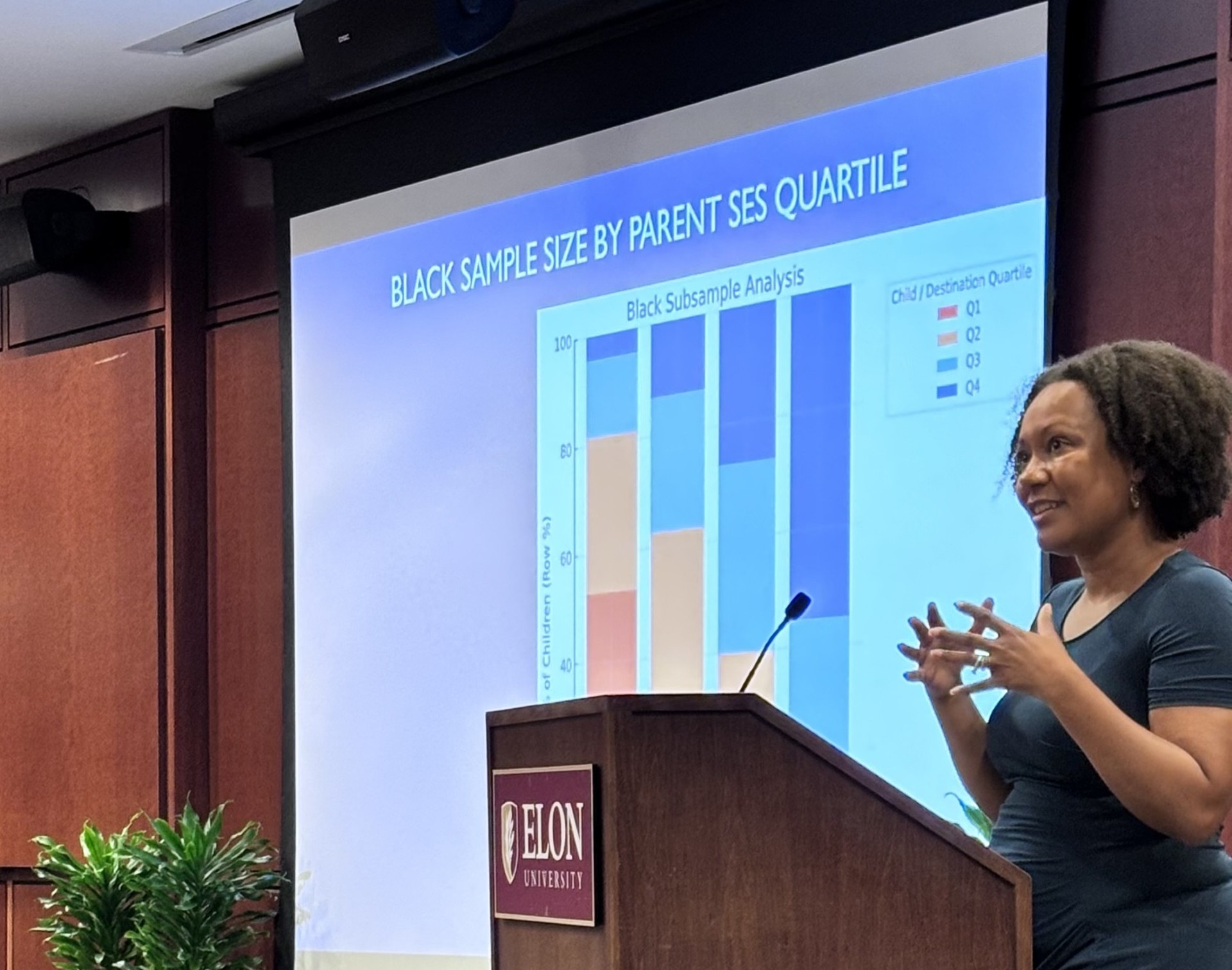
Janeria Easley presented her research on factors that contribute to racial disparities in intergenerational mobility at an event sponsored by African and African-American Studies at Elon (AAASE) and the Black Lumen Project.
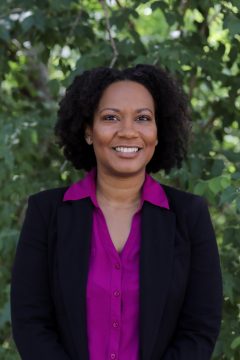
On Thursday, Sept. 17, Janeria Easley presented her research for the African and African-American Studies at Elon (AAASE) Interdisciplinary Minor Program’s Fall 2026 Invited Speaker Event in LaRose Digital Theatre. The AAASE minor coordinator, Jessica Carew, briefly introduced Easley, who is currently an assistant professor of African American Studies at Emory University. Easley’s research and teaching expertise centers around racial disparities in economic well-being, as well as demography, social stratification, urban studies, and media studies.
In Easley’s presentation titled “Beyond the Starting Point: Holistic Mobility Among Black and White Families,” she discussed the concept of intergenerational mobility and identified the degree to which racial disparities exist across several influential factors, such as wealth accumulation. Easley argues that to best understand what explains whether families experience intergenerational mobility, it is important to use measures that account for the interaction between and among multiple influential factors.
She and her co-authors utilize long-running national survey data to build a more complete picture of where families start and where they end up — combining occupation, income, education, wealth, and neighborhood quality into two composite measures, which they call an “origin profile” and a “destination profile.”
Rather than asking “Does parental education predict child education?” they ask, “Does someone’s overall starting position predict their overall ending position?” The data presented from this more holistic approach shows that the gap in mobility between Black and white families is stark, particularly at the high and low ends of socioeconomic status. Black families are more likely to encounter difficulty increasing their socioeconomic status, while the children of Black parents with a higher status encounter barriers that lead to them being less likely to maintain that status in adulthood (as compared to similarly situated White families).
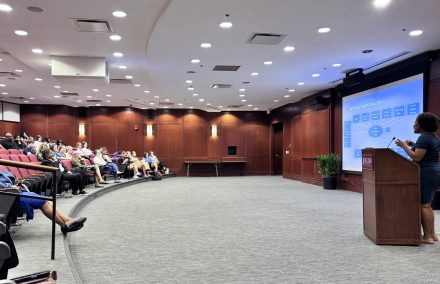
After the presentation, students and faculty in the audience participated in an engaging question-and-answer session that ranged from better understanding the measures used in the study to a consideration of other influential factors that are difficult to measure. Subsequently, Carew noted that Easley’s research is especially timely, given both the continuing rise of economic inequality in the U.S. and the increasingly hostile rhetoric challenging the merits of and belonging of Black Americans in higher education.
Easley’s findings demonstrate the strong influence of Black parents’ educational attainment on socioeconomic outcomes for their children. This research highlights what is at stake for the long term outcomes and prosperity of African American populations today and in the near future, in the context of the increasing barriers to education and employment that many encounter.