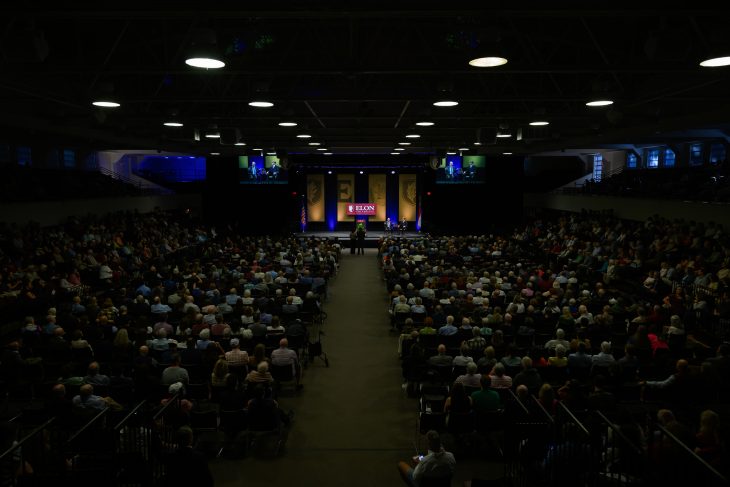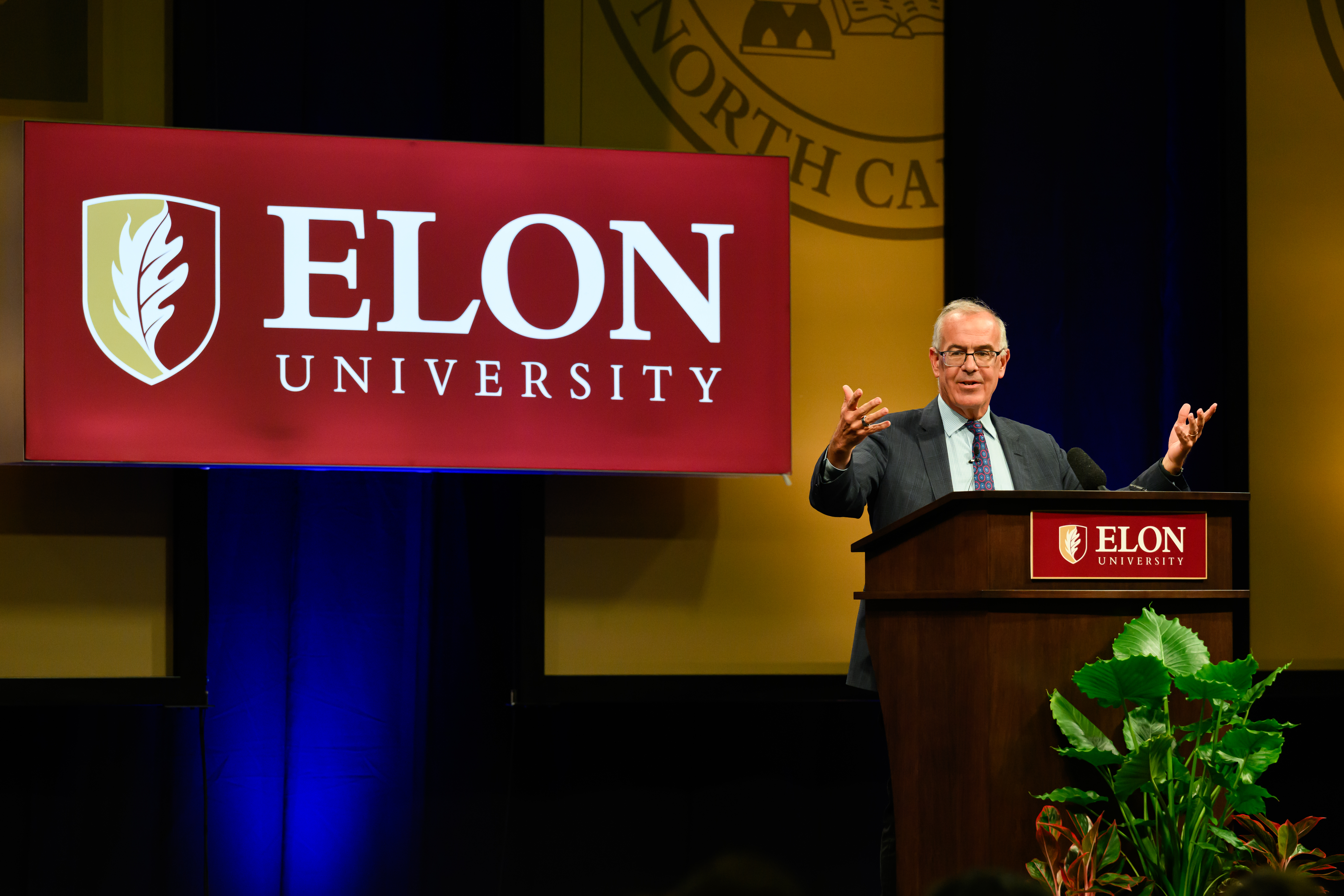
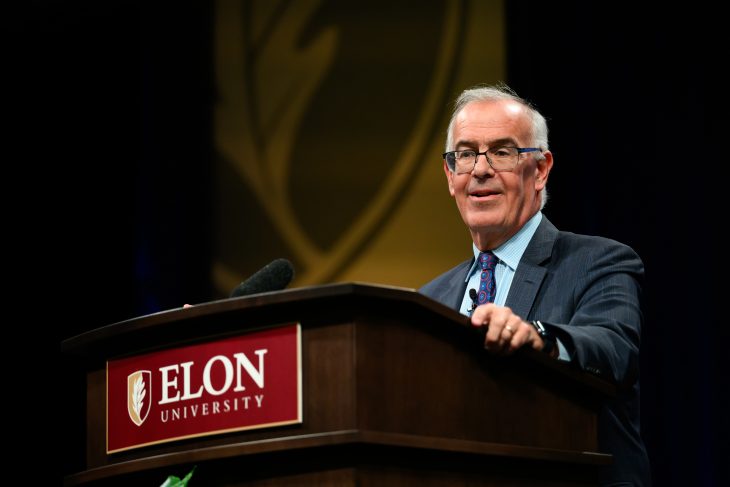
New York Times columnist and bestselling author David Brooks spoke to a sold-out crowd in Alumni Gym for Fall Convocation on Sept. 25, part of Family Weekend and the Elon University Speaker Series.
New York Times columnist and bestselling author David Brooks says there are two important skills needed for success — two skills that have taken him time to learn: how to see people and how to have an impact on the world.
“I tried to teach myself these social skills of how to see other people, and they’re basic social skills,” Brooks said. “It’s not mystery. It’s how do you learn to end a conversation gracefully? Are you going to be a good listener? How do you ask for and offer forgiveness? How do you ask somebody out? How do you break up with someone without breaking their heart? These are skills. And somehow, the last couple of generations, we have not taught these skills.”
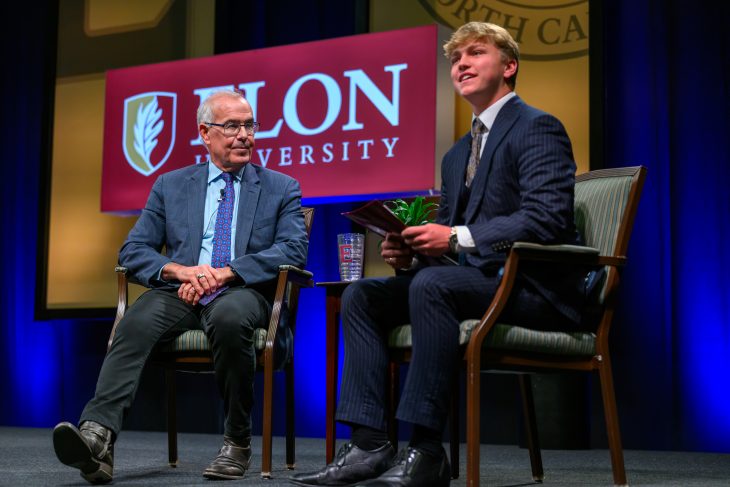
Brooks spoke to a sold-out crowd of students, families, faculty, staff and friends of the university during Fall Convocation on Sept. 25 in Alumni Gym. The event, held during Family Weekend, concluded with Brooks joining Student Government Body President Michael Swartz ’27 for a question-and-answer session featuring questions from the audience.
In addition to his longtime work for The New York Times, Brooks serves as a staff writer at The Atlantic, a commentator on PBS NewsHour and a senior fellow at Yale University’s Jackson School of Global Affairs. He is also the author of multiple bestselling books, including “How to Know a Person,” “The Second Mountain,” “The Road to Character” and “The Social Animal,” which explore moral development, human connection and the search for meaning.
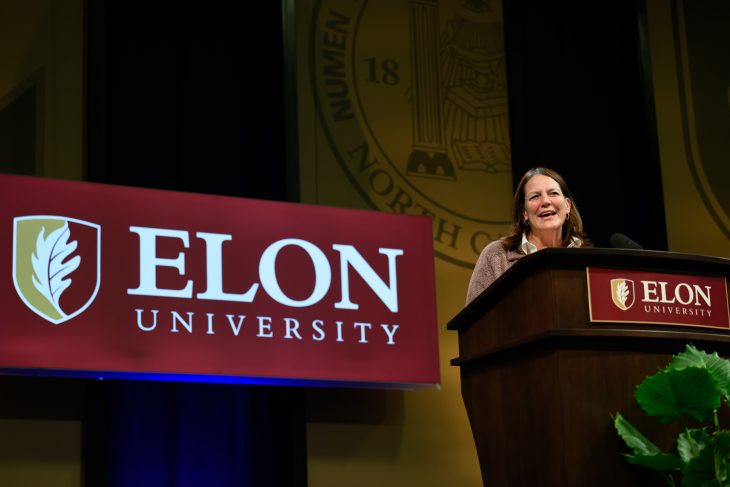
“The purpose of today’s gathering has never changed. A university education is far more than the accumulation of credits and credentials. An Elon education is about engagement, engagement with ideas and engagement with each other,” Elon President Connie Ledoux Book said during her opening remarks. “We want to listen, to discuss, and to see the world through the eyes of another person, and to use that knowledge to imagine a different world. A better world. Those are the habits of mind and heart.”
Learning to see others
Blending personal anecdotes with stories of people he has encountered throughout his life and career, Brooks offered several ways to become better at seeing and understanding others.
The first begins with something simple: how people look at one another.
“When we’re meeting somebody, we are unconsciously asking ourselves a question. Is this person going to be nice to me? Am I a person to this person? My priority to this person. And the answer to that question will be expressed in your eyes before any words come into your mouth, he said.
Brooks also emphasized “accompaniment,” focusing on what another person may need or be experiencing in a particular moment.
“Accompaniment is another centered way of being in the normal circumstances of life,” Brook said. “What does this person need right now? What are they going through right now? And that’s just such a generous, everyday skill.”
Becoming a great conversationalist is another part of truly seeing people, Brooks said. He noted that conversation experts have told him that a person should give someone either 100% of their attention or none of it, but never split their attention 60/40.
He also encouraged the audience to become “loud listeners” and to ask questions that invite people to tell stories about themselves.
“Get somebody telling a story. I no longer ask people, ‘What do you believe?’ I ask, ‘How do you comfortably believe that?’ I want to know who influenced and what event influenced them. The other part of good questions is, they’re more ambitious than you feel comfortable with. You think people are shy, you’ve got to earn their trust. That’s true, of course. But people want to get deep faster than you think.”
Making an impact on the world
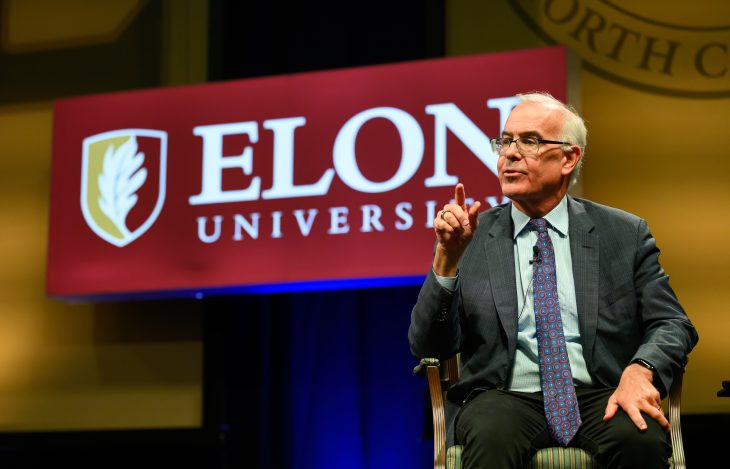
Turning to the second skill — how to have an impact on the world — Brooks described the “gleam” he often sees in people’s eyes.
“It’s the gleam on the young person’s eyes who was anticipating a big life, and it (is) hungering for a big life and I just love that boldness of spirit,” he said.
Brooks encouraged those gathered to be “enthusiastically engaged” with the world and to embrace their desires, motivations and passions.
“Deep down inside of us, each of us has a spiritual core. This nuclear actor, a place in the innermost core of all of our beings that produces immense flows of energy,” he said. “This is the place your desires come from, your yearnings, your tears, your aspirations, your affections, your hopes, your enthusiasm, and your loves,” he said.
Skills of the heart
Brooks also offered four concepts for students to consider as they navigate college.
The first was Rumspringa, drawing from the Amish rite of passage. Brooks said college should provide students with opportunities to explore rather than focusing exclusively on preparing for a profession.
“In my view, every college in America, including the one I teach at, is over-professionalized. It is a time in life, which is, for many people, the only time in life, you just get to explore. You get to wander,” he said.
He next introduced epitasis, a Greek term for “stretching” or an increase in intensity. Brooks described happiness as a pursuit and emphasized the importance of teaching people “to keep going.”
The third concept was orthocardio, or having the right kind of heart.
“The kind of heart that will love the right things the right way,” he said.
Finally, Brooks discussed phronesis, the Greek concept of practical wisdom and the ability to understand what matters in a given situation.
“It’s an intuitive grasp of any situation. What really matters here? How are events flowing? It’s the ability to see a person whole. Logic allows us to take things apart, figure it out. Phronesis allows us to see reality cold,” he said.
Together, the ideas returned to the central message Brooks offered throughout his address: Education should develop more than a person’s intellect. It should help students develop the human skills needed to understand others, pursue meaningful lives and engage fully with the world around them.
“The schools I admire most do not treat children and students as brains on a stick; but as whole people, and engage their ambitions and their dreams and the desires just as much as facts about spreadsheets,” Brooks said. “And so, what I’ve tried to describe to you tonight is skills, which are not skills of the head, but are skills of the heart.”