



This final poll before election day was conducted Sept. 29 – Oct. 8 and gathered input from 800 North Carolina adults, with an overall margin of error of +/-4.03%.
With 15 days to go before the Nov. 3 election, former North Carolina Gov. Roy Cooper has a 13% lead over Republican Michael Whatley among likely voters in the race for the state’s open U.S. Senate seat. Cooper has maintained strong leads in this race throughout this year’s surveys by the Elon University Poll. This final poll before election day was conducted Sept. 29 – Oct. 8 and gathered input from 800 North Carolina adults, with an overall margin of error of +/-4.03%.
Cooper was favored by 52% of likely voters, compared with 39% who favored Whatley, 6% who were undecided and 3% of likely voters said they favored Libertarian candidate Shannon Bray, Green Party candidate Michael Dublin, or “someone else.”
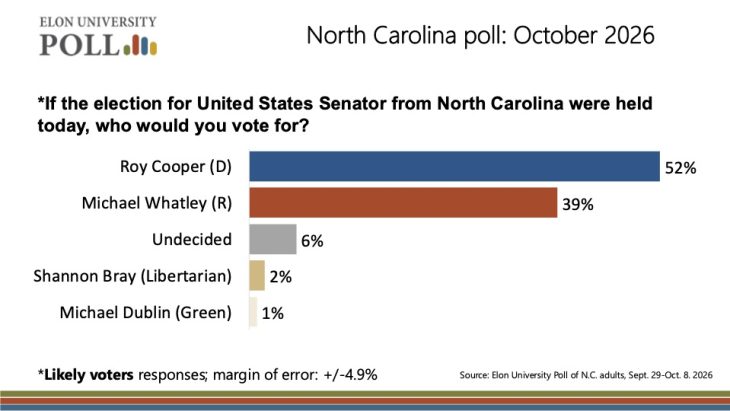
In a forced-choice question in which undecided voters were asked to make a choice of who they would vote for, Cooper’s advantage over Whatley shrank to 11% (54%-43%).
Among likely voters, Cooper was supported by 93% of Democrats and 50% of Independents, while Whatley was supported by 85% of Republicans and 24% of Independents. Seventeen percent of Independents said they were undecided.
Whatley led among White voters with 46%, compared with 40% for Cooper. However, Cooper held wide advantages in other demographics, including a 70%-14% margin among Black voters and a 59%-22% lead among Hispanic voters. Cooper and Whatley were tied at 42% each among male likely voters, but females favored Cooper by a 51%-34% margin.
“Roy Cooper’s sustained lead over Michael Whatley in North Carolina is being driven in large part by strong support among moderates, true independents and women,” said Jason Husser, director of the Elon University Poll and professor of political science and public policy. “We also are seeing signs of a potential turnout gap, with Cooper voters expressing higher levels of excitement about voting in the election and placing more importance on the election for real-world outcomes in their lives.”
“Three findings in our data stand out to me highlighting potential for Cooper’s lead to contract somewhat between now and Election Day,” Husser said. “First, Michael Whatley has a slight advantage among undecided voters when we pressed them to make a choice, attributable to more undecided voters being 2024 Trump voters than 2024 Harris voters. Second, Whatley voters continue to predict he will ultimately win, suggesting his supporters are still motivated to cast their votes. Third, Cooper’s lead among registered voters overall is smaller than his lead among the subset of registered voters who say they are likely to vote, implying opportunity for Republicans if they can motivate more of their base to turn out.”
Cooper continued to hold an advantage in voter familiarity, with 67% of likely voters saying they had heard a “great deal” about Cooper, compared with 38% who said they had heard a “great deal” about Whatley. Still, Whatley has closed the gap on familiarity, with a total of 80% saying they had heard at least something about him.
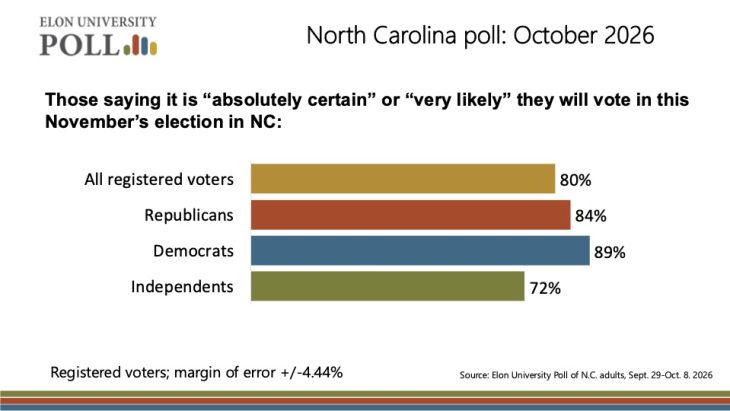
A large majority of registered voters said they intend to cast a ballot, with 63% saying it is absolutely certain they will vote and another 17% saying it is very likely they will vote.
Related to the campaign, 27% of registered voters said they had seen more negative ads about Cooper, with 18% saying they had seen more negative ads about Whatley, and the largest percentage (41%) saying they had seen about the same amount of negative ads for each candidate.
Impact of President Trump on this year’s election
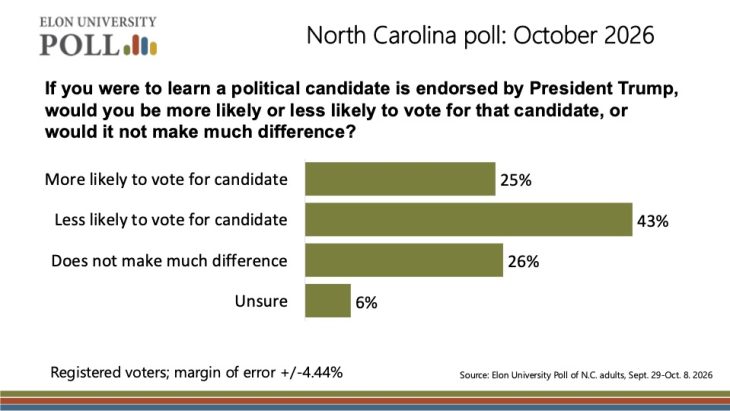
At campaign rallies, President Trump has told supporters they should “pretend” he is on the ballot. However, in this survey, 43% of registered voters said an endorsement by President Trump would make it less likely they would vote for a candidate, compared with 25% who said a Trump endorsement would make it more likely they would vote for a candidate. About 26% said a Trump endorsement would not make much difference.
Trump’s promise of giving a $5,000 “dividend” to each adult U.S. citizen if Republicans win control of both the House of Representatives and U.S. Senate appears to be having a somewhat negative effect, with 30% saying the promise makes them less likely to vote for Republicans and only 16% saying they are more likely to vote for Republicans. The largest percentage, 50%, said the dividend promise makes no difference in who they will vote for.
“President Trump’s $5,000 dividend idea does not appear to be swaying a net positive amount of North Carolina voters towards Republicans,” Husser said. “Even among those who approve of the President’s job performance, most said the dividend makes no difference to their voting decision. However, the President’s endorsement still resonates with his base. Among Republicans, almost none indicate that a Trump endorsement makes them less likely to support an endorsed candidate, and slightly more than half said it makes them more likely to support that candidate. This gives credence that visits by President Trump and Vice President Vance to the state have potential to motivate Republicans to turn out, even if those visits do not do much to persuade voters outside the GOP.”
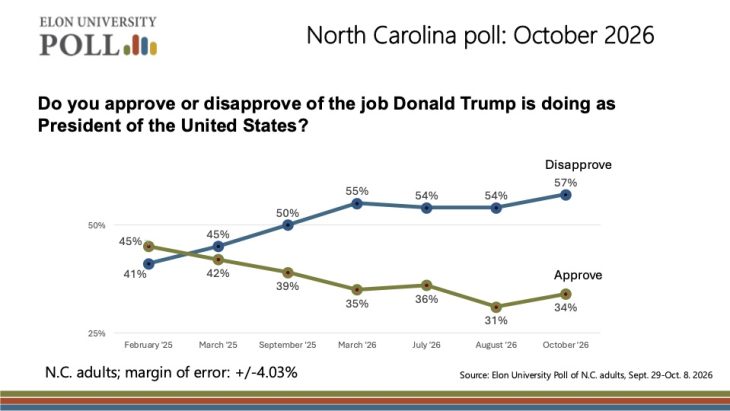
In this survey, Trump’s disapproval rating was at 57%, the highest in his second term in office, compared with a 34% approval rating, which is slightly higher than the August Elon University Poll.
The survey also asked about job performance for Pete Hegseth, secretary of defense/secretary of war. Forty-six percent disapproved of his performance, compared with 27% who approved and 28% who were unsure.
Issues on voters’ minds
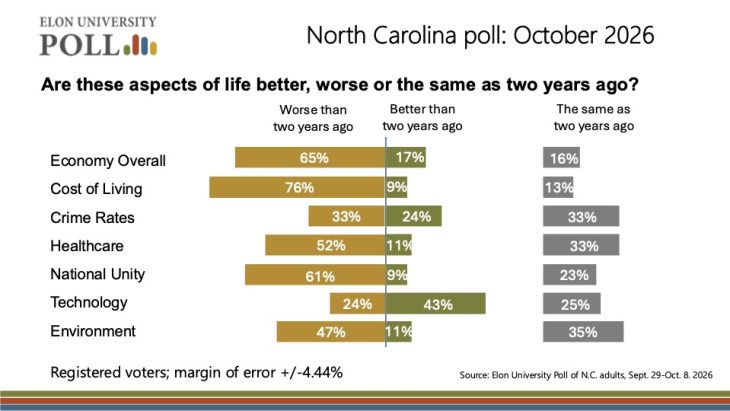
On issues in this mid-term election, a majority of registered voters said many aspects of their lives are worse than two years ago. This includes 76% who said the cost of living is worse, compared with only 9% who said it is better. Sixty-five percent said the overall economy is worse than two years ago, compared with 17% who said it is better, and 61% said national unity is worse, compared with 9% who said it is better.
In responding to an open-ended question that asked respondents to cite the single most important issue in the election in four words or less, 37% mentioned economic issues, including inflation and cost of living (22%) and economy and jobs (15%). These issues far outdistanced other issue categories, which included the following:
- Partisan control (16%)
- Democracy and civil rights (10%)
- Immigration and border security (6%)
- Leadership and corruption (6%)
- Education (3%)
- Foreign affairs and national security (3%)
- Taxes and federal budget (2%)
- Healthcare (2%)
- Crime, safety and policing (2%)
- Reproductive rights (1%)
- Social Security (1%)
- Technology (1%)
Among registered voters, 52% said they were extremely or very excited to cast their ballots, including 65% of Democrats and 55% of Republicans. An overwhelming percentage say the election is important for real-world outcomes in their lives, with 54% saying this year’s election is “extremely” important and 29% saying the election is “somewhat” important.
“As evidence that this midterm election is in many ways a referendum on the last two years, voters who think conditions have improved over the last two years tend to be supportive of the candidate of the party in control of the White House, Michael Whatley,” Husser said. “In turn, those who think conditions have worsened more often support the candidate of the other party, Roy Cooper. The asymmetry that matters here is that North Carolina has far more voters who think key issues have gotten worse than voters who think issues have gotten better.”
Party politics
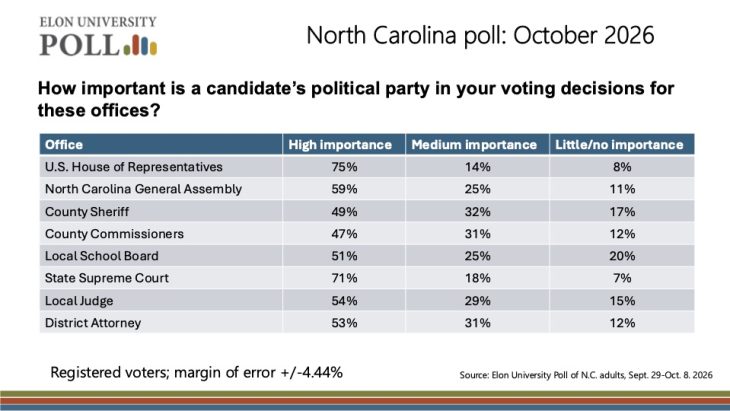
Registered voters in this survey said candidates’ party affiliation is of high importance for national, state and even local races. Three-quarters of registered voters said a candidate’s political party is highly important in their voting decision for the U.S. House of Representatives, while 71% said party is important in their votes for the North Carolina Supreme Court and 59% said it is important for their votes for North Carolina General Assembly offices.
In local races, candidates’ party affiliation is of high importance for local judges (54%), district attorney (53%), school board (51%), sheriff (49%) and county commissioners (47%).
“North Carolina voters place much less importance on party affiliation in local races than in federal races,” Husser said. “A substantial part of the electorate is also placing more importance on party in the statewide North Carolina Supreme Court choice than on their choices for local judges. While this pattern is not an absolute indicator of split-ticket voting in 2026, it is suggestive that we will see mixed outcomes by party throughout the state on local races.”
Poll Methodology
Access the poll topline and full methodology at: www.elon.edu/elonpoll. The survey was developed by the Elon University Poll and fielded by the international marketing and polling firm YouGov as an online, web-based survey, self-administered through online panels. Between September 29 and October 8, 2026, YouGov interviewed 1,038 North Carolina adults aged 18 and older. These respondents were then matched down to a sample of 800 to produce the final dataset. YouGov’s sample matching procedure was used to create a sample of panelists that was representative of the North Carolina population on education, age, race, gender, registration, and partisanship (2024 vote). The margin of error for likely voters in this survey is +/-4.9%, for registered voters in this survey (adjusted for weights) the margin of error is +/-4.44%, and the margin of error for all adults in this survey is +/-4.03%.
About the Elon University Poll
Established in 2000, the Elon University Poll conducts national and North Carolina surveys on issues of importance to voters and residents. Information from these polls is shared with media, citizens and public officials to facilitate informed public policymaking through the better understanding of citizens’ opinions and attitudes. The poll is fully funded by Elon University and operates as the neutral, non-biased information resource.
The Elon University Poll is a charter member of the Transparency Initiative, a program created by the American Association for Public Opinion Research (AAPOR) in 2014 to educate polling firms on ways to better share how they collect and interpret their information. The Elon Poll’s voluntary participation in this initiative signifies a willingness to clearly state in its reports how questions were asked, in what order, who funded the poll and who conducted it, and a definition of the population under study, among other details.