


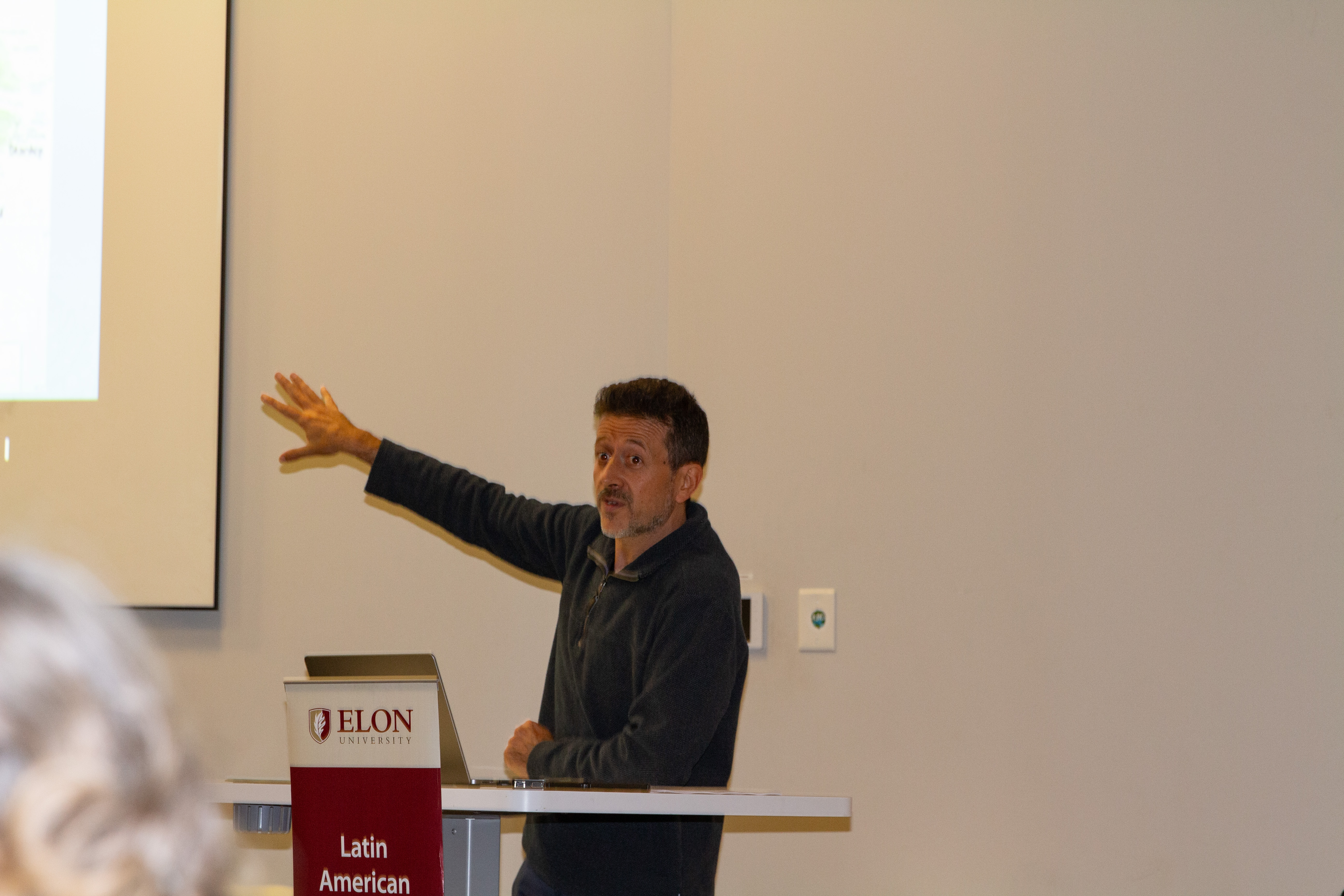
Fede Pous, professor of Spanish, delivered a lecture on intergenerational transmission of memories on Nov. 12 for the Latin American Studies research series.
Elon University professor Fede Pous presented his research on Nov. 12 in Sato Commons 103 as part of the Latin American Studies research series. His lecture, “Conjuring the War: Veteran Enemies and the Intergenerational Transmission of Memory in “Campo Minado/Minefield” (Lola Arias),” exposed his research about the production of collective memory regarding the last dictatorship in Argentina from 1976-83. During the talk, he analyzed “Campo Minado/Minefield,” (Arias 2016) a bilingual performance about the 1982 Falklands War between England and Argentina.
The play brings together three British and three Argentine veterans to reenact their own memories challenging the official memory of the war. For Pous, “Campo Minado” encourages the audience to share the burden and responsibility of remembering war and dictatorship for the sake of the new generations and the ongoing construction of a democratic society.
Pous explained how the production was groundbreaking because it puts together former enemies in the same stage.
“Think of any war today and try to imagine a sustained dialogue among soldiers of opposite sides sharing their memories on the same platform,” Pous said.
It seems impossible. But 33 years after the war, “Campo Minado” created the space and the political atmosphere to promote the collective production of these memories.
Historically, Britain has held the Falklands Islands since 1833, even though they are geographically next to Argentina. The latter’s sovereignty claim of the territory has long been part of its nationalist agenda, Pous said, but it did not escalate until the 1982 war, when the military government invaded and retook the islands to gain popularity to counteract an economic crisis and international demands for accountability over human rights violations.
Despite the defeat of Argentina in three months, the sovereignty claim has remained one of the few issues that unite a politically divided country today. Pous argues that Malvinas veterans, forgotten in public memory for more than 30 years, have recently become a figure of consensus for that reason. This is especially relevant today as Argentine President Javier Milei’s government has challenged collective memory of the country’s 1976-1983 military dictatorship, negating and justifying the human rights violations committed during that period. Pous also emphasized how Milei’s government has also used the Malvinas War (as they are known in Argentina) to gain popular support while failing to recognize veterans’ needs.
In his talk, Pous sustained that “Campo Minado” helped veterans overcome two obstacles. Human rights defenders hesitated to treat former soldiers as victims because of their ties to the military, and veterans were reluctant to identified themselves as political activists like the ones persecuted during the dictatorship. The theatrical production uses drama therapy techniques to help each performer process his own experiences, create a singular performative memory, and re-enacted them using their bodies on the stage.
Pous pinpoints how this reconfiguration of the Malvinas War based on the reenactment of memories by former enemies, challenges the Argentine society to share the task of explaining that history to younger generations, rather than leaving it to veterans alone.
“Even though this war took three months, it changed the lives of the veterans forever,” Pous said.
Indeed, this frame can be thought for any war, any traumatic event that lives in the body of the survivors forever. For Pous, this play is an antidote for them and hopefully for our society.
Pous was born in Argentina during the dictatorship and describes himself as part of the “postmemory” generation. He was raised during efforts to create a collective memory of those years, even though he was too young to remember them. For Pous, memory works as “a thermometer of democracy” and requires the collective effort of artists and activists as well as institutions and ordinary people to keep it alive.
His academic research looks at how traumatic memories that were never put into words pass to later generations as feelings without a narrative.
“Even after several generations people can have phobias and anxieties that cannot be explained,” Pous said.
Research on the intergenerational transmission of trauma connects those psychological reactions to painful experiences that older generations have never processed.
“For that reason keeping an ongoing dialogue about collective memory is crucial and studying how different societies have dealt with collective trauma can help communities stop the current expansion of authoritarianism throughout the globe,” Pous said.
In that sense, Pous argues that “Campo Minado” reaches beyond Argentina and applies to veterans around the world, conjuring the war despite the many ghosts that keep returning.
The lecture was presented by Latin American Studies and co-sponsored by the Department of World Languages and Cultures and Peace and Conflict Studies.