


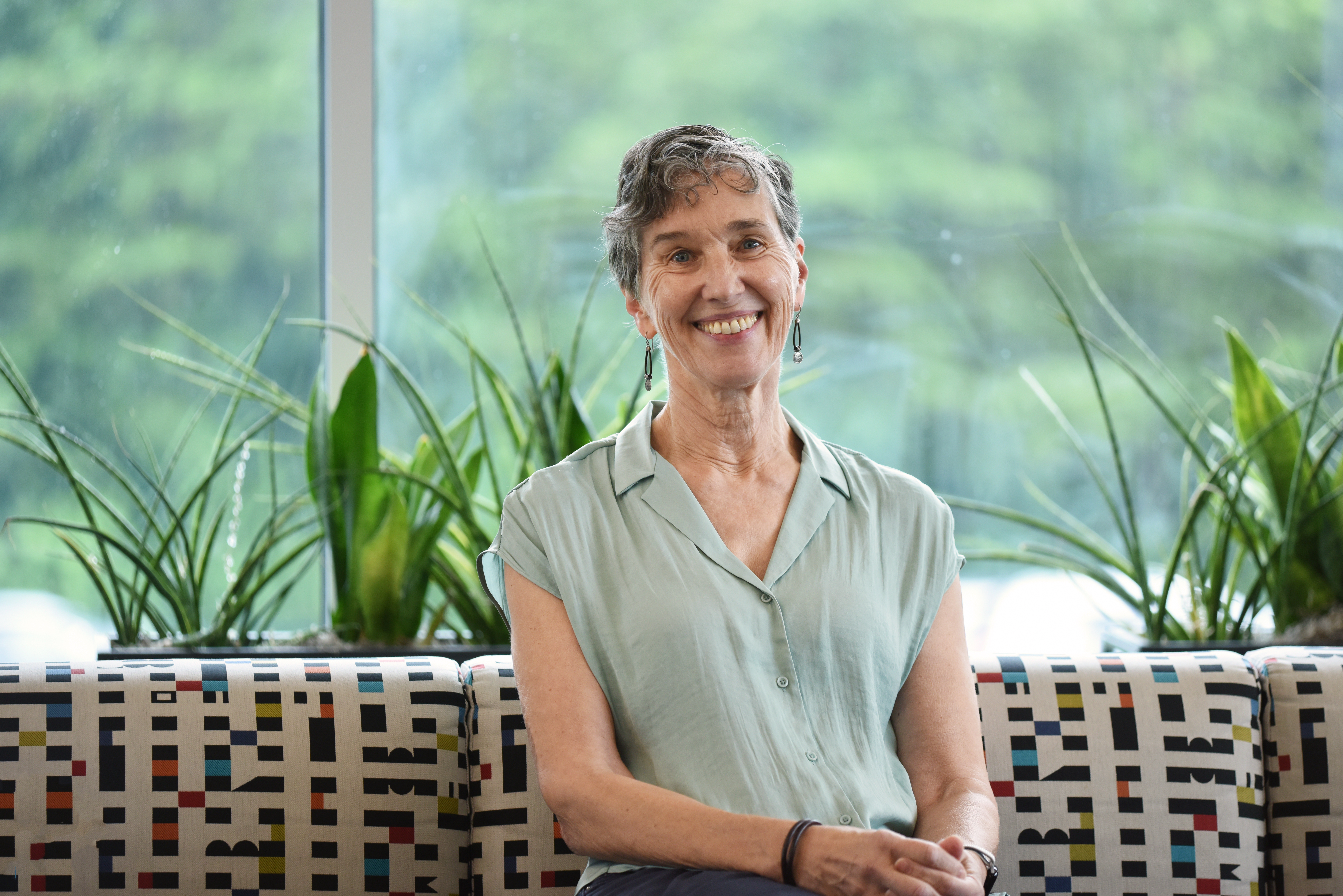
For Charity Johansson, language and movement are both ways of helping people feel understood, even when words fall away.
Colleagues in Elon’s Doctor of Physical Therapy program call her “the word- smith.”
That’s not just because Charity Johansson is quick to catch a missing comma or rework a clunky sentence — though she’ll gladly do both. For more than 25 years, she has been the one people turn to when they want to say something just right. She is deliberate with words and knows what they can carry: clarity, care and, sometimes, an entire story.
Johansson has taught in Elon’s Doctor of Physical Therapy program since 1999 and will retire in December as department chair.
“I just fell in love with words, what they do, the stories they hold and how even slight changes can create different meanings,” she said.
That same attention to language has shaped her work as a physical therapist.
Whether in the classroom or the clinic, Johansson is always listening, not just to what is said, but to what isn’t.
“Sometimes with older populations, especially those who have dementia, I get stories in unexpected ways like a moment of lucidity or a nonverbal response,” she said.
Johansson recalled one patient who had a stroke and was grieving the loss of her voice. “She no longer had an ability to vocalize her prayers. And to reassure her, I said, ‘Does God need words?’”
For Johansson, moments like these aren’t extraordinary, they’re essential. She believes care begins with observation, interpretation and presence. Patients who can no longer speak or who have lost other physical or mental abilities can still share who they are if the people they are with know how to tune in.
Johansson once worked with a woman with dementia who had grown quiet and disengaged. Johansson remembered she was a fan of music and asked which genre was her favorite. The woman replied, “folk.”
“I started singing, ‘If I Had a Hammer…’ and she started singing,” Johansson said. “She wasn’t exactly getting all the words right, but she was just belting it out.”
The patient’s family noticed. “They came in and asked, ‘What happened? We got our mother back!’”
In both therapy and teaching, Johansson uses storytelling to build trust, uncover meaning and help people move physically and emotionally from one place to another. She co-authored a widely used textbook on patient mobility skills and helped shape Elon’s relationship-centered approach to education. Her work is grounded in science, but her gift is interpretation and discovering deeper connections.
After she retires in December, Johansson plans to write fiction, a new form of storytelling for her, but not an unfamiliar one.
“Fiction lets you tell your own story to some extent,” she said. “Sometimes you tell a story you didn’t know you needed to tell.”
She has spent a career helping others feel heard through sentences and steps, questions and quiet. She is determined to bring the same instinct after retirement that she always has: to listen closely and follow the story wherever it leads.