


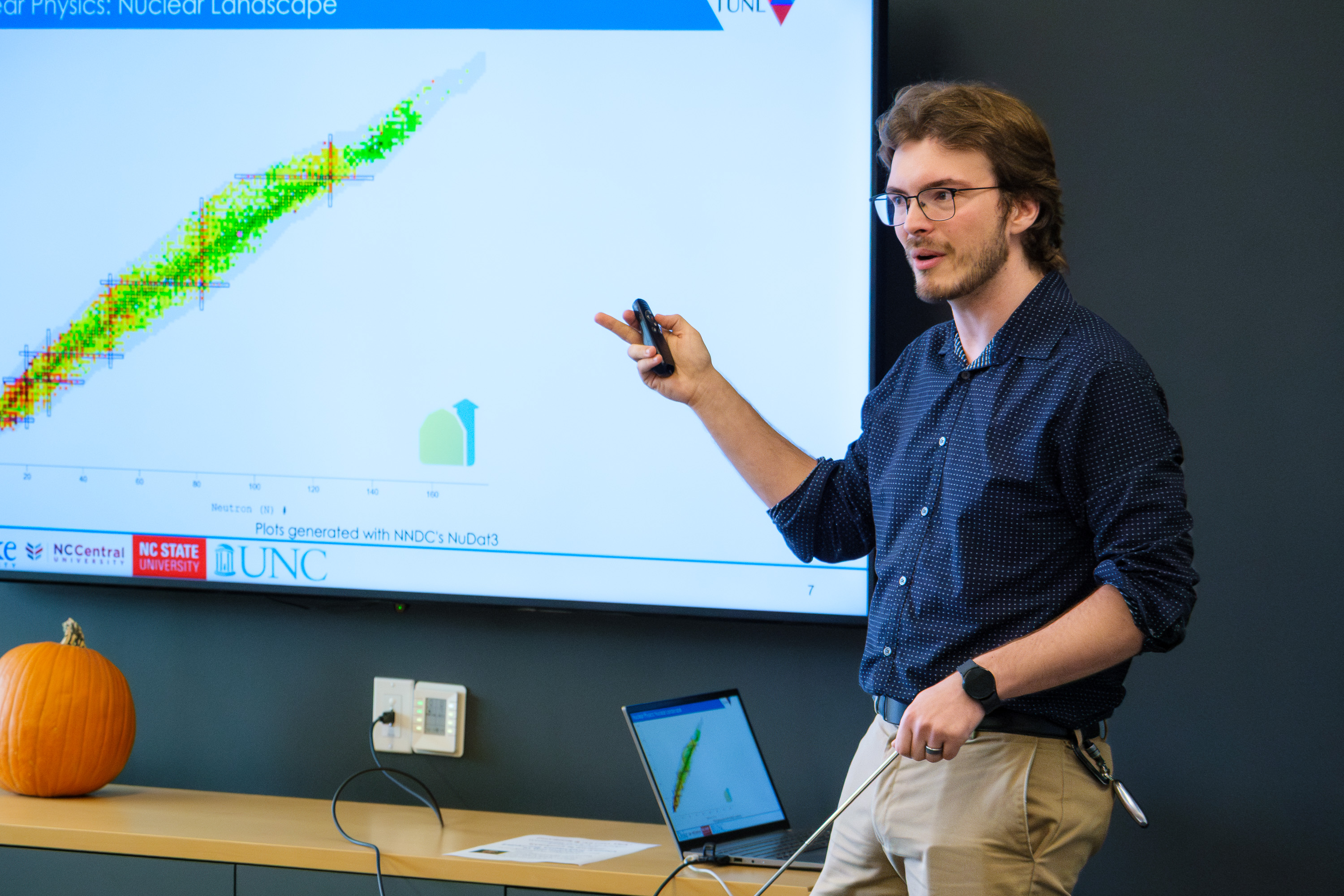
Guest speaker Tyler Kowaleski describes particle physics work done at TUNL
Every element on the period table is defined by the number of protons in its nucleus, but the number of neutrons can vary widely. Elements with the same number of protons but different numbers of neutrons are called isotopes; some isotopes are more stable than others. Tyler Kowaleski (University of North Carolina – Chapel Hill) visited the Department of Physics and Astronomy to share the work he and his collaborators have been doing to figure out why this is.
Kowaleski is part of the Triangle Universities Nuclear Laboratory (TUNL), a partnership between UNC-Chapel Hill, Duke University, and North Carolina State University. Kowaleski and his colleagues use a particle accelerator to create gamma rays aimed at a variety of germanium isotopes. When hit with the gamma rays, germanium nuclei become excited and decay in a one-step “elastic” or two-step “inelastic” process. Emissions from the decay provide evidence about the structure of the nucleus and its stability.
Hosted weekly by the Department of Physics and Astronomy, Physics & Astro Tea promises engaging discussions, thought-provoking ideas and a delightful spread of refreshments. Open to all students, faculty and staff, this gathering is the perfect opportunity to connect with fellow physics aficionados in a relaxed and informal setting. Meetings take place in the third-floor lounge of Innovation Hall at 3:20 p.m. on Wednesdays.