


Three Elon faculty members presented research at the UNESCO Chair on Intercultural Competences Conference in Morocco, demonstrating how these approaches foster cultural humility, student empowerment, and global citizenship.
Three Elon University faculty members had their research featured at the UNESCO Chair on Intercultural Competences Conference from Sept. 28 to Oct. 2. The research explores how mentoring and collaborative online international learning can foster intercultural understanding and student empowerment.
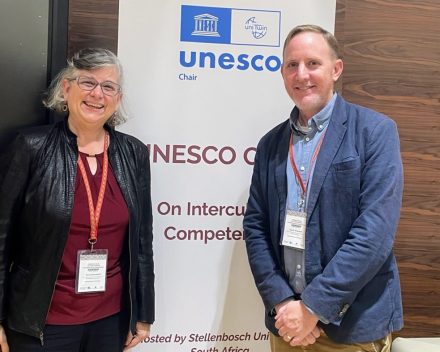
Sandy Marshall, associate professor of geology and Center for Research on Global Education (CRGE) intercultural learning scholar, attended the conference and shared research co-authored with Maureen Vandermaas-Peeler, professor of psychology and CRGE director, and Waseem Kasim, assistant professor of history. Their research was featured alongside the work of other international educators focused on Ubuntu philosophy, equitable North–South partnerships, and student empowerment through virtual collaboration.
Scholars and practitioners from Africa, Europe, the Middle East and North America gathered at Université Internationale de Rabat, Morocco, for the conference. Hosted by Stellenbosch University, Université Internationale de Rabat, and Al Akhawayn University, the conference focused on advancing intercultural competence and inclusive global partnerships through education, dialogue, and virtual exchange.
The faculty research poster, “Supporting Intercultural Learning through a Mentoring Constellation Model,” explored how relational mentoring within a constellation model can foster intercultural learning and cultural humility. Marshall, Vandermaas-Peeler, and Kasim defined mentoring as a developmental, learner-centered relationship that supports academic, identity and cultural growth.
The research drew connections between mentoring constellations and Ubuntu philosophy, emphasizing mutual respect, reciprocity, and interdependence. The presentation highlighted the importance of cultural humility and critical self-reflection for both mentors and mentees, suggesting that incorporating near-peer mentoring and global experiences can deepen intercultural competence.

The second presentation, “Beyond Competence: COIL as a Tool for Critical Consciousness and Student Empowerment,” featured Marshall in collaboration with Abdalkarim Zawawi and Alia Gilbrecht from An-Najah University in Palestine. The research examined a six-week COIL—Collaborative Online International Learning exchange between students at Elon and An-Najah University.
The study found that Palestinian students gained confidence, communication skills and empowerment to advocate for themselves globally, while U.S. students developed empathy, cultural awareness and a deeper sense of responsibility toward global justice. The project demonstrated COIL’s potential as a critical pedagogy, drawing from Paulo Freire’s concept of conscientization, rather than just a professional development tool. The research emphasized that trust, preparation, motivation and curiosity serve as essential components of successful intercultural exchanges.
Elon’s participation underscores the university’s leadership in intercultural learning and global education research. The presentations connect to Elon’s mission of preparing students for global citizenship through mentorship, dialogue, and experiential learning, while aligning with global educational priorities around equitable partnerships and decolonizing international education.
The conference also featured related sessions on virtual exchange as resistance, Africa–HBCU partnerships, and Ubuntu-informed pedagogy, contextualizing Elon’s contributions within a global movement toward transformative intercultural learning. Through research and practice, Elon continues to advance understanding of how educational institutions can foster meaningful cross-cultural dialogue and prepare students to engage thoughtfully with diverse global communities.