


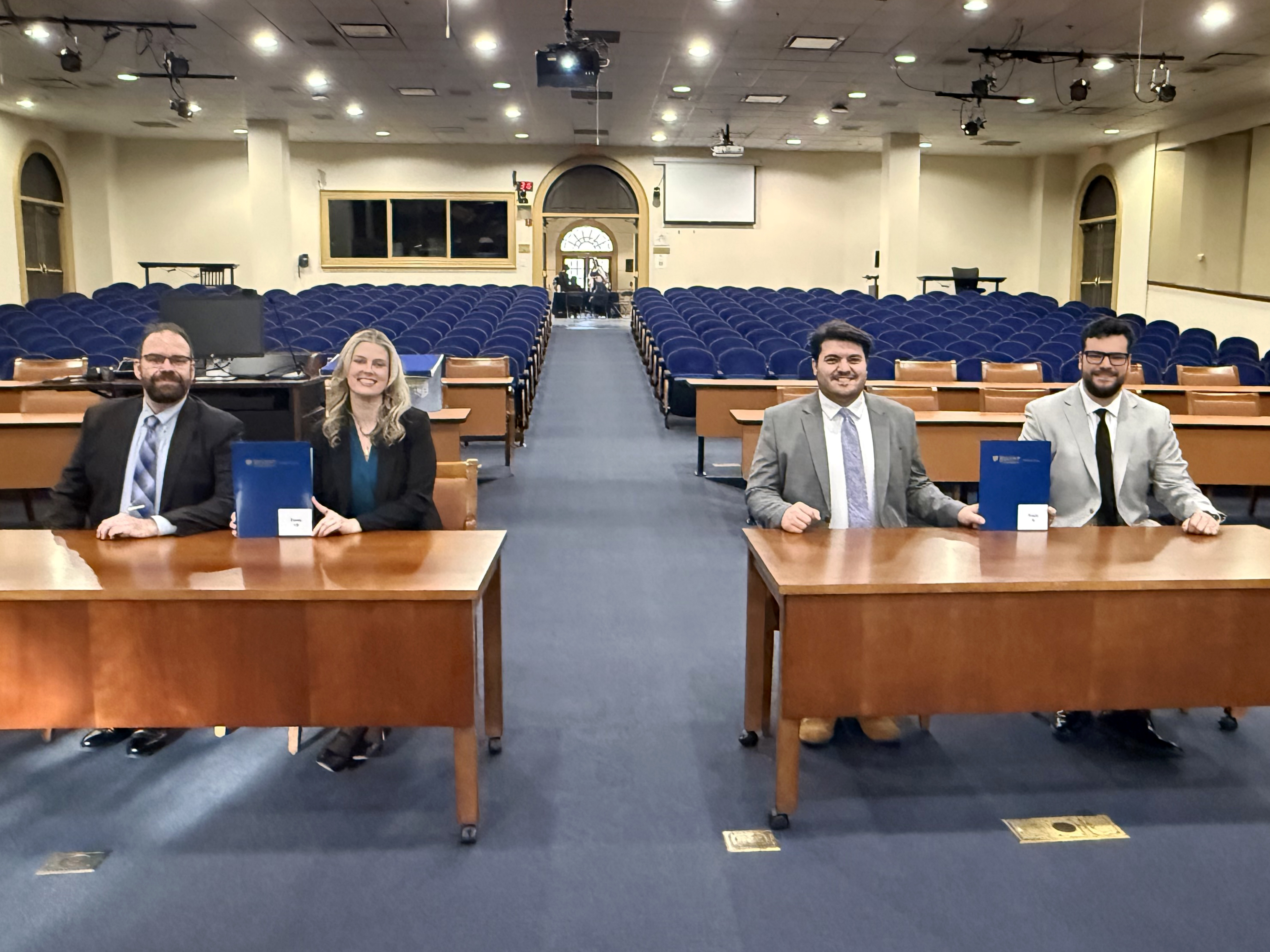
Four second-year law students competed in the Hassell National Constitutional Law Moot Court Competition at Regent University’s School of Law.
Four students from Elon University School of Law competed in the 25th Annual Leroy R. Hassell Sr. National Constitutional Law Moot Court Competition, hosted Jan. 22–24 at Regent University School of Law.
Students Matt Cottrell L’26, Isabel Craige L’26, James Galipeau L’26 and Daulton Hadaway L’26 formed two teams that argued a complex constitutional problem addressing a fictional case surrounding police response to an incident of domestic violence. Advocates developed arguments around whether states may be held liable under the state-created danger doctrine and whether the Fifth Amendment’s Takings Clause requires compensation when private property is destroyed during lawful exercises of police power. Elon Law’s moot court participation was made possible through the generous support of Riddle & Riddle Injury Lawyers, at justicecounts.com.
After two preliminary rounds before panels of attorneys, professors and judges, the team of Craige and Cottrell advanced to the Round of 12, finishing among the top teams in the national competition.
The students were coached by Vice Dean and Professor of Law Alan Woodlief, who directs Elon Law’s moot court programs, and Prof. Marty McAuliffe, director of academic and bar success. The coaches praised the students’ preparation, professionalism and poise as they made oral arguments before multiple panels of competition judges.
For Craige and Cottrell, the experience was both challenging and affirming.
“As a first-generation law student who had never been in a courtroom before law school, participating in moot court and competing at Regent brought classroom learning to life,” Craige said. “The process of crafting arguments, receiving feedback from coaches and peers, and presenting before experienced judges strengthened my confidence and helped prepare me fore a career in advocacy.”
Cottrell echoed that and added that moot court teaches valuable skills in quick, clear thinking.
“This competition was a great way to really dig into an issue and understand how to argue both sides of a case,” Cottrell said. “Moot court forces you to not only understand your side, your brief, but to be able to argue the opposite position effectively. Our side in our final round was determined by a coin toss, just 30 minutes before the round began. You certainly must be on your toes and know your facts and case law cold.”