


An Elon University Poll finds 62% of residents oppose sending a large number of ground troops to Iran, while majorities say recent U.S. actions make Americans less safe.
With more than 50,000 U.S. troops in the Middle East, including soldiers from the Army’s 82nd Airborne Division based at Fort Bragg, there is strong opposition in North Carolina to deploying ground troops in Iran.
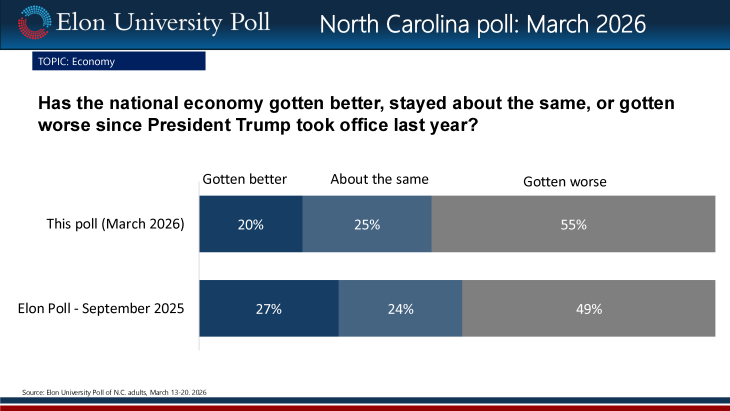
In a survey conducted by the Elon University Poll, nearly two-thirds of North Carolinians (62%) opposed sending a large number of U.S. ground troops into Iran, with only 16% expressing support. The strong opposition spans political affiliations, including 85% of Democrats, 62% of Independents and a 42% plurality of Republicans. Only 27% of Republicans favored a large troop deployment in Iran, with 31% unsure.
The survey of 800 North Carolina adults was conducted from March 13 to 20, 2026. The poll’s margin of error is +/-4.43%.
Beyond the prospect of ground troops, a majority of the poll respondents (51%) opposed current U.S. military involvement in Iran overall, compared to 30% who supported it. When asked about President Donald Trump’s military actions since January 2025, 52% of respondents said he has “gone too far” in using military force abroad, while 32% said he has done about what is necessary.
Looking ahead, 44% of North Carolinians said they expect that Americans will be less safe one year from today as a result of recent military actions in Iran, compared to 29% who said Americans will be more safe. In addition, 58% of North Carolinians said the president should be required to get Congressional approval before taking military actions like those recently seen in Iran and Venezuela.
“North Carolinians are showing clear hesitation about further military escalation,” said Jason Husser, director of the Elon University Poll. “The strong opposition to deploying ground troops, coupled with the bipartisan desire for Congressional oversight, signals significant public anxiety about the long-term safety and direction of U.S. involvement abroad.”
Assessing Trump’s job performance and the administration
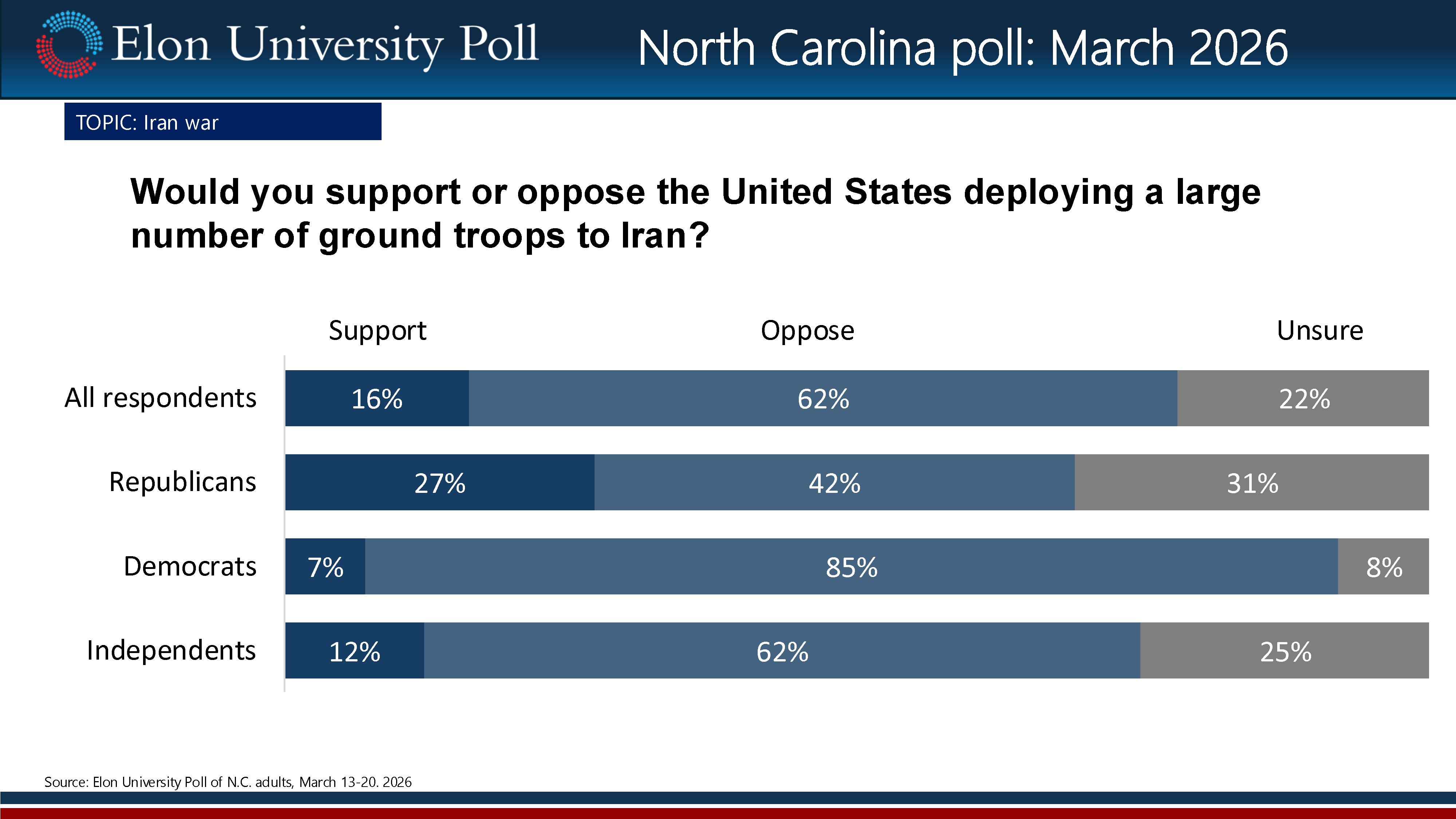
President Donald Trump’s approval rating in the state continues to face a widening gap. In this poll, 35% of North Carolinians approved of the job he is doing as president, while 55% disapproved. In March 2025, the gap was much narrower, with 42% approving and 45% disapproving.
Approval ratings for key administration figures are strongly correlated with perceptions of President Trump. Vice President JD Vance received a 34% approval rating with 45% disapproving. Secretary of State Marco Rubio stood at 34% approval and 38% disapproval, while Secretary of Defense (Secretary of War) Pete Hegseth held 30% approval and 46% disapproval ratings.
The U.S. Congress got the worst approval rating among measured institutions, with 64% disapproving of the job Congress is doing, compared with just 11% who approved.
Economic grades and tariff impacts
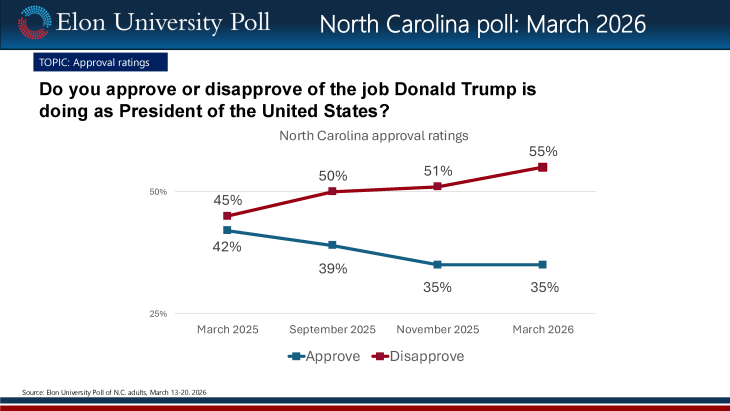
More than half of North Carolinians (55%) said the national economy has gotten worse since President Trump took office last year, with only 20% saying it has gotten better and 25% saying it has stayed about the same. When asked to assign a letter grade to the national economy, 47% gave a grade of “D” or “F,” while just 20% gave an “A” or “B.”
Commenting on their own financial situation, 53% said they have experienced a negative impact from the Trump administration’s tariffs on goods imported from other countries. This represents an increase from September 2025, when 46% reported negative impacts. Only 12% in the latest poll said the tariffs have had a positive impact personally.
Views on ICE and local law enforcement
On immigration enforcement, 52% of respondents held a negative overall impression of the United States Immigration and Customs Enforcement (ICE), compared to 33% who viewed the agency positively. Democrats (87%) and Independents (61%) expressed overwhelmingly negative impressions of ICE while 68% of Republicans had a positive impression.
Poll respondents were split on whether state, county and local law enforcement agencies should assist federal ICE officers in enforcing federal immigration laws. In this poll, 41% said local agencies should assist, while 38% said they should not. Support for local assistance has dropped five points since September 2025, when 46% were in favor.
Poll Methodology
Access the poll topline and methodology at: www.elon.edu/elonpoll. The survey was developed by the Elon University Poll and fielded by the international marketing and polling firm YouGov as an online, web-based survey, self-administered with online panels. Between March 13 and March 20, 2026, YouGov interviewed 928 North Carolina adults aged 18 and older. These respondents were then matched down to a sample of 800 to produce the final dataset.
The matched cases were weighted to the sampling frame using propensity scores based on age, gender, race/ethnicity, years of education, and home ownership. The margin of error for this poll (adjusted for weights) is +/-4.43%.
About the Elon University Poll
Established in 2000, the Elon University Poll conducts national and North Carolina surveys on issues of importance to voters and residents. Information from these polls is shared with media, citizens and public officials to facilitate informed public policy making through the better understanding of citizens’ opinions and attitudes. The poll is fully funded by Elon University and operates as the neutral, non-biased information resource.
The Elon University Poll is a charter member of the Transparency Initiative, a program created by the American Association for Public Opinion Research (AAPOR) in 2014 to educate polling firms on ways to better share how they collect and interpret their information. The Elon Poll’s voluntary participation in this initiative signifies a willingness to clearly state in its reports how questions were asked, in what order, who funded the poll and then conducted it, and a definition of the population under study, among other details.