


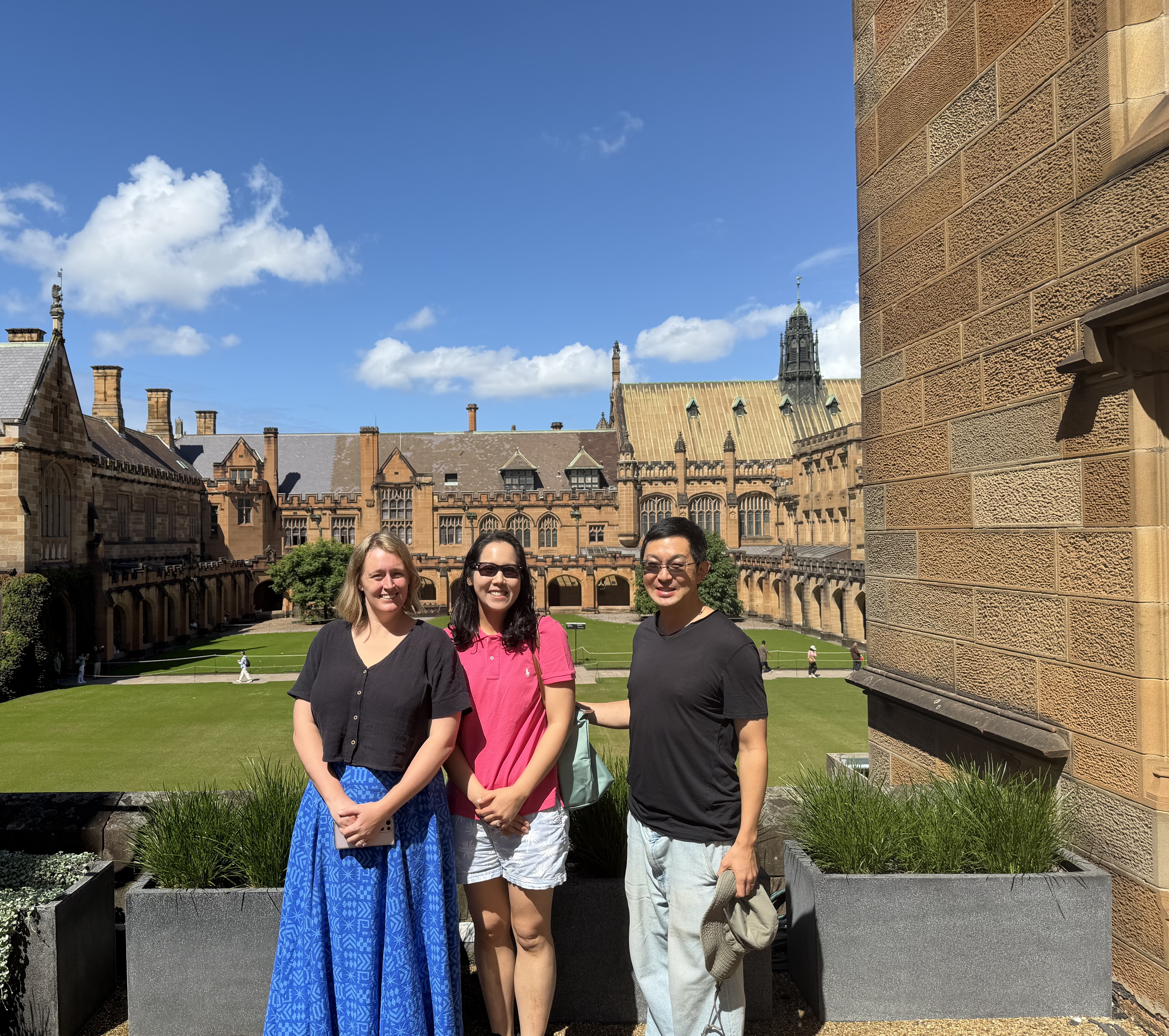
Hwayeon Ryu, associate professor of mathematics, visited the Sydney Mathematical Research Institute at the University of Sydney, Australia, from March 23 to April 7 as part of its international visitor program to pursue research collaboration with two researchers, and delivered a colloquium talk during her visit.
Hwayeon Ryu, associate professor of mathematics, recently visited the Sydney Mathematical Research Institute (SMRI) at the University of Sydney, Australia, from March 23 to April 7 through its international visitor program. During her visit, she initiated a new international research collaboration with Peter Kim, professor of applied mathematics at the University of Sydney (host institution), and Adrianne Jenner, senior lecturer (equivalent to assistant professor) at Queensland University of Technology, to investigate the potential link between Epstein–Barr virus (EBV) infection and the onset of multiple sclerosis (MS).
The primary goal of this project is to investigate the link between EBV and MS using a virtual clinical trial framework by testing three hypotheses: EBV resurgency, impaired B cell regulation, and molecular similarity between EBV antigens and myelin in genetically predisposed individuals.
The team has developed a within-host mathematical model of EBV infection, building on existing frameworks that incorporate epithelial and B cell dynamics, to examine which mechanisms are most likely to drive disease onset, with a current focus on immune cross-reactivity. The model will be further extended to include autoreactive immune responses and myelin damage, providing a more comprehensive representation of MS-related pathology.
During her visit, Ryu also delivered a colloquium talk titled “Immune Dysregulation in COVID-19: What Can Mathematical Modeling Tell Us?” based on her recently published work supported by the National Science Foundation. In the talk, she addressed why some individuals experience mild COVID-19 while others develop severe disease, presenting a mathematical framework that captures interactions between SARS-CoV-2 and the immune system. Through computational simulations and sensitivity analysis, she demonstrated how variations in immune responses can lead to divergent disease trajectories and highlighted key mechanisms that influence disease progression.
Following her time in Sydney, Ryu will travel to the University of Melbourne in late April to help organize a two-week workshop, “Collaborative Workshop for Under-Represented Genders Advancing Mathematical Biology,” co-organized with Jenner. This will be held at MATRIX, a residential research institute for the mathematical sciences in Australia near the campus of the University of Melbourne.
These visits provide valuable opportunities to advance interdisciplinary collaboration and strengthen international research connections in mathematical biology.