


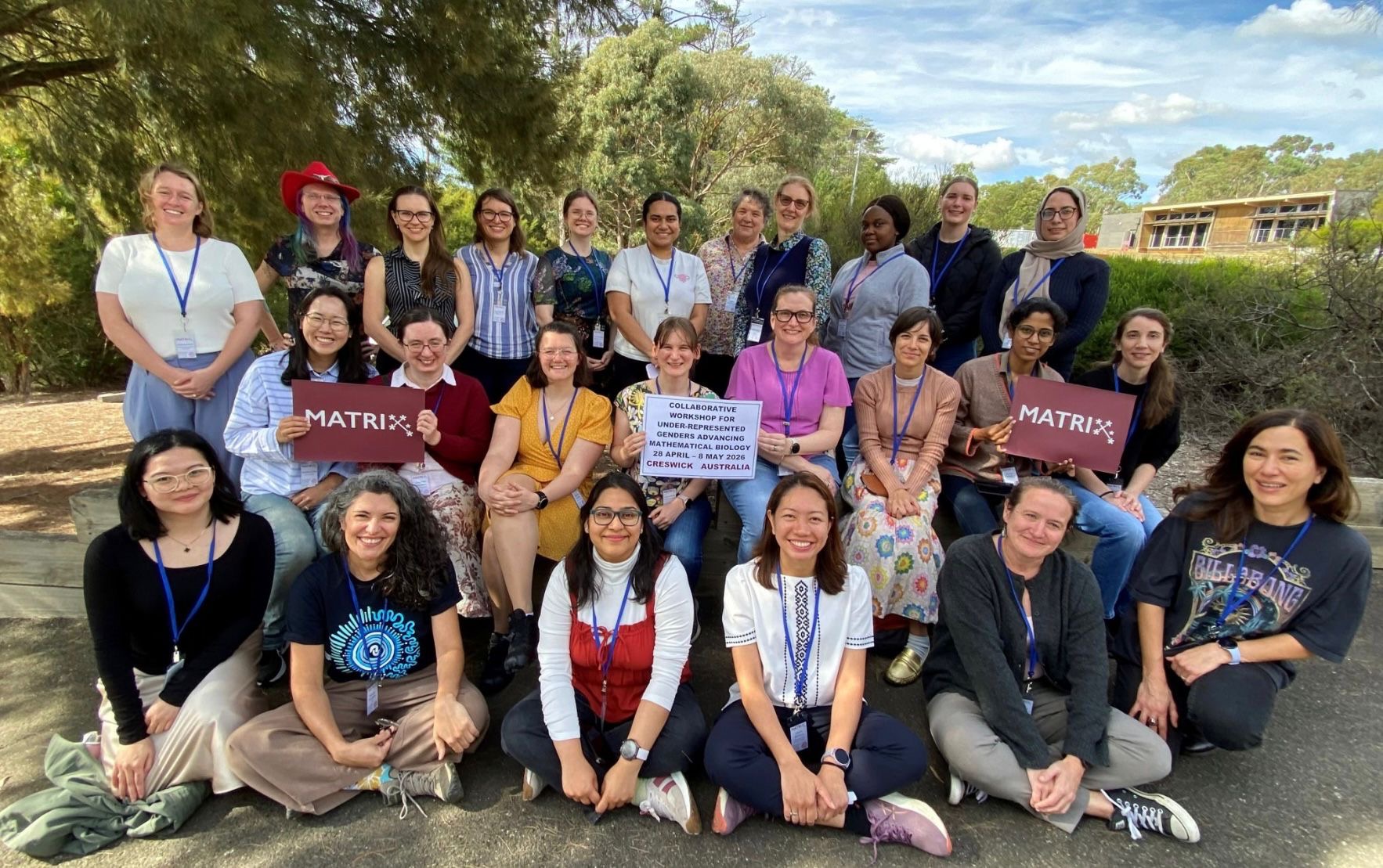
The workshop focuses on collaborative research, in small groups of underrepresented genders, including female-identifying researchers, each group working on an open problem in a particular area of mathematical biology guided by a senior group leader.
Hwayeon Ryu, associate professor of mathematics, organized the two-week collaborative workshop at MATRIX, a residential research institute for the mathematical sciences at the University of Melbourne, Australia from April 28 to May 8. Ryu also delivered two math biology seminar talks at the University of Melbourne and Queensland University of Technology (located in Brisbane) following the workshop attendance.
Ryu co-organized the two-week workshop (with Adrianne Jenner, senior lecturer, equivalent to assistant professor, at Queensland University of Technology) entitled “Collaborative Workshop for Under-Represented Genders Advancing Mathematical Biology” at MATRIX. This workshop focuses on collaborative research, in small groups of underrepresented genders, including female-identifying researchers, each group working on an open problem in a particular area of mathematical biology guided by a senior group leader.
During her visit, she participated in a collaborative project entitled “Models for cell dynamics in developing atherosclerotic plaques,” led by Mary Myerscough, professor of applied mathematics at the University of Sydney. The primary goal is to develop and analyze mathematical models of macrophage behavior in atherosclerotic plaque development, with a focus on understanding how lipid trafficking, LDL cholesterol and HDL activity influence plaque progression and reduction. Building on existing spatial models, the project will simplify these models into systems of ordinary differential equations to perform bifurcation analyses and investigate whether incorporating mid-stage plaque processes preserves predictions about the effectiveness of increasing HDL action and reducing LDL levels.
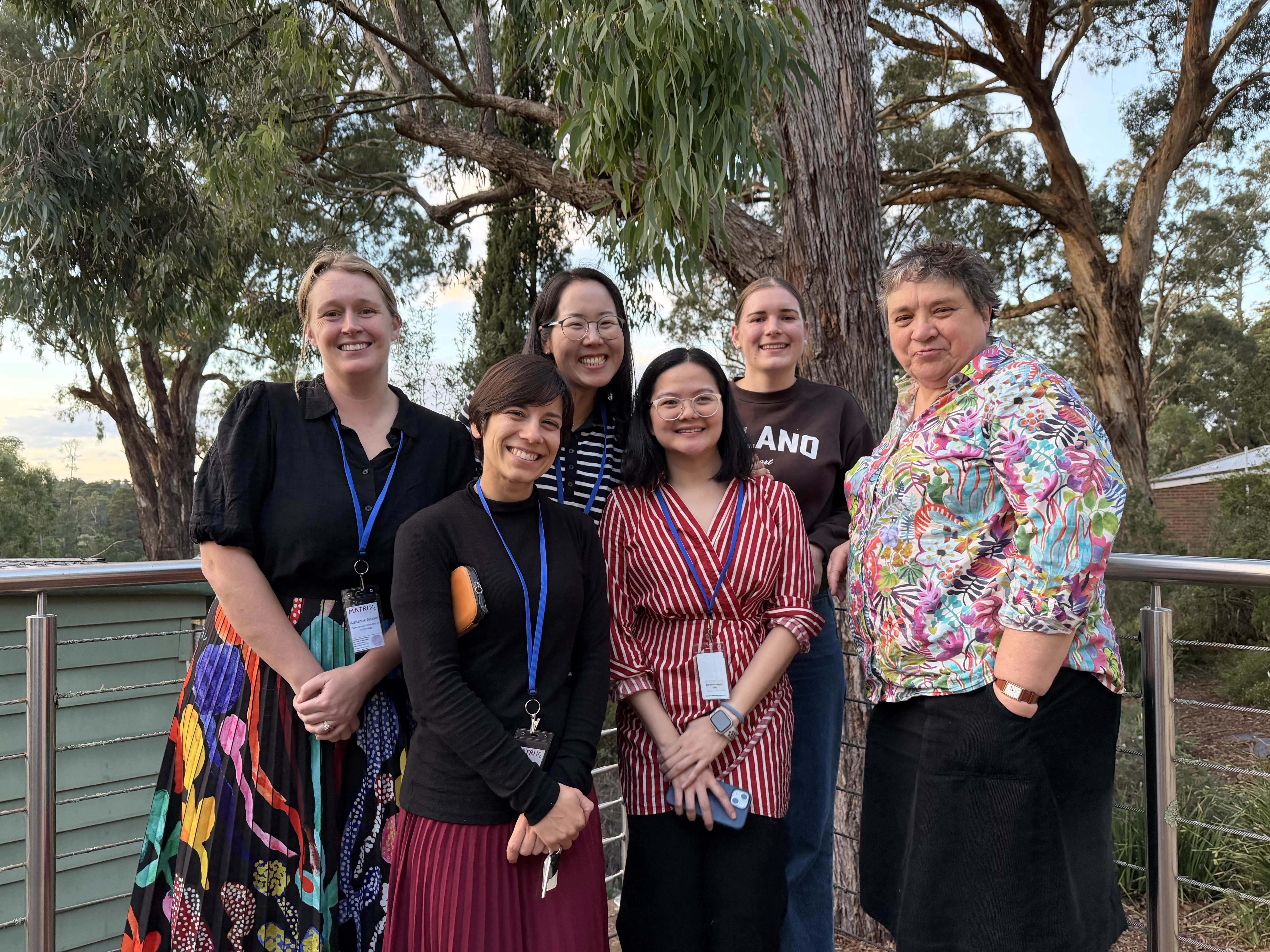
Upon the MATRIX workshop, Ryu also delivered a math biology seminar talk at the University of Melbourne, titled “Immune Dysregulation in COVID-19: What Can Mathematical Modeling Tell Us?” based on her recently published work supported by the National Science Foundation. In the talk, she addressed why some individuals experience mild COVID-19 while others develop severe disease, presenting a mathematical framework that captures interactions between SARS-CoV-2 and the immune system. Through computational simulations and sensitivity analysis, she demonstrated how variations in immune responses can lead to divergent disease trajectories and highlighted key mechanisms that influence disease progression.
Following her time in Melbourne, Ryu briefly visited Queensland University of Technology in Brisbane to continue working with Jenner on their collaborative project. In addition, she delivered a seminar talk there titled “Bistable Dynamics Arising from Macrophage-Tumor Interactions in the Tumor Microenvironment” based on her recently published paper.
These visits, supported by the National Science Foundation and Elon University College of Arts and Sciences, provided valuable opportunities to advance interdisciplinary collaboration and strengthen international research connections in mathematical biology.