


Elon assistant professor Corey Roberts’ lifelong curiosity about language took on new meaning when he discovered his Occaneechi and Tuscarora ancestry and began supporting efforts to revitalize the Yesa:sahį́ language.
At 4 years old, Corey Roberts was already trying to make sense of language.
In kindergarten, as his class recited the Pledge of Allegiance, Roberts listened to the phrase “for which it stands” and began spelling what he heard in his head.
“I thought we were pledging for ‘wicked stands,’ and I was not okay with it,” recalls Roberts, an assistant professor of Native American and Indigenous studies in the Department of World Languages & Cultures.
The interpretation was wrong, of course, but the instinct behind it was already there: Listen closely, break language apart and try to understand what the words are doing.
“I barely remember a time when I was not interested in languages,” Roberts says.
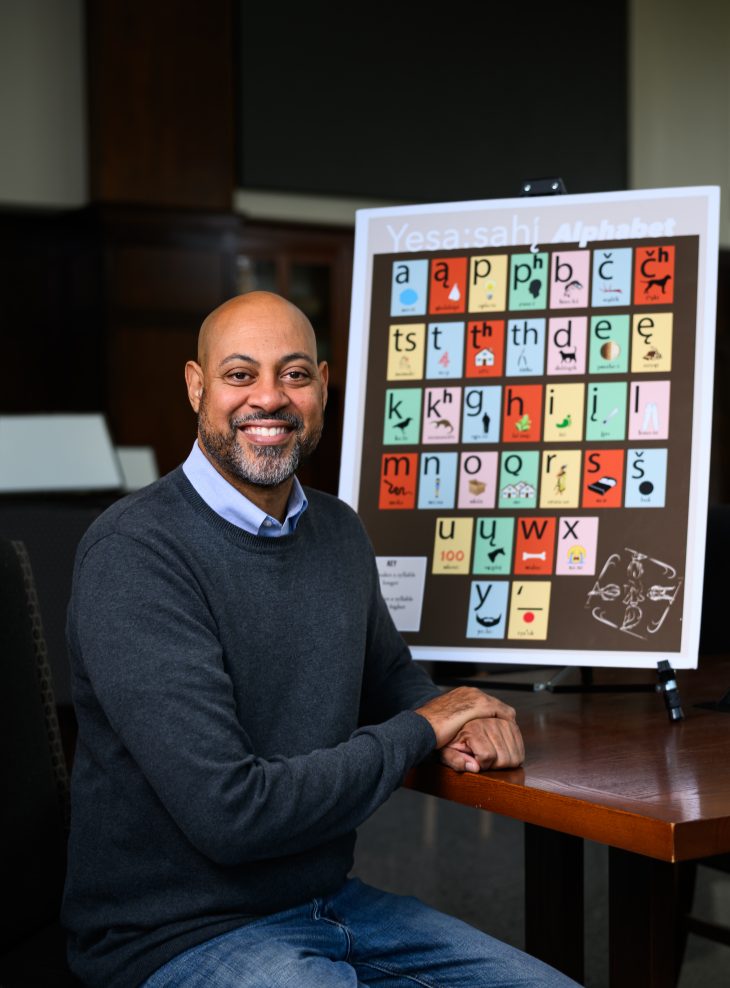
Spanish followed in seventh grade. At Penn State, Roberts took Russian and quickly realized that the engineering path he had imagined for himself was giving way to something else. By the time he finished his undergraduate education, he had studied five additional languages. He has continued adding to that list ever since.
Years later, language would also give Roberts a way to understand a part of his own family history that he had never known. In 2017, after his father’s funeral, Roberts and several relatives were discussing genealogy when an older cousin casually mentioned something that previous generations had known but never passed down: His paternal family included Occaneechi and Tuscarora ancestry.
The discovery opened a new connection to his family’s history and a desire to learn more about the cultures, traditions and language tied to it. His work to study and support the revitalization of the Yesa:sahį́ language deepened his relationship with the Occaneechi Band of the Saponi Nation. Over time, Roberts learned that those relationships required more than knowledge or credentials. They required showing up, listening and allowing trust to be earned.
“I thought, ‘I just want to be a language person, so I’m just going to do the language stuff,’” Roberts says. “Maybe one day if they feel that I have gotten enough trust in the community, they will reveal cultural things to me.”
He soon realized the distinction he had drawn between the two was arbitrary.
“Language is an intrinsic part of culture,” Roberts says. “That artificial barrier that I had set up between language and culture was something that completely dissolved because it was just never there in the first place.”
That openness has become central to how Roberts thinks about inclusion: being in community with others without assuming you will fully understand everything they bring with them. At Elon, he sees that same spirit in people’s willingness to engage with one another across languages, cultures and experiences.
It is an approach that mirrors the curiosity he has carried since childhood: Listen closely, recognize what you do not know and remain open to learning from the people around you.
Corey Roberts is part of Huemanity of People, a series by the Division of Inclusive Excellence highlighting the people, paradigms and praxis of inclusive excellence that shape Elon University’s community.