


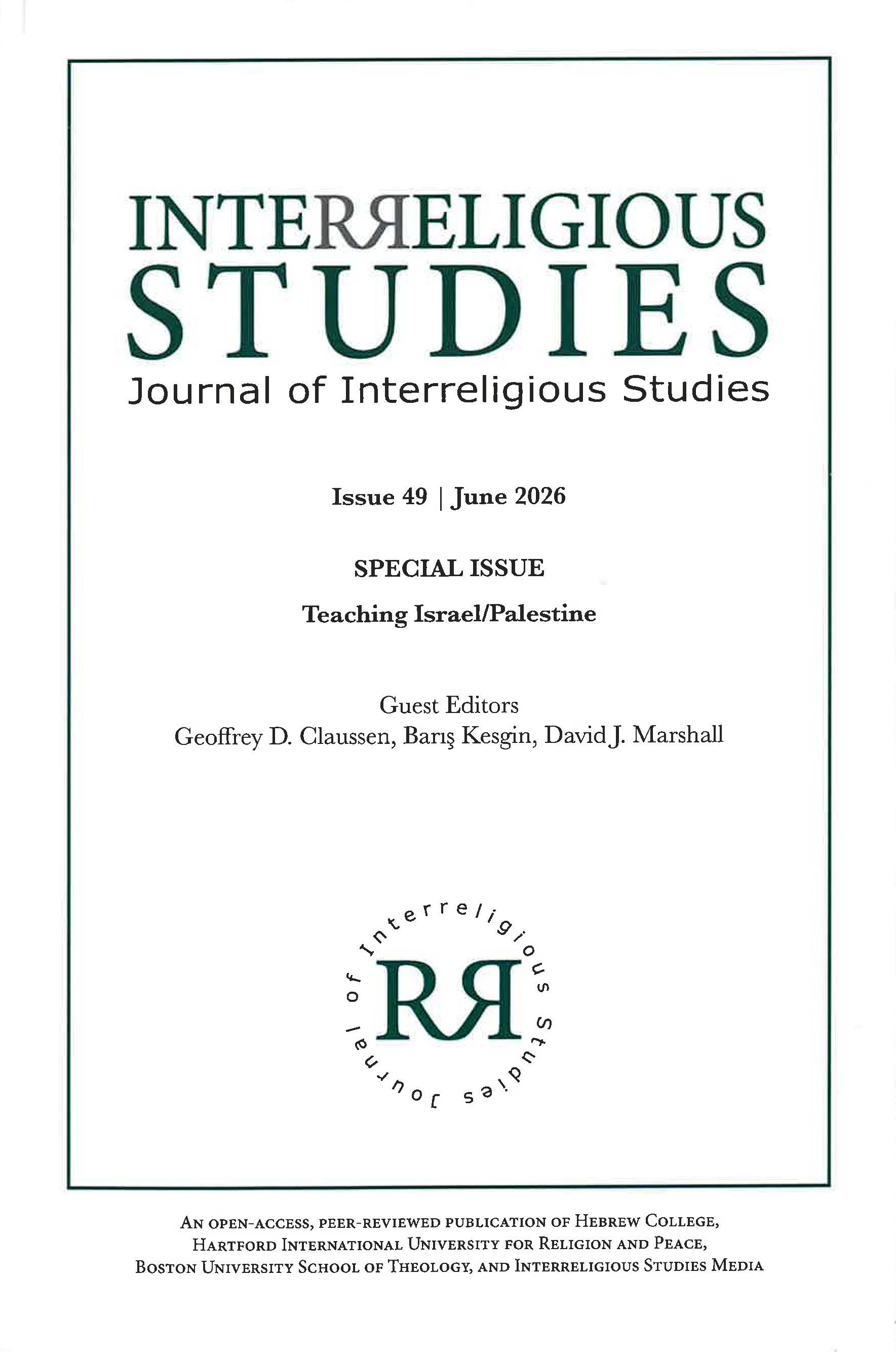
The special issue of the "Journal of Interreligious Studies" grew out of a 2025 symposium organized by the Elon Center for the Study of Religion, Culture and Society.
Three Elon University faculty members have guest edited a special issue of the Journal of Interreligious Studies focused on the challenges and possibilities of teaching about Israel/Palestine.
The issue was guest edited by Geoffrey Claussen, professor of religious studies, Lori and Eric Sklut Professor in Jewish Studies and chair of the Department of Religious Studies; Barış Kesgin, professor of political science and Public Policy; and Sandy Marshall, Associate professor of geography. The issue brings together scholars from a range of disciplines to examine how educators can help students engage critically and constructively with one of the most contested subjects in contemporary higher education.
Most of the contributions originated as papers presented at Elon’s February 2025 “On the Edge” symposium, “Teaching Israel/Palestine in Turbulent Times,” which Claussen, Kesgin and Marshall organized with Brian Pennington, professor of religious studies and director of Elon’s Center for the Study of Religion, Culture and Society. The symposium was part of the “On the Edge” series Pennington directed. The gathering drew participants from fields including religious studies, political science, English, comparative literature, journalism, history, geography, sociology, anthropology, education, peace and conflict studies, Middle East studies, and Jewish studies.
The special issue asks what ethical and effective teaching looks like amid mass violence and growing pressures on colleges and universities. Contributors explore how educators might navigate tensions among dialogue, advocacy, and justice; how identity, emotion, and power shape classroom learning; and how institutions can protect intellectual inquiry and academic freedom amid intense public scrutiny and political pressure.
In their introduction, Claussen, Kesgin and Marshall emphasize that there is no single definitive approach to teaching Israel/Palestine. Instead, the issue presents a range of approaches suited to different institutional settings, courses and learning goals. The collection includes contributions by Maha Nassar, Atalia Omer, Brian Hillman, Oren Kroll-Zeldin, Laurence Roth, Nicholas Clark, Benjamin Sax, Liora Halperin, Hilary Kalisman, Michal Raucher, Emily Schneider, Mahan Mirza, Tzvi Novick, Russell Arnold and Diya Abdo.
Claussen, Kesgin and Marshall also argue that universities remain among the few places where sustained and thoughtful engagement with the subject of Israel/Palestine is possible.
“We must recognize the vital role that we as educators play in informing (not dictating) the perspectives and attitudes of emerging citizens, scholars, and leaders, and that pursuing pedagogies of justice and empathy in our classrooms can be a powerful means of promoting justice and healing in the world,” they write.
The “Journal of Interreligious Studies” is a peer-reviewed, open-access publication of Hebrew College, Boston University School of Theology, Hartford International University for Religion and Peace, and Interreligious Studies Media.