


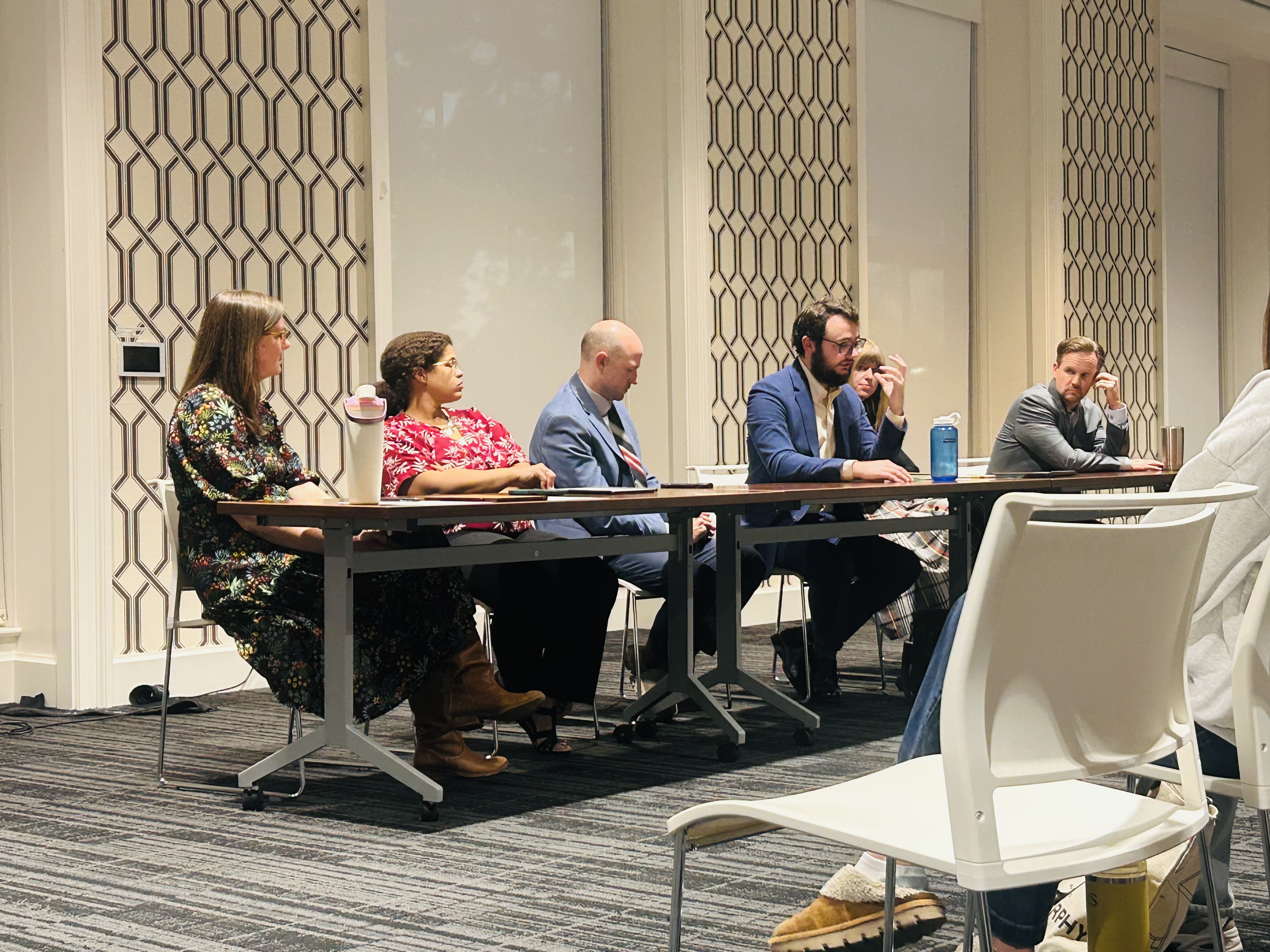
Six faculty members from the Department of Political Science and Public Policy outlined election results and their implications for the future in a panel on Tuesday, Nov. 10.
Elon students and faculty from the Department of Political Science and Public Policy gathered for a panel discussion on the midterm elections Tuesday, Nov. 10 in LaRose Student Commons.
The panel included the chair of the department, Associate Professor Carries Eaves, Associate Professor Jessica Carew, Professor Jason Husser, Assistant Professor Brian Brew, Assistant Professor Dillan Bono-Lunn and Professor Jason Kirk. There was also fact checkers present with the Phoenix Policy Institute.
Husser, who is also director of the Elon Poll, started the panel by discussing how monumental the results were in Alamance County.
He noted how Alamance County typically sees an 8-to-12-point lead toward Republicans, with Republicans at a nine-point lead in the 2024 election. The 2026 midterms, though, were incredibly different.
“What we saw in 2026 was really a cross-the-board sweep, just about, for Democrats in Alamance County,” Husser said. “That was tremendously unusual.”
District 63 and 64, two seats for the North Carolina House of Representatives, were on the ballot for Alamance County. Both were highly competitive, and both went to Democrats. District 63, with candidates Ian Baltutis and Ryan Moffit, is yet to be officially called.
The North Carolina Senate, however, is more precarious, according to Husser. Senate Seat 24, with candidates Danny Britt and Catina Hamm, is still in a close race. The seat would determine whether the North Carolina Senate will be tied 25-25, or with 26 Republicans and 24 Democrats.
If the US House sees a 25-25 split, the Lt. Gov. Rachel Hunt, a Democrat, could help Democrats win tiebreakers.
“Functionally, you would have a trifecta in North Carolina,” Husser said.
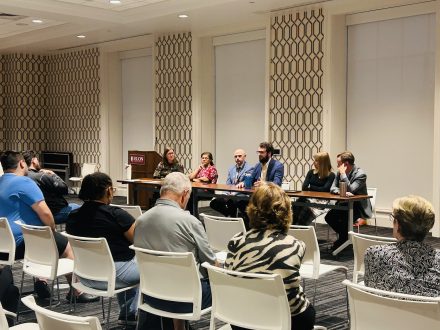
The national setting saw a Democratic sweep. Jessica Carew outlined the party divisions in the U.S. Senate and House.
In the U.S. Senate, the division is 55 Democrats and 44 Republicans, with one outstanding seats in Alaska. In the U.S. House, the division is 256 Democrats and 167 Republicans.
Carew also noted the monumental firsts of the election, including but not limited to the first elected Latino governor, Xavier Becerra, first Black female governor, Keisha Lance Bottoms, first American Indian governor, Deb Holland, and the first openly gay senator, Chris Pappas.
The panel also brought to attention the implications this midterm election may have on the presidential election in 2028.
Kirk noted the wins in Texas, with James Talarico as senator and Gina Hinojosa as governor, may be a strong point in 2028. Texas has four of the 10 largest metro areas in the U.S. based on population.
Brew pointed out the work Democrats will have to do in the U.S. House and Senate to solidify their strength with voters.
“That definitely raises questions for the Democratic Party as it considers its future trajectory as we get into the 120th Congress about what it’s going to prioritize,” Brew said. “As the inevitable 2028 conversations have already begun, where the Democrats go from here.”