Astronomy Program
An Astronomy Degree at Elon: Driven by Big Questions
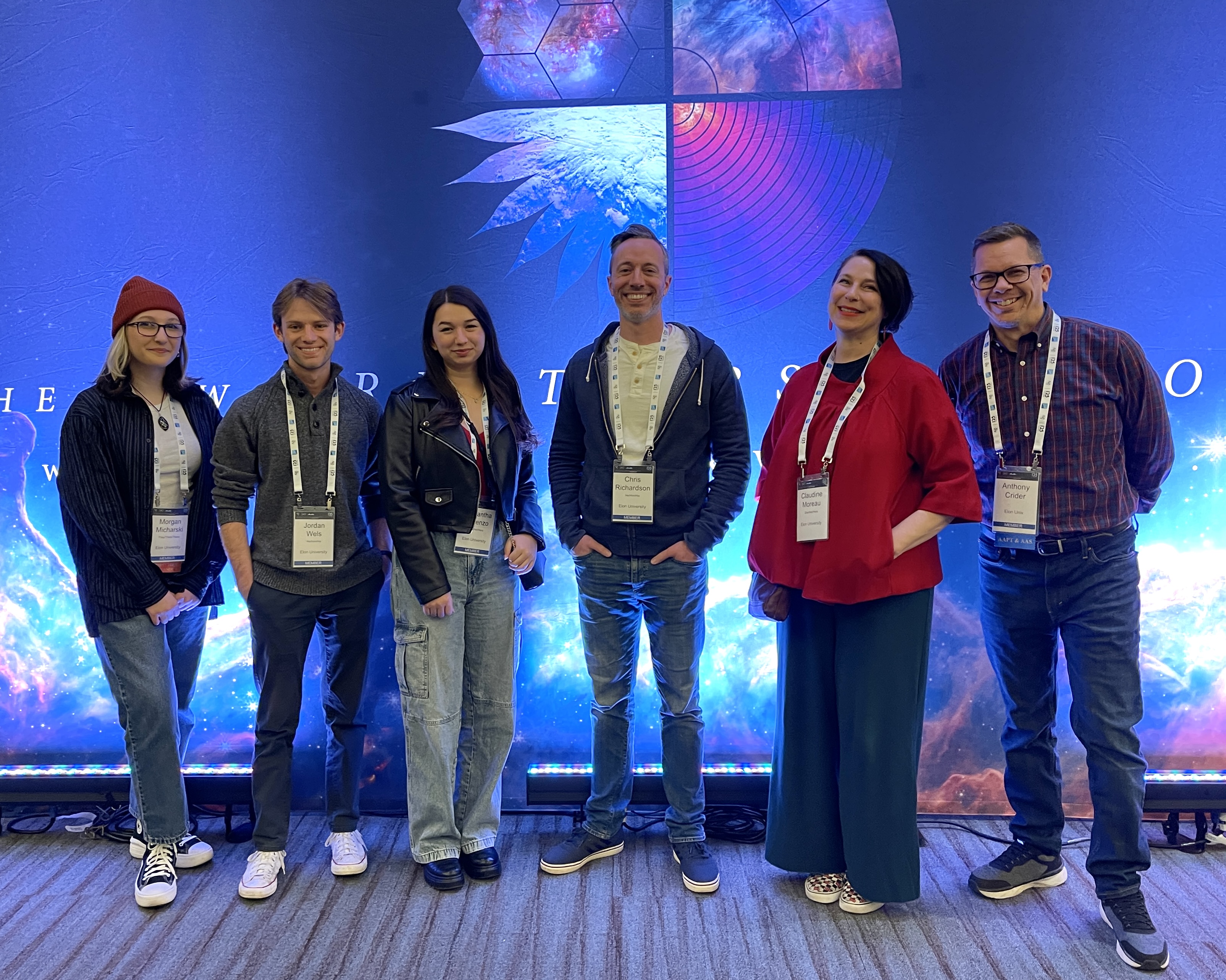
Astronomy faculty Tony Crider (right), Claudine Moreau (center right), and Chris Richardson (center) attend the American Astronomical Society meeting in New Orleans with undergraduate researchers, which attracts ~3000 experts each year.
Astrophysics and astronomy ultimately focus on broad questions with deep implications. Are we alone? What is history of our galaxy, the Milky Way? What is the fate of the Universe?
These questions motivate our majors to pursue the wonder instilled in them from looking up at the night sky or from remembering the first time they looked through a telescope. Society at large unites around the prospect of exploring the universe, whether it’s through science fiction or actual space missions that bring our ideas to reality. In addition to careers in astronomy, graduates of our programs find success in other fields, like business and journalism, based on the curiosity required to ask challenging questions and the skill set required to solve them.
The astronomy program is led by a team of engaged astrophysics faculty members: Tony Crider, Zack Hutchens, Claudine Moreau, and Chris Richardson. Together, they engage students with modern discoveries in the field, as well as research (including theory and observation), and outreach opportunities (such as Stargazing for Mental Health).
Astronomy vs. Astrophysics? A Robust Curriculum in Both Fields
Elon University was the first institution to offer a degree in astronomy and astrophysics in North Carolina. We offer two degrees in the program: Astronomy B.A and Astrophysics B.S.
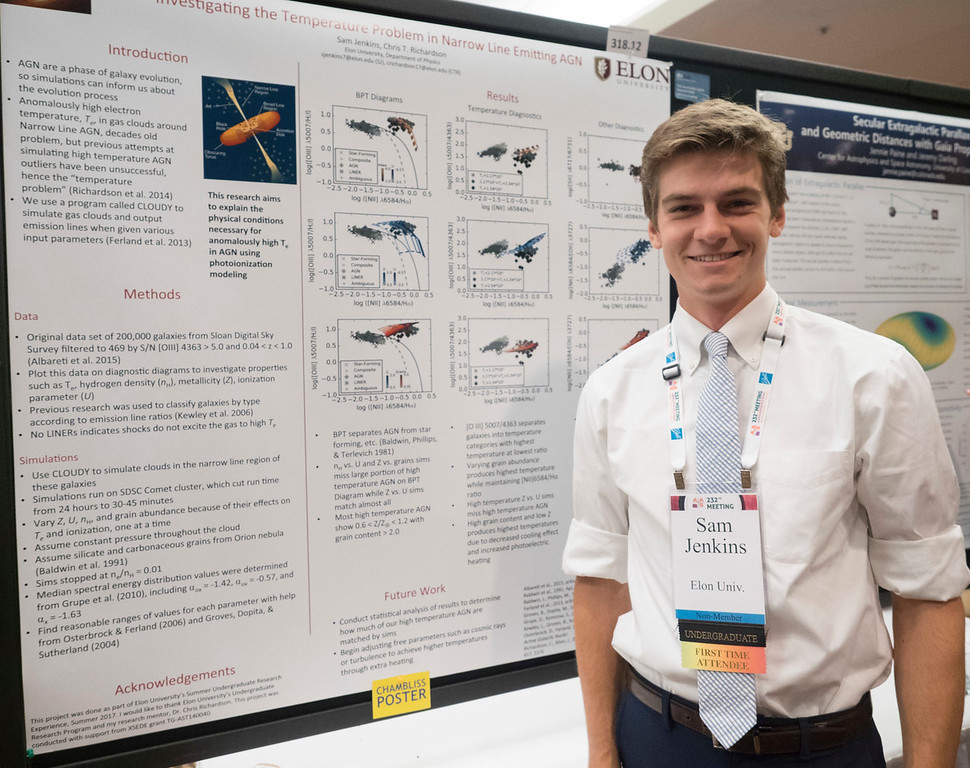
Chambliss Award recipient Sam Jenkins during the Coffee/Posters/Exhibitors session at the American Astronomical Society’s 232nd meeting in Denver, Colorado, 2018. Photo by Phil McCarten/Corporate Event Images, © 2018 American Astronomical Society.
Our curriculum focuses on uncovering content about planets, stars, galaxies, and cosmology at both introductory and advanced levels. The introductory courses Planetary Astronomy and Galactic Astronomy provide the framework for these topics, while Modern Astrophysics and Advanced Astrophysics revisit them with more in-depth analysis. After taking Introduction to Astronomy, majors often serve as Teaching Assistants for the nighttime astronomy lab, guiding non-majors through operating telescopes and using their phones for astrophotography.
In pursuing a degree in astrophysics or astronomy at Elon, students are encouraged to combine astronomy with another discipline, which Elon University makes possible by emphasizing connections across disciplines and courses. Students in astronomy have a double majors in English, music, and computer science to create a novel skill set for a future career.
The astrophysics degree is designed for students who wish to pursue further education in graduate school and aspire to a professional career in the field. Our students have completed summer research experiences at universities such as Caltech and Yale. Similarly, students have attended graduate school at institutions such as MIT, UT-Austin, Rice University, Tufts University, and UNC-Chapel Hill.
We emphasize that the fundamental principles learned in physics courses also translate to astrophysical phenomena, which creates a well-rounded foundation for graduates. Astrophysics majors also complete a semester of research, and many conduct research spanning several years, giving them the avenue to explore their own questions.
Develop Unique Skills with Astrophysics & Astronomy Degrees
Observations are an inherent part of the scientific process in astronomy, the most visually based science. As such, visual literacy is developed in all our classes, equipping graduates with the skills to analyze detailed images, interpret complex graphs, and effectively utilize visual aids.
Similarly, astrophysics and astronomy majors are positioned to play an essential role in a data-driven world. The era of “big data” forces astronomers to find novel ways to coherently display relationships found in observations and simulations.
To assist with this, every major develops the ability to write computer code, a crucial skill in the world today. Scientific results are only valuable if shared with others, and our majors are routinely tasked with writing and presenting their findings to audiences with a wide range of backgrounds. Being effective communicators sets our graduates apart from those at other institutions and lies at the heart of an Elon education.
What can I do with Astrophysics & Astronomy Degrees?
Students graduating with either an astronomy-related major or minor have pursued numerous career paths. The computational skills required in astronomy set up graduates for jobs geared towards data analytics and data science. The writing aspects of the profession have inspired graduates to author fictional short stories about astronomy-related phenomena and edit online publications for popular media outlets like Science News. Many often decide to attend graduate school to continue their education before entering the job market, and our department has a strong track record of acceptance into high-ranking programs.