


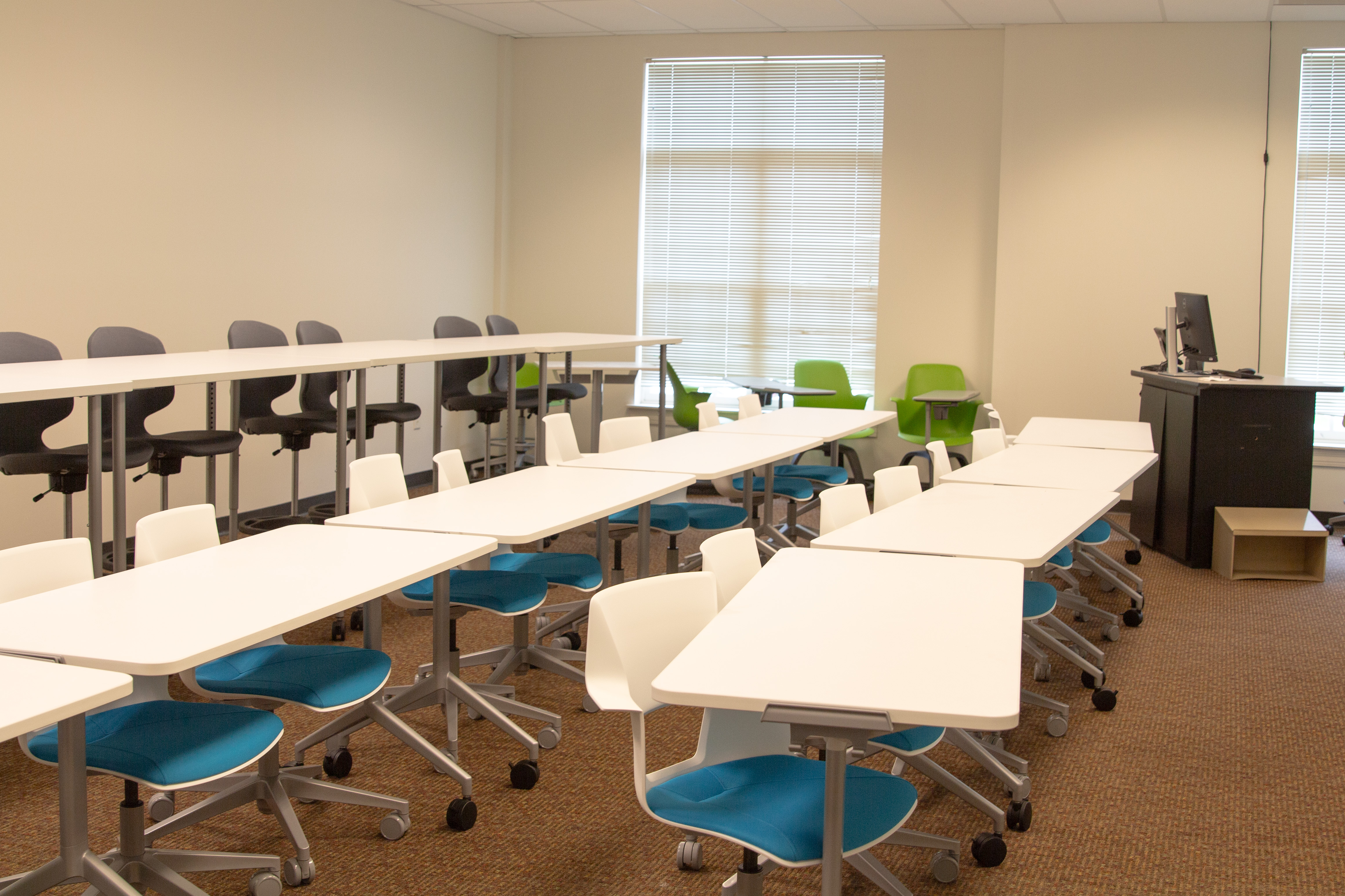
New resources in Lindner Hall offer flexible seating and sensory-friendly spaces for building visitors.
Two newly reconfigured classrooms and a student lounge in Lindner Hall have been created to offer additional neuroinclusive learning spaces on campus.
The Dean’s Office in Elon College, the College of Arts and Sciences, identified the need for more neuroinclusive spaces and worked with facilities staff and interior designers to bring the idea to life.
Spaces were designed with neurodivergent students in mind and aim to support a variety of learning styles and sensory needs while benefiting all students.
Lindner Hall 204 and 210 offer flexible layouts and furniture options. Both classrooms include adjustable, mobile and varied-height seating, chairs with and without arms, tall stools with slight wobble for sensory feedback, and individual writing surfaces.
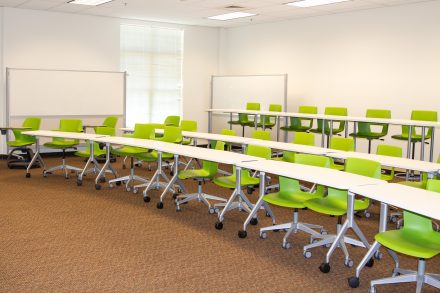
The classrooms can be reconfigured for different teaching styles, and can also be organized into zones for quiet reflection or active discussion, with integrated technology to support both independent and collaborative learning.
“One of the primary goals was to upgrade these classrooms so that they were inclusive of needs that support neurodivergent students,” said Caroline Ketcham, associate dean in Elon College, the College of Arts and Sciences, and the point person for the project. “The classrooms are arranged for 33 to 35 students of all learning styles, and there are different orientation designs for different pedagogical approaches.”
A neuroinclusive lounge, located in Lindner Hall Suite 200, offers a calming space for anyone in need of a sensory break or a quiet space to work. It features sensory-friendly and ergonomic furniture, minimized visual and auditory clutter, varied textures and surfaces, and biophilic design elements with neutral colors. Lighting and seating options can be adjusted for individual needs.
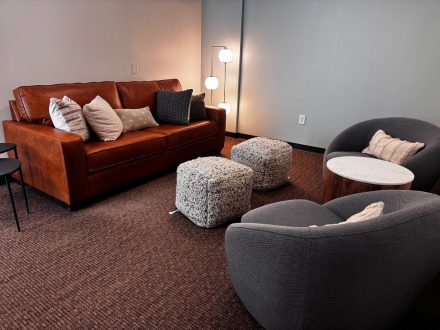
“These spaces give people a space that feels comfortable,” Ketcham said, “and the furniture helps meet the needs of all students.”
Ketcham is working this semester with Professor Jessie Moore and three students, Kira Campagna, Kaz Kelly, and Ben Krasnow, as part of a Center for Engaged Learning seminar to research how the new spaces are used. The team is gathering student feedback for potential future projects.
That seminar, “Affirming and Inclusive Engaged Learning for Neurodivergent Students,” is a three-year multi-institutional research seminar where teams from across the world come together to engage in a topic.
“Creating neuroinclusive spaces is about having a lens as you build spaces that support students to learn in ways that meet their strengths,” Ketcham said.