


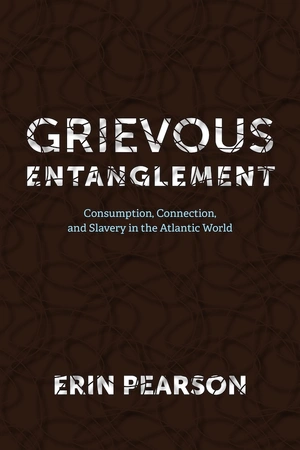
In “Grievous Entanglement: Consumption, Connection, and Slavery in the Atlantic World,” Associate Professor Erin Pearson examines how people in the late 18th and 19th centuries understood consumption as implicating them in slavery.
An Elon University associate professor has published a new book that explores the way antebellum abolitionists persuaded audiences of their complicity with slavery as part of a strategic approach to advancing the cause of freedom.
Published by the University of Virginia press, “Grievous Entanglement: Consumption, Connection, and Slavery in the Atlantic World” by Erin Pearson in the Department of English examines how everyday purchasing habits linked individuals to slavery through commodities such as cotton and sugar.
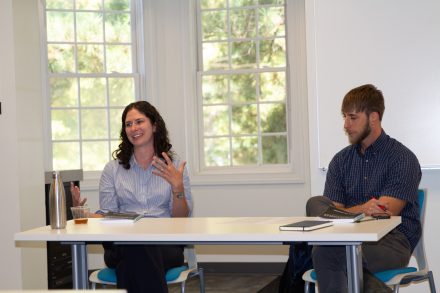
Pearson read an excerpt from her book during a moderated discussion with Assistant Teaching Professor Ben Murphy on Oct. 22, 2025, to celebrate the new publication.
“Grievous Entanglement” investigates how people who were geographically distant from slavery came to understand themselves as closely connected to — and even implicated in — the system. Pearson examines a wide range of materials, including poetry, novels, sheet music, political cartoons and campaign speeches, to show how common consumption was structuring how people thought about slavery.
“A lot of people started to recognize that their everyday purchases, such as buying sugar grown by enslaved people, actually linked them to a system that tried to make human beings economically consumable,” Pearson said. “This recognition spurred action, including the first major consumer boycott.”
Pearson was surprised to find that people with different political and ideological perspectives all turned to consumption to make sense of slavery. She observed how commentators of the era depicted consumption to spur disgust in their audiences.
“Sometimes that disgust targeted the institution of slavery, and sometimes it targeted enslaved people themselves,” Pearson said. “I was especially struck by the fact that Black abolitionists including Olaudah Equiano and Harriet Jacobs recognized the ways disgust could be put to racist ends, but they still made a pragmatic choice to use consumption to capitalize on its ability to spark antislavery action.”
Pearson wrote the book with teaching in mind and has already incorporated its ideas into her courses. Students in her classes have examined Jacobs’s “Incidents in the Life of a Slave Girl,” exploring how she condemned the economic interconnections between the North and South in the antebellum United States.
Pearson’s students have also read 19th century poems encouraging readers to avoid products of slavery, and they sampled a teacake made from a recipe by abolitionist and poet Elizabeth Margaret Chandler.
Pearson became interested in this topic during her doctoral studies, when she was intrigued by a comment in Eric Lott’s famous study “Love and Theft,” noting how often blackface minstrel songs depict Black people who have been transformed into things.
“I decided to investigate further by conducting research in several archives, examining popular culture portrayals of enslaved people as interchangeable with objects,” Pearson said. “When I started researching transatlantic abolitionism in more depth, I realized that there were surprising and significant overlaps between certain antislavery strategies and those racist depictions in popular culture, and I wanted to understand why.”
“Grievous Entanglement” is Pearson’s first published book. A member of the Elon faculty since 2017, her scholarship focuses on the discourse of slavery, the construction of race and 19th-century American and transatlantic literature.